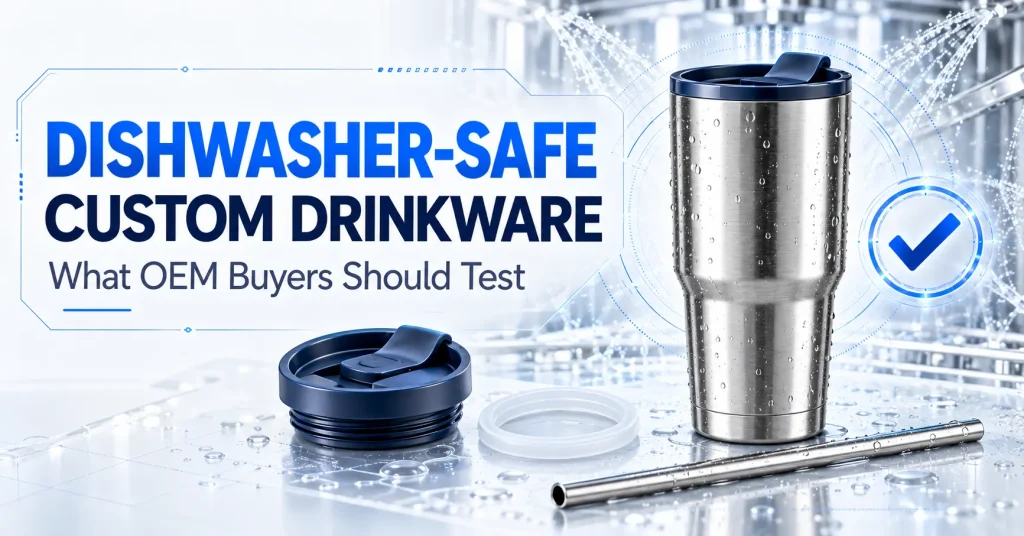
“Dishwasher safe” appears to be a simple product benefit. For an OEM buyer, however, it is a performance claim covering the complete finished product—not only its stainless steel body.
A tumbler may retain its shape while its coating fades. A bottle body may remain intact while the printed logo loses adhesion. A lid may warp, a gasket may swell, or an insulated product may no longer meet its original thermal target after repeated washing.
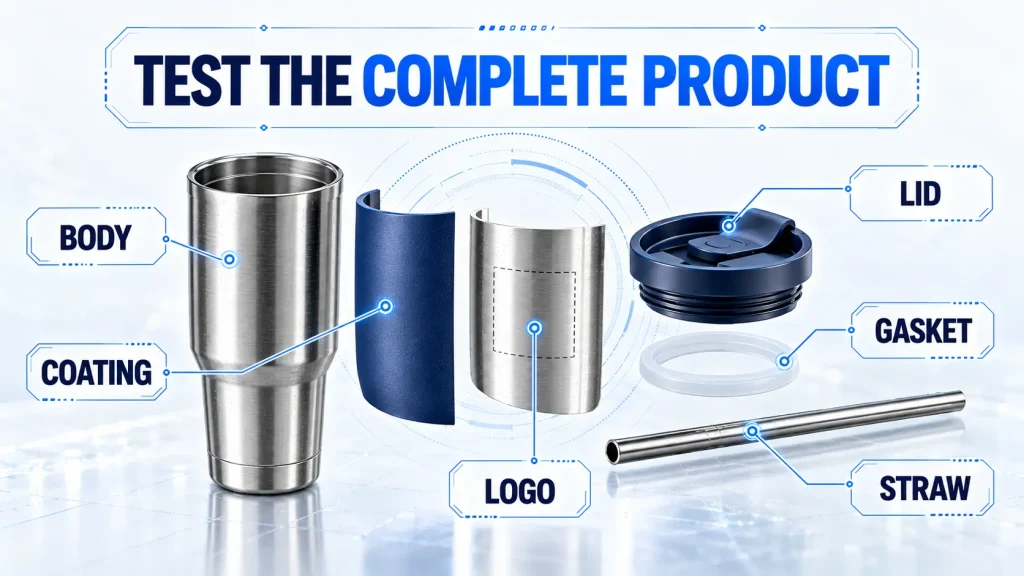
That is why dishwasher-safe custom drinkware should be specified, tested, and approved as a complete product system. Before using the claim on packaging or a retail listing, buyers should define the exact product, wash conditions, number of cycles, and pass criteria.
This guide explains what brands, importers, retailers, and corporate gift buyers should confirm before production.
The Short Answer
A bottle or tumbler should not be described as dishwasher safe simply because it is made from stainless steel.
The claim should be supported by testing the final production configuration, including:
- Bottle or tumbler body
- Surface finish and color
- Final logo decoration
- Lid, slider, button, handle, and straw
- Silicone seals and removable gaskets
- Any adhesives or bonded components
- Leakage, fit, appearance, odor, and insulation after washing
The protocol should identify the dishwasher program, temperature, detergent, loading position, drying conditions, cycle count, inspection intervals, and acceptance criteria.
If only selected components have been validated, the care statement should say so. “Lid top-rack dishwasher safe; decorated body hand wash only” is more accurate than an unsupported claim covering the entire product.
What Does “Dishwasher Safe” Actually Mean?
For purchasing purposes, dishwasher safe should mean that the product can undergo a defined number of mechanical dishwashing cycles without unacceptable changes to appearance, dimensions, or function. Food-contact compliance remains a separate requirement.
Dishwashing exposes drinkware to several stresses at once:
- Elevated wash and rinse temperatures
- Detergent chemistry
- Repeated wetting and drying
- Water jets and mechanical movement
- Contact with racks or adjacent items
- Heat concentrated near the drying system
- Moisture retained beneath seals or inside lid channels
There is no universal cycle count that automatically makes every product dishwasher safe. The European reference method EN 12875-1 addresses resistance to the combined chemical, thermal, and mechanical stresses of domestic dishwashing but does not prescribe one required number of cycles for every product.
The buyer and supplier must therefore agree on four points:
- Which exact product and components are covered?
- Under what washing conditions?
- For how many cycles?
- What results count as a pass?
Test the Complete Product, Not Just the Steel
The weakest component usually determines the correct care claim.
| Product element | Possible wash-related risk | What buyers should verify |
|---|---|---|
| Stainless steel body | Staining, corrosion at damaged areas, water retention | Grade, construction, drainage, appearance, and insulation |
| Powder coating or paint | Fading, blistering, softening, or peeling | Pretreatment, cure, color change, and adhesion after cycles |
| Printed logo | Cracking, lifting, abrasion, or color loss | Print method, ink system, cure, and post-wash readability |
| Plastic lid parts | Warping, shrinkage, or stress cracking | Resin, dimensions, fit, and operation |
| Silicone gasket | Swelling, odor, or loss of compression | Material, hardness, fit, and sealing after cycles |
| Straw, valve, or slider | Deformation, trapped residue, or reduced flow | Cleaning access, operation, and reassembly |
| Vacuum construction | Possible change in thermal performance | Insulation before and after cyclic testing |
Changing the color, logo process, lid supplier, gasket compound, or assembly adhesive can change the result even when the base bottle remains the same.
Do 304 or 316 Stainless Steel Prove Dishwasher Safety?
No. Stainless steel grade is relevant, but it does not prove the finished product claim.
Both 304 and 316 can be suitable for drinkware when properly specified and processed. Compared with 304, 316 generally offers stronger resistance in chloride-rich or more aggressive environments. However, a 316 body with an unsuitable coating or lid can still fail, while a properly engineered 304 product may perform well under its agreed wash conditions.
Buyers should separate two questions:
- Is the food-contact metal suitable for the intended beverage and market?
- Can the complete decorated product withstand the specified dishwasher program?
For a detailed material comparison, see 304 vs 316 stainless steel water bottles.
Coatings, Logos, and Components: What Can Fail?
Surface finishes
Powder coating can provide a durable finish, but “powder coated” does not automatically mean dishwasher safe. Performance depends on surface pretreatment, powder chemistry, film thickness, coverage, and curing conditions.
Spray-painted finishes may achieve specialized colors and effects, but their resistance depends on the complete primer, color layer, topcoat, and cure system. Final approval should use the actual bottle, color, and production-equivalent process—not only a color panel.
An undecorated stainless surface removes one common failure point, but buyers should still check staining, seams, trapped water, and thermal performance.
Our guide to powder coating vs spray painting explains the broader sourcing differences.
Logo methods
| Logo method | Dishwasher consideration |
|---|---|
| Laser engraving | No separate ink layer; often a strong durability option, but contrast and the surrounding finish still require testing. |
| Screen printing | Performance depends on ink, pretreatment, cure, and print location |
| UV printing | Supports detailed multicolour graphics, but edge lifting, fading, and adhesion should be checked. |
| Heat transfer | Suitable for larger graphics; inspect seams, edges, fading, and delamination. |
Laser engraving often avoids ink-adhesion problems, but it does not make the entire bottle dishwasher safe. The lid, gasket, coating, and insulated construction still require verification. Compare the processes in our guide to UV printing, screen printing, and laser engraving.
Lids, seals, and straws
Plastic and silicone parts may warp, shrink, swell, discolour, or retain odour. Complex lids can also trap detergent and moisture.
Confirm whether:
- The lid is dishwasher safe, top rack only, or hand wash only
- Sliders, magnets, valves, straws, and gaskets must be removed
- Small parts should be placed in the utensil basket
- All components can dry completely before reassembly
- Leakage and operation remain acceptable after repeated cycles
“Top rack only” should be supported by testing, not used as a generic disclaimer.
How OEM Buyers Should Define the Dishwasher Test
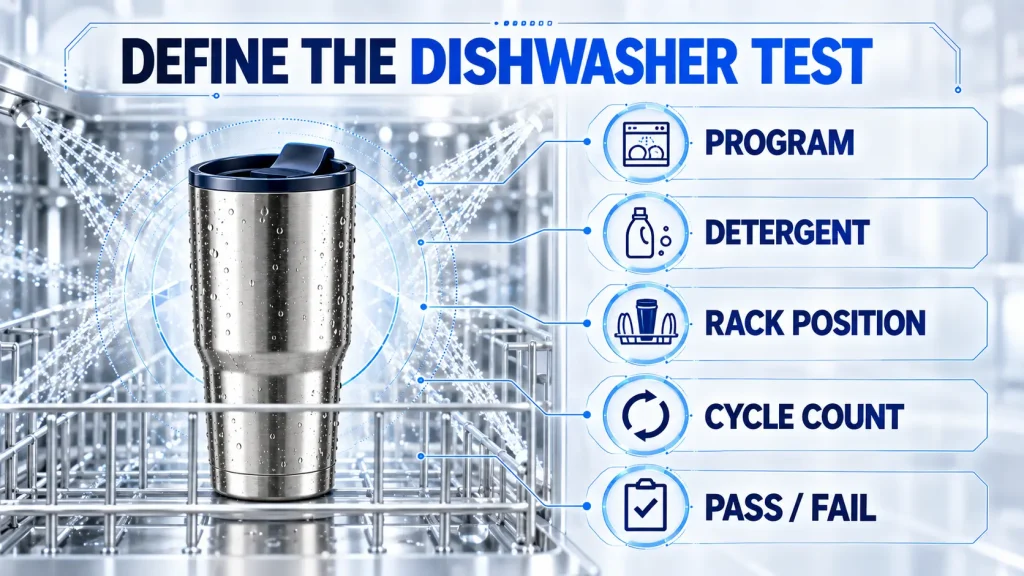
Writing only “dishwasher safe required” in an RFQ is not enough. Suppliers may otherwise use different machines, programs, detergents, rack positions, and pass standards, making results difficult to compare.
1. Use the final product configuration.
Test production-equivalent samples with the final steel construction, coating, color, logo, lid, gasket, straw, and accessories. Early engineering samples may be useful for screening, but they should not be the only evidence supporting a retail claim.
2. Record the wash conditions.
The test specification should identify:
- Domestic or commercial machine
- Wash program and cycle duration
- Wash and rinse temperature range
- Heated drying, if used
- Detergent and rinse aid
- Rack position and product orientation
- Whether components are assembled or separated
If a recognized method is required, identify the standard and any agreed project-specific deviations.
3. Agree on cycle count and inspection points
The number of cycles should reflect the expected service life, target market, retailer requirements, materials, and product positioning.
A “100-cycle test” is not automatically stronger evidence than a “50-cycle test.” Results are comparable only when the product configuration, wash program, detergent, loading, and pass criteria also match.
Interim inspections are useful because they show when a coating, logo, or component begins to change.
4. Define pass/fail criteria.
Replace “no obvious problem” with written acceptance criteria, such as
- No unacceptable coating peel, blistering, cracking, or fading
- No logo lifting, illegibility, or excessive color change
- No visible corrosion or persistent staining
- No lid warpage affecting fit or operation
- No unacceptable detergent odor
- No gasket swelling, tearing, or loss of compression
- Leakage remains within the agreed limit
- Buttons, handles, and sliders remain secure
- Thermal retention remains within the agreed range
Keep an unwashed control sample for visual comparison. Where appearance is critical, also define lighting, viewing distance, and acceptable color or gloss change.
What to Inspect After Dishwasher Cycling
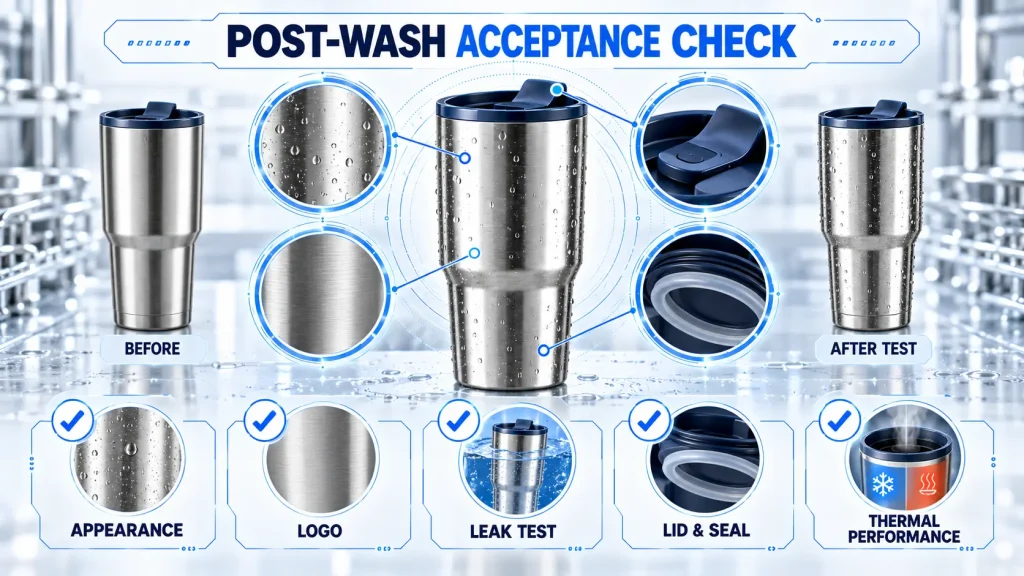
A product can still look attractive while no longer sealing properly or remain functional while its retail appearance becomes unacceptable. Check both appearance and performance.
Appearance
- Compare the test sample with the approved control
- Inspect fading, gloss, whitening, staining, and logo edges
- Check the base, rim, seams, corners, and recessed areas
Fit and operation
- Confirm threads and press-fit lids still engage correctly
- Reinstall every removable gasket and accessory
- Test sliders, buttons, locks, valves, and drinking flow
Leakage, odor, and insulation
- Repeat the agreed leak or spill-resistance test
- Check hidden channels for detergent residue or retained moisture
- Compare post-test thermal performance with the approved baseline
These checks should form part of the broader stainless steel bottle quality-control plan.
A Passing Sample Does Not Guarantee Mass Production
A development sample can pass while later goods fail if a key material or process changes.
Typical risks include:
- Different powder, paint, ink, plastic, silicone or adhesive suppliers
- Shorter pretreatment, curing or drying time
- Uneven film thickness
- A logo moved to a more difficult surface
- Different resin or colour masterbatch in lid components
- Gasket hardness or dimensions drifting from the approved range
Freeze the approved bill of materials and critical process requirements. The golden sample, test report, artwork, care instruction and production specification should all identify the same product version.
For higher-risk orders, include batch coating checks, print adhesion, dimensional inspection, leakage tests and periodic dishwasher verification in the control plan.
An ASTM D3359 tape test can support coating adhesion control, but it does not reproduce repeated detergent, heat, spray and drying exposure. It should complement—not replace—dishwasher cycling.
When “Hand Wash Recommended” Is More Appropriate
Not every product needs a dishwasher-safe claim. Hand washing may be more accurate for:
- Delicate or special-effect coatings
- Large-area, highly detailed printing
- Metallic, pearlescent or soft-touch finishes
- Bonded decorative elements
- Bamboo or other natural-material details
- Complex lids that trap water
- Products not validated under the intended wash conditions
The care instruction should match the evidence. Depending on the approved configuration, appropriate wording may include:
- Dishwasher safe. Remove components and dry completely before reassembly.
- Bottle body dishwasher safe; lid and gasket top-rack only.
- Lid top-rack dishwasher safe. Hand wash the decorated body.
- Hand wash only. Do not soak.
Keep the instruction consistent across the product, packaging, insert, online listing and retailer data sheet. Add it to the custom drinkware packaging specification before artwork approval.
Dishwasher durability is separate from food-contact compliance. The destination market may still require appropriate evidence for stainless steel, plastic, silicone, coatings and inks. See our guide to FDA vs LFGB requirements.
Dishwasher-Safe Drinkware RFQ Checklist
Include the following information when requesting a quotation:
Product and market
- Bottle type, capacity and dimensions
- Intended user and beverage temperature
- Destination market
- Domestic or commercial cleaning conditions
- Quantity and repeat-order forecast
Materials and decoration
- Steel construction
- Plastic and silicone requirements
- Surface finish and colour reference
- Logo method, artwork, size and position
- Any adhesive, insert or special accessory
Dishwasher requirement
- Components covered by the claim
- Full-dishwasher or top-rack-only requirement
- Program, temperature, detergent, drying and rack position
- Cycle count and inspection intervals
- Appearance and functional acceptance criteria
- Leakage, odour and thermal retesting requirements
Approval and production control
- Production-equivalent samples
- Report format and photographs
- Golden sample and bill-of-material freeze
- Change-notification requirements
- Production inspection and retest plan
- Exact consumer care statement
Combine this information with our custom stainless steel drinkware quote checklist to reduce quotation gaps and sample revisions.
Frequently Asked Questions
Are all stainless steel water bottles dishwasher safe?
No. The steel may tolerate washing, but coatings, printed decoration, plastic parts, silicone seals, adhesives and insulated construction may respond differently. Test the complete finished product.
Is powder-coated drinkware dishwasher safe?
It can be, provided the surface pretreatment, powder, application and cure have been validated on the final bottle. A generic claim about powder coating is not sufficient.
Does an ASTM D3359 4B or 5B result prove dishwasher safety?
No. ASTM D3359 assesses coating adhesion by tape testing. It does not reproduce cyclic exposure to dishwasher heat, detergent, spray and drying.
How many dishwasher cycles should a product pass?
There is no single number for every project. Set the target according to the intended claim, service life, retailer requirements, market and materials. Test conditions and acceptance criteria matter as much as the cycle count.
Does dishwasher testing replace food-contact testing?
No. Dishwasher testing addresses durability under defined cleaning conditions. Food-contact testing addresses material suitability and possible migration. They answer different questions.
Final Takeaway
“Dishwasher safe” should be treated as a verified product specification, not a casual marketing phrase.
Define the claim before sampling. Test the final configuration under documented conditions. Agree on clear acceptance criteria. Then carry the approved materials, components and processes into mass-production quality control.
For some projects, the evidence will support a complete dishwasher-safe claim. For others, a top-rack, component-specific or hand-wash instruction will be more accurate.
Funzlife helps brands, importers, retailers and corporate gift buyers compare custom drinkware configurations and coordinate specifications, sampling, testing, packaging and quality requirements with suitable manufacturing partners.
Contact Funzlife with your bottle style, target market, finish, logo method, quantity and required care claim. We can help organise the information needed to evaluate the project before production.