A stainless steel bottle can leave production in perfect condition and still reach the customer scratched, dented, incorrectly labeled, or presented in a box that feels completely wrong for the brand.
This is why packaging should not be treated as the final decorative step of a custom drinkware order. It is part of the product specification.
The right packaging must do several jobs at the same time. It should protect the bottle and its finish, keep the lid and accessories organized, communicate the brand clearly, suit the intended sales channel, and remain practical for production, shipping, and storage.
These requirements do not always point in the same direction. A premium rigid gift box may create an impressive unboxing experience, but it can also increase packaging cost, carton volume, and freight. A plain white box may be commercially sensible for a promotional program, yet too generic for a product competing on a retail shelf.
The best custom drinkware packaging is therefore not automatically the cheapest or the most elaborate option. It is the packaging that fits the product, order quantity, brand position, distribution route, and target cost.
This guide explains how buyers can make that decision more systematically.
The Short Answer: What Should Buyers Confirm First?
Before selecting a box, answer four questions:
- Where will the product be sold or distributed? Retail, e-commerce, corporate gifting, and promotional programs have different packaging priorities.
- What must the packaging protect? Consider the bottle finish, lid, handle, straw, silicone parts, and other accessories—not only the steel body.
- What must the packaging communicate? This may include brand identity, product features, instructions, barcodes, warnings, and market-specific information.
- What is commercially practical? Compare the packaging MOQ, setup cost, packing labor, master carton quantity, shipment volume, and inventory risk.
The packaging decision should be made early enough to be included in the quotation, sample approval, and quality-control plan. Our custom stainless steel drinkware RFQ checklist explains the other product details buyers should define before requesting a final price.
1. Think in Packaging Layers, Not Only in Boxes
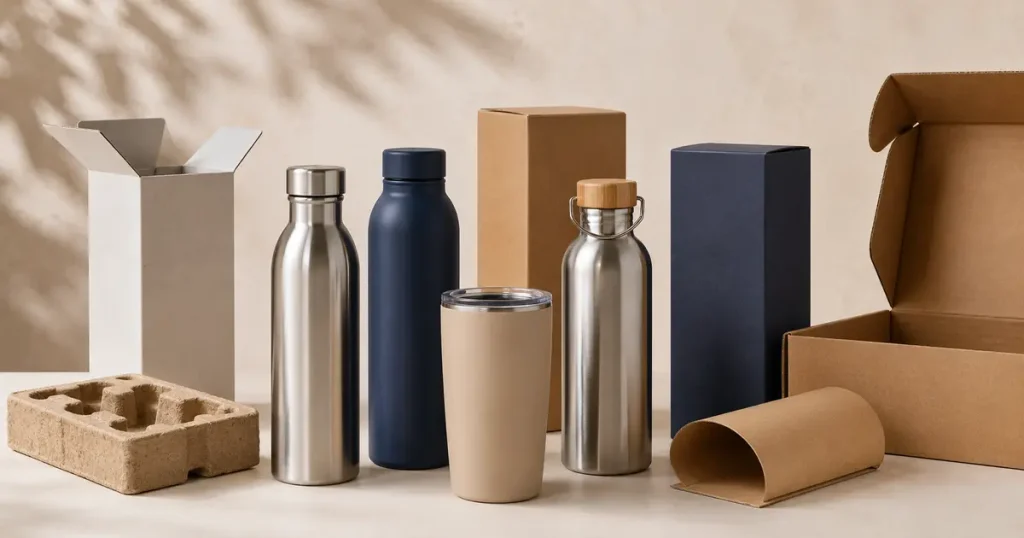
When a supplier quotes “one color box,” important details are still missing. A complete packaging system may contain several layers:
- Surface protection: polybag, tissue paper, paper sleeve or another material that reduces dust and scuffing
- Individual retail packaging: white box, kraft box, printed color box, gift box or cylinder
- Internal support: cardboard insert, molded pulp, foam, divider or another structure that holds the product in position
- Accessory control: bags, compartments or fixing points for straws, brushes, spare lids, straps, manuals or gift cards
- Identification: barcode, SKU label, color sticker, country or importer information, carton marks and other required labels
- Transport packaging: master carton, internal dividers, protective corners, sealing method and, where applicable, pallets
Each layer solves a different problem. A beautiful printed box does not necessarily stop a heavy tumbler from moving inside it. A strong export carton does not prevent two loose metal accessories from scratching each other. A precise insert cannot correct an outdated barcode.
For this reason, “custom packaging included” is not a complete specification. The quotation and approval documents should describe the individual protection, box, insert, printed materials, and master carton separately.
2. Start with the Sales Channel
Packaging should be designed around the way the product will be displayed, handled, and delivered.
Retail packaging
A bottle sold in a store must communicate quickly. Depending on the retail program, the packaging may need space for the following:
- Product name and capacity
- Key functions and usage information
- Brand story and visual identity
- Barcode and SKU information
- Materials, care instructions and warnings
- Market- or retailer-specific information
The buyer should also consider whether customers need to see or touch the bottle before purchase. A fully enclosed color box offers more printable space and surface protection. A window box can show the actual color and finish, but the opening may reduce protection and change the box structure. A sleeve or hang tag keeps more of the product visible but exposes the surface to handling.
Corporate gift packaging
Corporate gifting usually places greater emphasis on presentation. A gift box, coordinated insert, message card, or multi-piece set can make the product feel more valuable.
However, presentation should still be balanced against the program budget and delivery method. If hundreds of gift boxes will be shipped individually, the retail gift box may need an additional protective mailer. If the products will be distributed together at an event, a simpler outer-shipping solution may be sufficient.
The product, logo, and packaging should also feel like one program. A premium box cannot compensate for an unsuitable bottle, weak decoration, or inconsistent colors. Buyers can review available custom drinkware options before finalizing the complete gift concept.
Ecommerce packaging
E-commerce adds another handling environment. The attractive product box may pass through parcel sorting, repeated drops, vibration, compression, and exposure to moisture before reaching the consumer.
The buyer should decide whether the individual product box is intended to serve as the shipping box or whether it will be placed inside a separate mailer. The second option adds material and volume, but it may protect the branded box and improve the unboxing condition.
Testing should use the actual packed configuration. Testing an empty box or a different insert does not prove that the final bottle, lid, and accessories will remain protected through the intended distribution route.
Promotional and wholesale packaging
For promotional campaigns and bulk wholesale projects, unit cost, packing speed, and transport efficiency may be more important than a complex unboxing experience.
Practical options can include bulk divider packing, a plain white box, a standard kraft box, or a simple branded label. The correct choice depends on how the products will be distributed and whether each unit must be individually presented.
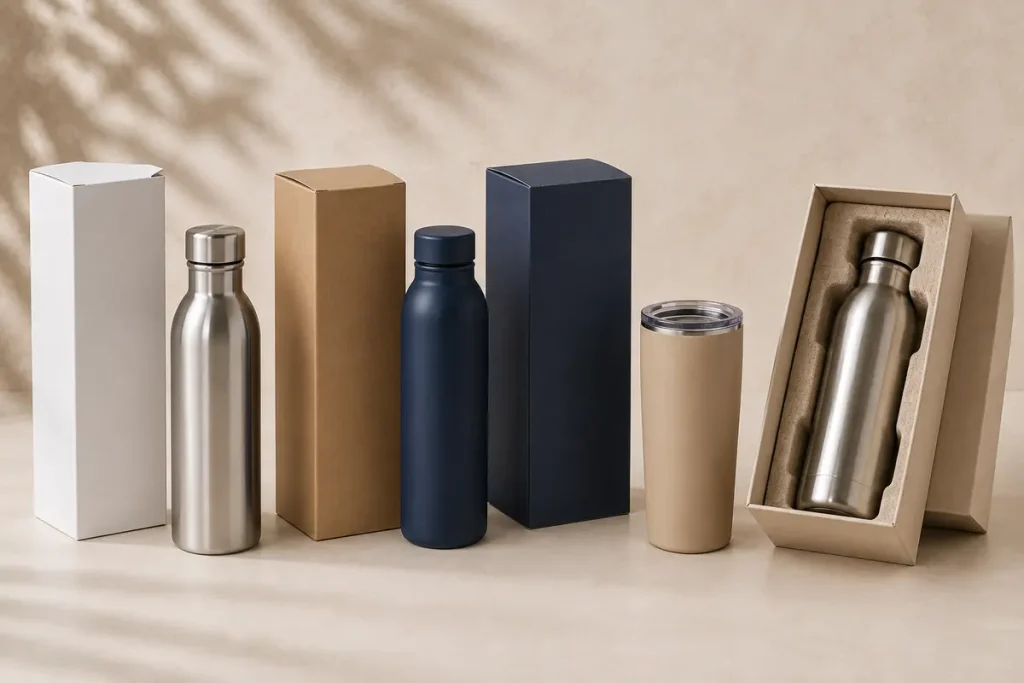
3. Compare the Main Custom Drinkware Packaging Options
| Packaging option | Common applications | Main advantage | Main trade-off |
|---|---|---|---|
| Bulk divider or egg-crate packing | High-volume promotional and wholesale orders | Efficient use of carton space and lower packaging cost | Limited individual presentation and surface protection must be checked carefully |
| Plain white box | Samples, wholesale, promotional projects and low-volume launches | Simple, flexible and easy to combine with a label | Minimal brand communication |
| Kraft box | Natural, minimalist or environmentally positioned collections | Clean appearance and reduced reliance on heavy ink coverage | Printed colors may look different on kraft material |
| Printed color box | Retail and private-label products | Strong branding and space for product information | Separate printing MOQ, artwork approval and setup may apply |
| Printed sleeve over a standard box | Small launches, seasonal editions and multiple SKUs | Creates branding while keeping the base box standardized | Adds another component and packing step |
| Window box | Retail products where color and finish influence purchase | Lets customers view the actual product | The window affects protection, structure and material choices |
| Rigid gift box | Premium retail, corporate gifts and presentation sets | High perceived value and strong unboxing experience | Higher unit cost, storage space and shipping volume |
| Cylinder or tube | Gift programs and visually distinctive collections | Recognizable format with good presentation | Often less efficient to pack and ship than rectangular boxes |
| Multi-piece set box | Bottle-and-mug sets, extra-lid sets and premium gifts | Keeps several items together as one program | Insert design, accessory control and total package size become more complex |
These names are only starting points. Two suppliers may both quote a “gift box” while using different paper, board thickness, construction, printing, inserts, and closures. Buyers should compare the complete specification rather than the packaging name alone.
4. Design Protection Around the Actual Product
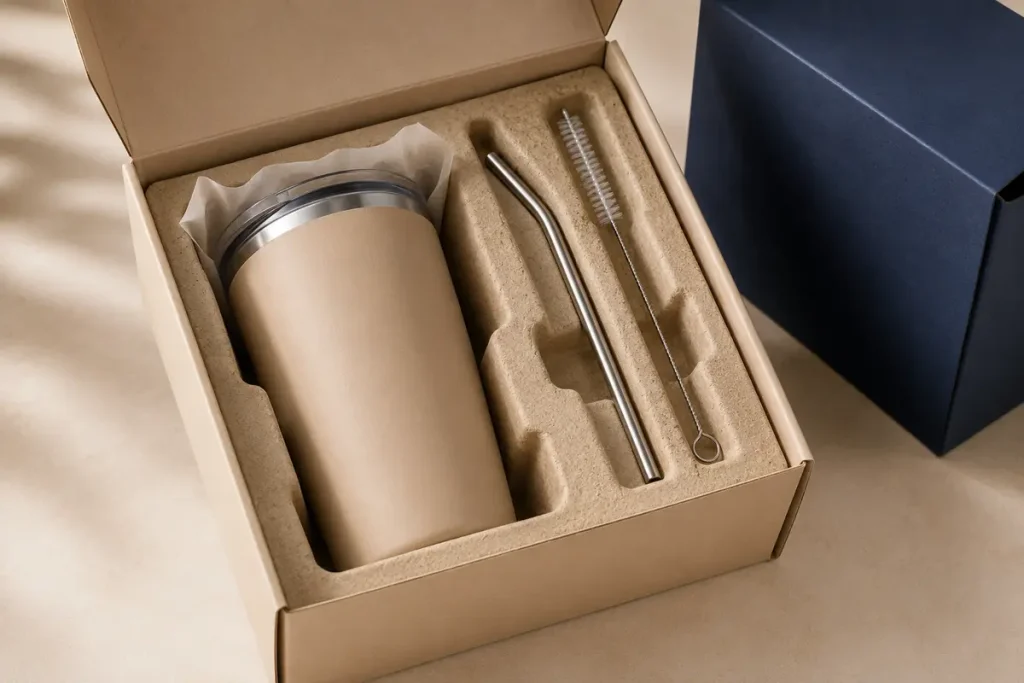
Drinkware packaging must control several different risks.
Protect the surface finish
Powder-coated, painted, polished, and printed surfaces can react differently to rubbing and pressure. A bottle may look fine when placed in the box but develop marks after vibration during transportation.
The packaging review should check:
- Whether the body touches rough cardboard or hard accessories
- Whether the lid or handle can rub against the coating
- Whether printed areas contact the insert
- Whether tissue, a bag or another protective layer is required
- Whether the bottle can move vertically or sideways inside the box
The protective material should also be checked for cleanliness, odor, and possible color transfer.
Hold the lid and accessories securely
Straws, cleaning brushes, spare lids, silicone boots, and carry straps should have defined positions. Loose accessories can scratch the bottle, disappear during packing, or make noise inside the box.
For a set containing several components, approve the exact packing sequence. A photograph or diagram can help the packing team reproduce the intended arrangement consistently.
Control empty space
Too much empty space allows movement and increases shipment volume. Too little space can place pressure on the lid, handle, or box corners.
The insert should hold the product without forcing delicate components into an unnatural position. This is particularly important for protruding handles, flip lids, straws, and decorative attachments.
Specify the master carton
The master carton is part of the protection system. Confirm:
- Number of units per carton
- Carton dimensions
- Net and gross weight
- Board construction or agreed strength requirement
- Internal dividers or protective corners
- Sealing method
- Carton marks and label positions
- Maximum weight or handling limits required by the buyer or distribution channel
The final carton should be reviewed with the actual packaged units inside. The same carton may perform differently when the pack quantity, product weight, or internal arrangement changes.
Define a relevant test method
“Drop tested” is incomplete unless the test conditions are stated. The protocol should identify the packed configuration, package weight, test sequence, drop height or other conditions, number of samples, and pass/fail criteria.
The appropriate method depends on whether the goods will move mainly by pallet, container, courier parcel, or a retailer-specific distribution system. Where a customer, marketplace, or retailer has its own packaging standard, it should be shared before the packaging is approved.
Packaging is also part of the final stainless steel bottle quality-control process, not a separate design exercise completed after inspection.
5. Control Branding, Artwork and Printed Information
Packaging errors often come from file control rather than box construction.
Before printing, confirm:
- Approved dieline and box dimensions
- Final artwork version and revision date
- Logo size, position and clear space
- Print colors and reference standards
- Surface finish, such as matte or glossy lamination where applicable
- Barcode type, number, size, contrast and quiet zone
- Product capacity, color name and SKU
- Instructions, warnings and care information
- Country-, importer- or retailer-specific content where required
A digital proof helps review layout and wording, but it cannot reproduce every material, color, and finishing effect accurately. For projects where color or presentation is commercially important, a printed packaging sample is safer than approving only a screen image.
Barcodes should be checked after printing, not only in the artwork file. Distortion, insufficient contrast, lamination glare, or poor print quality can affect scanning.
Product images and claims on the box must also match the actual item. If the lid, color, accessory, or capacity changes during development, the packaging artwork should be updated before mass printing.
Use clear version control. A filename such as this final-new-2.pdf is easy to misunderstand. Record the approved artwork code or date in the purchase specification so the supplier, packaging printer, and inspection team are all checking the same version.
6. Understand Why Packaging MOQ Can Differ from Bottle MOQ
The bottle, coating, lid, logo, and packaging may come from different production processes. They do not necessarily share one minimum order quantity.
Custom box MOQ can be influenced by:
- Paper or board purchasing requirements
- Printing setup and color preparation
- Die-cutting and finishing setup
- Special inserts or molded components
- Surface treatments such as foil, embossing or lamination
- The number of artwork versions, sizes and SKUs
For example, a buyer may order 1,000 bottles but divide them across four colors. If every color requires different packaging artwork, the packaging printer is effectively handling four smaller print runs rather than one 1,000-piece design.
This is one reason the practical MOQ for a custom water bottle is not always controlled by the steel body.
Practical ways to manage a smaller first order
Depending on the project, buyers can consider the following:
- A standard white or kraft box with a custom label
- One common printed box with a color-identification sticker
- A standard box plus a printed paper sleeve
- The same box structure across several capacities or SKUs, where dimensions allow
- Digital printing for a smaller run, when available and commercially suitable
- A printed insert card instead of fully printed outer packaging
These solutions do not suit every retail program, but they can reduce the commitment to packaging inventory during an initial market test.
The lowest unit price is not always the lowest-risk decision. Ordering several thousand extra boxes may appear economical per box, but outdated packaging becomes unusable if the artwork, product specification, barcode, or legal information changes.
7. Calculate the Effect on Shipping and Landed Cost
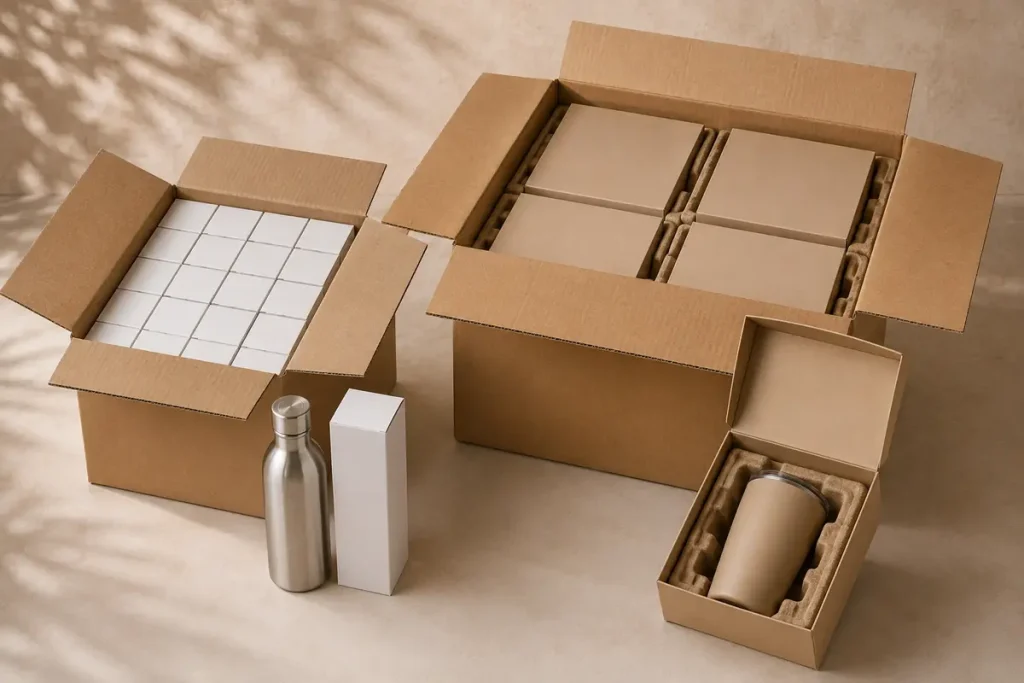
Buyers often compare the unit price of two packaging options without comparing the shipment data.
A larger box can change:
- Pieces per master carton
- Number of cartons
- Total shipment volume
- Chargeable freight weight
- Container loading quantity
- Pallet quantity
- Warehouse space
- Local fulfillment and disposal cost
The basic volume calculation is:
Carton volume in cubic meters = length × width × height in centimeters ÷ 1,000,000
Total shipment volume = carton volume × number of cartons
Consider an illustrative order of 1,000 bottles:
- Option A: 25 individually boxed bottles per master carton, 40 cartons in total, 0.085 m³ per carton = 3.40 m³
- Option B: 12 gift-boxed bottles per master carton, 84 cartons in total, 0.110 m³ per carton = 9.24 m³
The exact figures will depend on the product and box design, but the principle is important: the premium option affects much more than the box price. It can change freight handling and storage throughout the supply chain.
Before final approval, ask for the estimated individual box dimensions, master carton dimensions, pieces per carton, and gross weight. Reconfirm the final data before booking shipment.
8. Build a Written Packaging Specification
A clear packaging specification helps the bottle supplier, packaging supplier, packing team, and inspector work from the same standard.
| Specification area | Details to record |
| Individual protection | Bag, paper, sleeve or other material; size; placement; sealing method |
| Unit box | Box type, dimensions, material, construction, closure and finish |
| Insert | Material, shape, color, product orientation and accessory positions |
| Artwork | File code, dieline version, colors, logo, text and approved proof |
| Labels | Barcode, SKU, color label, warning label and required positions |
| Accessories | Included items, quantity, bagging and placement |
| Packing sequence | Product orientation and step-by-step arrangement |
| Master carton | Units per carton, dimensions, weight, dividers, sealing and carton marks |
| Testing | Packed configuration, method, sample quantity and acceptance criteria |
| Reference sample | Approved blank structure, printed sample or complete packed sample |
The specification should match the approved physical sample. If any part changes after approval, update both the document and the sample reference.
9. Use a Risk-Based Packaging Approval Process
Not every project requires the same number of sample stages, but a structured process may include:
- Confirm the channel and target cost. Decide whether the project is primarily promotional, retail, e-commerce, or gifting.
- Select the packaging concept. Choose the box type, insert direction, printed components, and master carton approach.
- Approve the dieline and structure. Check the dimensions using the actual bottle, lid, and accessories.
- Approve the artwork. Review content, barcode, colors, and file version.
- Review a printed sample where necessary. Check the real material, print, finish, and assembly.
- Test the complete packed product. Confirm movement, rubbing, accessory control, and transport protection.
- Approve the written specification. Record all packaging layers and acceptance criteria.
- Inspect the production packaging. Check incoming boxes and printed materials before the complete order is packed.
- Verify final packing data. Confirm carton quantity, dimensions, weight, marks, and total shipment volume.
High-risk packaging—such as a premium gift set, fragile printed finish, e-commerce parcel pack, or multi-accessory kit—deserves more validation than a standard white box used for bulk distribution.
10. Match the Packaging to the Project
For a low-volume promotional order
Prioritize cost control, simple packing, and reliable surface protection. A standard white box, kraft box, or bulk-divider solution may be more practical than fully customized retail packaging. Branding can be added through the bottle logo, label, sleeve, or insert card.
For a new retail product
Balance shelf communication with inventory risk. Use one box structure across several colors where possible, and differentiate variants with labels or artwork areas that are easy to update. Confirm barcode and product information before printing.
For a premium corporate gift
Build the experience around presentation, but calculate the complete cost. Review the bottle, logo, insert, message card, and outer box as one design. If the gifts will be shipped individually, include the courier-protection solution in the test.
For an e-commerce product
Focus on the condition in which the customer receives both the product and its branded packaging. Minimize unnecessary empty space, secure the lid and accessories, and test the final product box inside its actual shipping configuration.
11. Common Packaging Mistakes to Avoid
Leaving packaging until the bottle is almost finished
Custom packaging can require artwork, sampling, printing, and separate materials. Starting late can delay an otherwise completed order.
Choosing by appearance alone
A box can look excellent in a rendering and still allow the bottle to move, rub, or break through the insert.
Approving an empty box
The structure should be checked with the actual bottle, lid, accessories, and protective materials inside.
Describing the requirement only as “custom box”
Without dimensions, material, insert, print, and finish details, suppliers may quote different specifications.
Ignoring the separate packaging MOQ
The chosen bottle quantity or color split may not be efficient for the packaging printer. Confirm this before the design is finalized.
Forgetting the master carton
Individual packaging and export packing must work together. A strong retail box does not automatically create an efficient or safe master carton.
Approving artwork without checking the final product
Capacity, lid, color, accessories, and claims shown on the packaging must match the production item.
Comparing only the box price
The real comparison should include setup, inserts, packing labor, cartons, freight volume, storage, and unused inventory.
A Packaging Brief Buyers Can Send to a Supplier
Use the following format as a starting point:
Product: 20 oz vacuum-insulated stainless steel tumbler
Quantity: 2,000 pieces total
Color breakdown: 1,000 navy blue / 1,000 beige
Sales channel: Retail and e-commerce
Individual protection: Please recommend a paper-based or bag solution that prevents coating scratches
Unit packaging: Printed color box
Branding: Full-color artwork; final AI/PDF file will be supplied
Insert: Cardboard or molded-pulp insert; bottle and straw must not move inside the box
Accessories: One straw and one cleaning brush per unit
Labels: EAN barcode and color/SKU label
Testing: Please propose a test method for the final packed configuration
Packing data required: Box dimensions, pieces per carton, carton dimensions, net/gross weight and total estimated volume
Quotation: Please separate product, packaging, setup and testing costs
Alternative: Please also quote a lower-MOQ option using a standard box with a custom sleeve or label
The more clearly these requirements are stated, the easier it is to compare quotations on the same basis.
Frequently Asked Questions
Does custom drinkware packaging have the same MOQ as the bottle?
Not necessarily. Bottles, custom coatings, plastic lids, printed boxes, inserts, and labels may be produced through different processes. Each component can have its own practical MOQ and setup cost. Confirm the quantity for every custom packaging component, especially when the order includes several colors or artwork versions.
What is a practical packaging option for a small custom order?
A standard white or kraft box with a custom label, sleeve, or insert card is often worth evaluating. It keeps the base packaging simple while adding brand information. The best option still depends on the sales channel and the level of presentation required.
Is a rigid gift box always better than a color box?
No. A rigid gift box can create a more premium presentation, but it normally uses more material, occupies more space, and costs more to ship and store. It is suitable when the brand position and selling price justify those trade-offs.
When should packaging be approved?
The packaging direction should be discussed during quotation and product development. The final structure, artwork, and complete packed sample should be approved before mass packaging begins. Packaging with a longer lead time may need to start before bottle production is complete, so version control is essential.
How can buyers reduce packaging-related freight costs?
Reduce unnecessary empty space, compare pieces per carton, standardize box sizes where practical, and review the total shipment volume before approval. Do not reduce protection simply to make the box smaller; the goal is efficient packaging that still controls the real distribution risks.
What information is needed for an accurate packaging quotation?
Provide the product dimensions and weight, quantity and color split, sales channel, preferred packaging type, artwork requirements, accessories, labels, destination market, and testing expectations. Ask the supplier to state any assumptions and quote major packaging components separately.
Plan Custom Drinkware Packaging with Funzlife
Funzlife supports promotional, retail, and private-label buyers with product selection, customization, packaging coordination, sampling, production follow-up, and quality control.
We work with selected drinkware and packaging partners to match the packaging solution to the product, quantity, sales channel, and target cost. Whether your project needs efficient bulk packing, a branded retail box, or a coordinated corporate gift set, the first step is to define what the packaging must achieve.
Browse our stainless steel drinkware products or contact us with your preferred product, quantity, logo, packaging idea, and destination market. We will help you evaluate practical options and prepare a detailed quotation.