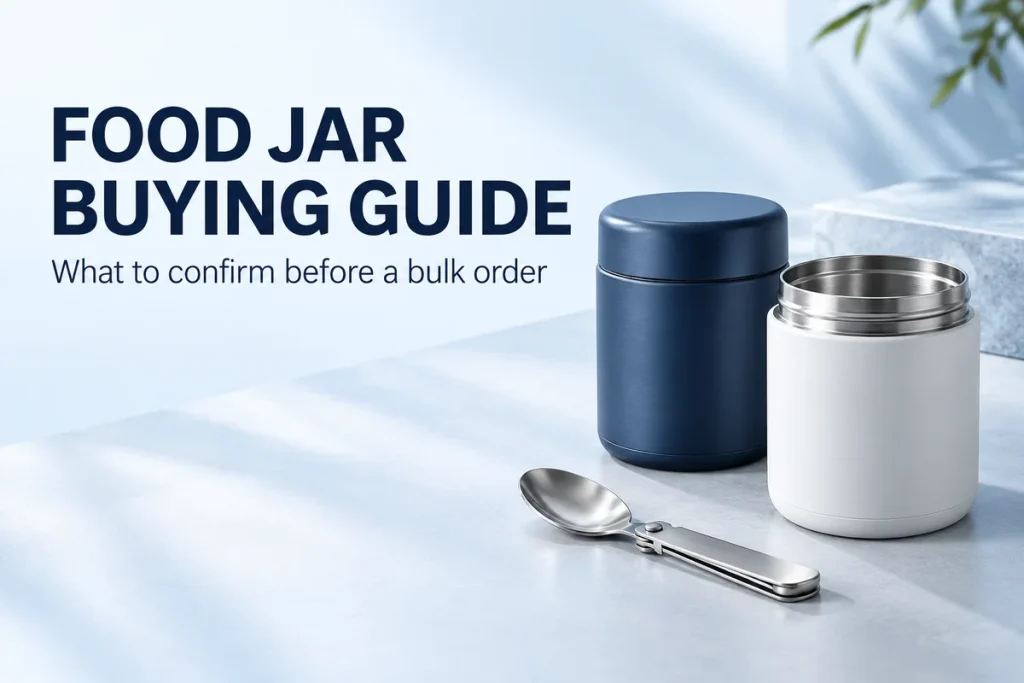
A vacuum food jar can look ready for a private-label range while leaving important buying questions unanswered. Does the stated capacity describe usable fill? Is the spoon included? Can users remove and reinstall the seal? What does the insulation claim actually measure?
For brands, importers, retailers, and corporate-gift buyers, the best starting point is a complete product specification. This vacuum food jar wholesale buying guide explains how to compare models, approve a practical sample, and request a quotation that covers the whole set.
1. Start with the Meal and Sales Channel
Define the intended meal before selecting a jar size. Soup, oatmeal, and mixed solid food create different needs for filling, eating, sealing, and cleaning. Ask whether users will eat directly from the jar or transfer the contents to another container.
Then consider the channel. A retail range needs clear product information and consistent variants. A corporate lunch kit may prioritize an easy-to-use lid, coordinated branding, and practical packaging. An online seller also needs protection for individual parcel delivery.
Use the vacuum food jar options to build a shortlist, then compare the exact models. A category name alone does not confirm identical construction, accessories, or performance.
For a first launch, avoid adding capacities and colors without a clear reason. Each extra variant creates another quantity split, label, and replenishment decision.
2. Compare Capacity, Construction, and Accessories Together
A larger nominal capacity does not automatically make a better lunch container. Compare the usable portion, opening, empty weight, filled weight, and space needed in a bag. Do not equate a milliliter capacity with the same number of grams for every food.
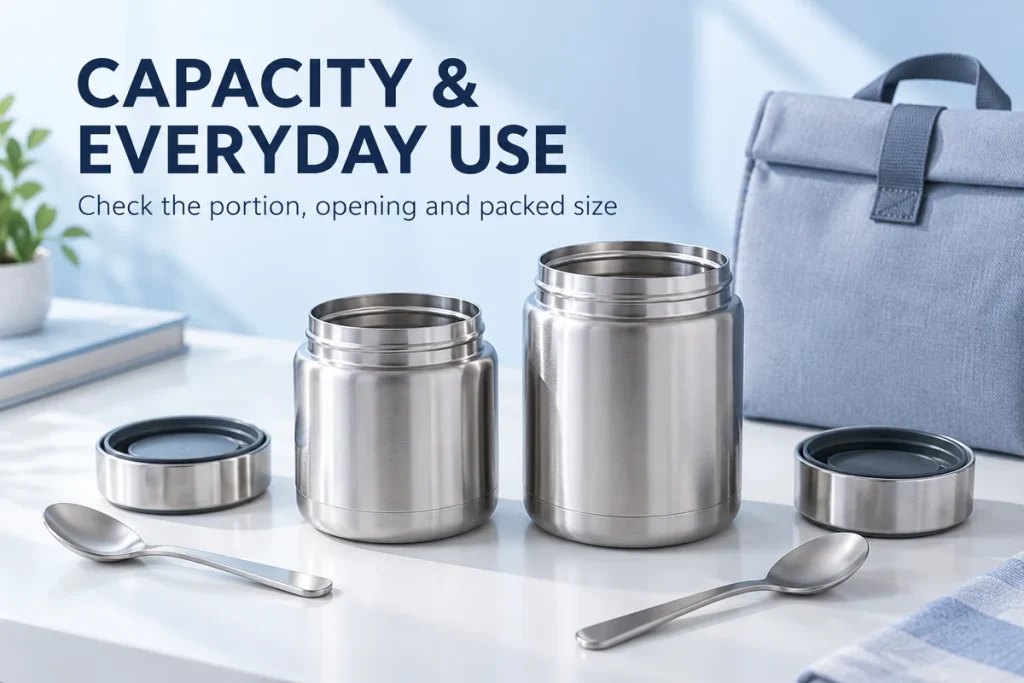
These two current Funzlife listings illustrate why capacity should not be compared in isolation:
| Listed specification | 400 ml food jar | 530 ml breakfast cup |
|---|---|---|
| Product reference | FL-KB0018; the specification table also identifies FH8. | FL-KB0017 |
| Inner liner | SUS304 stainless steel | 304 stainless steel; optional 316 version listed |
| Outer body | SUS201 stainless steel | PP |
| Listed dimensions | 93 × 93 × 154 mm | H118 × Ø100 mm |
| Spoon arrangement | Reusable spoon in an external silicone holder | Plastic soup spoon in a top storage compartment |
Compare the 400 ml food jar with spoon and the 530 ml insulated breakfast cup against your intended meal and carrying setup.
These are published specifications, not measurements from a side-by-side test. Confirm the current drawing, weight, fill definition, and supplied components before approval. Also request the construction specification: a stainless liner or an insulated-product label alone does not establish the same vacuum structure across models.
During sampling, fill each candidate to its approved usable level, close it as instructed, and check spoon access. Keep food clear of the sealing interface and follow the model-specific filling instructions.
3. Evaluate the Lid as a Working Assembly
Check the complete lid, neck, threads, gasket, and any pressure-release feature together. A screw lid is not automatically leakproof, and a photograph cannot establish how reliably the seal works.
Ask the supplier to identify the intended closure position, assembly method, and test conditions. Where leakage resistance is required, agree on the liquid, fill level, temperature, orientation, duration, and acceptance result. Confirm whether testing covers the accessory configuration you will sell.
Also check everyday operation. Does the lid engage smoothly without cross-threading? Can users grip it comfortably? If a release mechanism is present, are its function and instructions clear?
Opening effort can change after temperature exposure. Evaluate it under the intended use conditions with appropriate precautions, rather than judging an empty room-temperature sample only. Do not improvise pressure-release modifications or describe the jar as suitable for fermentation, carbonated contents, or cooking without specific supporting validation.
4. Check Cleaning Before Choosing More Features
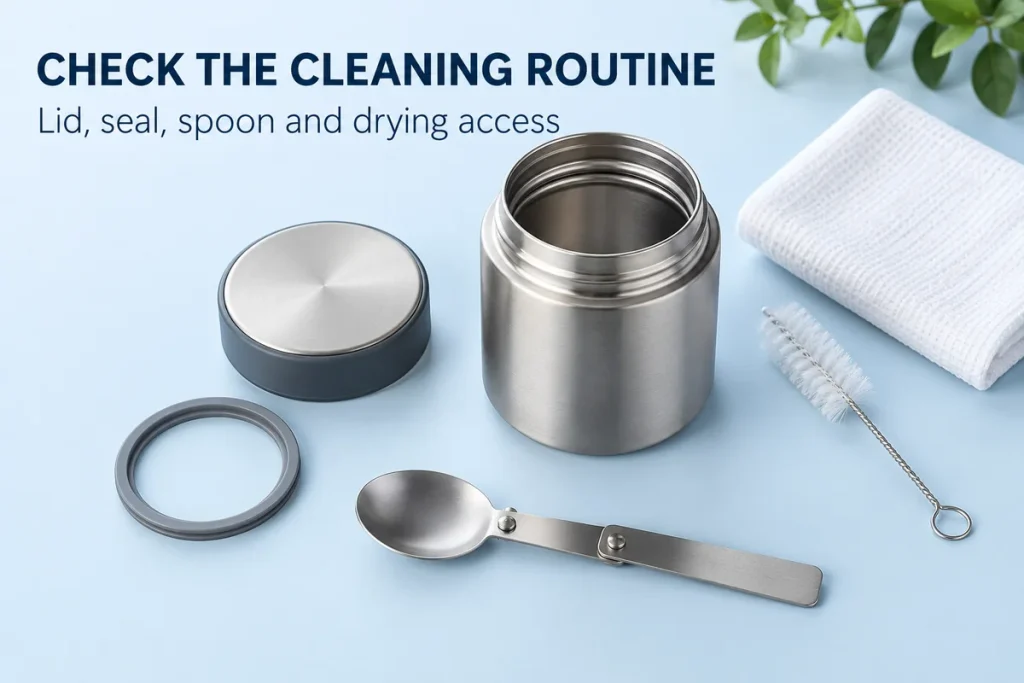
A wide mouth is helpful, but it does not answer every cleaning question. Food can reach the lid underside, gasket groove, spoon hinge, or storage compartment.
Request a demonstration of the cleaning routine, including which parts are removable. Check whether the seal can be reinstalled correctly and whether the instructions show its position clearly. Parts not intended for removal should not be presented as user-serviceable.
Review the sample with the intended spoon and a suitable cleaning brush. Look for inaccessible recesses, unfinished edges, and areas that are difficult to inspect or dry. A separate spoon holder may simplify access but adds another component to clean and control.
Do not infer dishwasher suitability from stainless steel alone. Any dishwasher claim needs evidence for the finished body, decoration, lid, and accessories under defined conditions. If components have different care instructions, make that distinction visible on the retail insert and listing.
5. Separate Insulation Performance from Food Safety
An insulation result should identify the exact model and configuration, starting temperature, fill quantity, ambient conditions, preconditioning, opening schedule, and measured temperature over time. Compare claims only when the conditions and endpoints are comparable.
“Still warm after six hours” does not establish that a meal has remained safely hot. Water-based laboratory results also should not become an unconditional promise for every food, portion, or user routine.
USDA consumer guidance for packed hot lunches recommends keeping food at 140°F (60°C) or above in a closed insulated container. This is U.S. food-handling guidance, not a universal product-certification threshold or evidence that a particular jar achieves it. Instructions for the destination market should reflect the product and applicable local guidance.
Avoid a fixed safe-storage duration unless it has been appropriately established for the stated conditions. A food jar retains temperature; it should not be marketed as a substitute for safe preparation, handling, or validated cooking instructions.
6. Match Food-Contact Documents to the Complete Set
List every relevant food-contact component: liner, lid surfaces, seal, spoon, and any food-contact coating. Record the proposed material and intended food, temperature, contact time, and repeated-use conditions.
For EU projects, Regulation (EC) No 1935/2004 provides the general food-contact framework. Applicable plastic components also need review against Regulation (EU) No. 10/2011 and its current amendments. Material-specific and national requirements may also matter. A steel-grade description or BPA-free statement does not demonstrate compliance of the complete set.
Ask for supporting documents matched to the model and components ordered. Have the responsible importer and a competent testing provider confirm the applicable scope, including any formulation or component changes. These legal requirements are separate from buyer-defined preferences such as logo placement or accessory color.
7. Approve the Packaging and Accessory Count
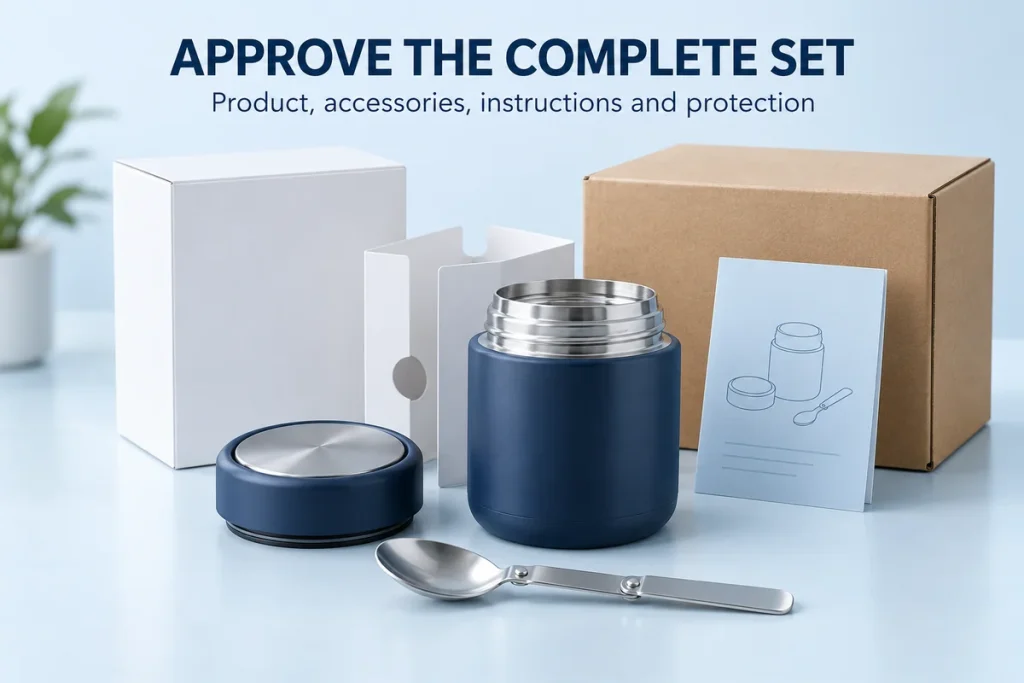
Define one saleable set explicitly. For example, it may contain one jar, its assembled lid and seal, one spoon, one holder, and one instruction insert. This is an illustrative configuration, not a standard inclusion for every model.
Confirm where each component sits in the box. A loose spoon can mark the finish, and a projecting holder or strap can change the required box dimensions. Inspect the actual packed sample rather than approving an empty box separately.
Match the protection to the route. Bulk cartons delivered to a retailer and individual e-commerce parcels face different handling. Agree on suitable packaging validation and check the product again afterward, including accessory retention and lid function.
Use the custom drinkware packaging guide for box selection. Keep capacity, color, accessory version, and care wording consistent across the jar, insert, individual box, and carton records.
8. Turn the Sample into a Purchase Specification
Before committing to production, close the following points in writing:
| Approval area | What the purchase specification should record |
|---|---|
| Product identity | Model, revision, construction, materials, dimensions, and agreed tolerances |
| Use and performance | Intended foods, usable fill, closure instructions, and agreed test methods and acceptance criteria |
| Supplied set | Spoon, seal, holder or strap, insert, and packaging configuration |
| Customization | Quantity by variant, finish, logo method, approved artwork, and packaging version |
| Release evidence | Required documents, inspection scope, issue handling, and person authorized to approve shipment |
Request itemized costs for the product, accessories, customization, packaging, sampling, and any agreed testing. Confirm quantity requirements for each color and component rather than assuming that one total order quantity covers every combination.
Retain the approved sample and written specification together. Changes to the lid, seal, spoon material, or supplier should trigger a review of affected fit, performance, instructions, and documentation before shipment.
Frequently Asked Questions
Is 530 ml always better than 400 ml for wholesale food jars?
No. Portion size, usable fill, opening, construction, and packed dimensions matter together. Compare physical samples and your intended meal instead of choosing only the larger capacity number.
Does a stainless steel liner mean the whole jar is stainless steel?
No. The outer body, lid, spoon, and seal may use other materials. Request a component-level specification and confirm the exact construction of the model quoted.
Does a heat-retention claim prove food is safe for that many hours?
No. Product temperature testing and safe food handling are different questions. Review the measured conditions and relevant destination-market guidance before approving consumer-facing claims.
What should a buyer send for a custom food jar quotation?
Send the model or reference, intended foods, capacity, market, quantity per color, logo, accessory list, packaging and delivery destination. Identify any leakage, cleaning or thermal claims that require verification.
Prepare Your Food Jar Project with Funzlife
Funzlife supports product selection, customization, sampling, packaging, quality-control planning and coordination with suitable manufacturing resources. The practical goal is a clearly specified product and saleable set, not a quotation based on appearance alone.
Send your food jar project brief with your preferred model, quantity, logo, destination market and accessory requirements. We can help compare available configurations and identify the details to confirm before sampling and ordering.
Sources and Further Reading
- European Commission: Food-contact materials legislation — general framework and material-specific rules. Reviewed 18 October 2026.
- USDA FSIS: Keeping “Bag” Lunches Safe — U.S. consumer guidance, not product certification. Reviewed 18 October 2026.