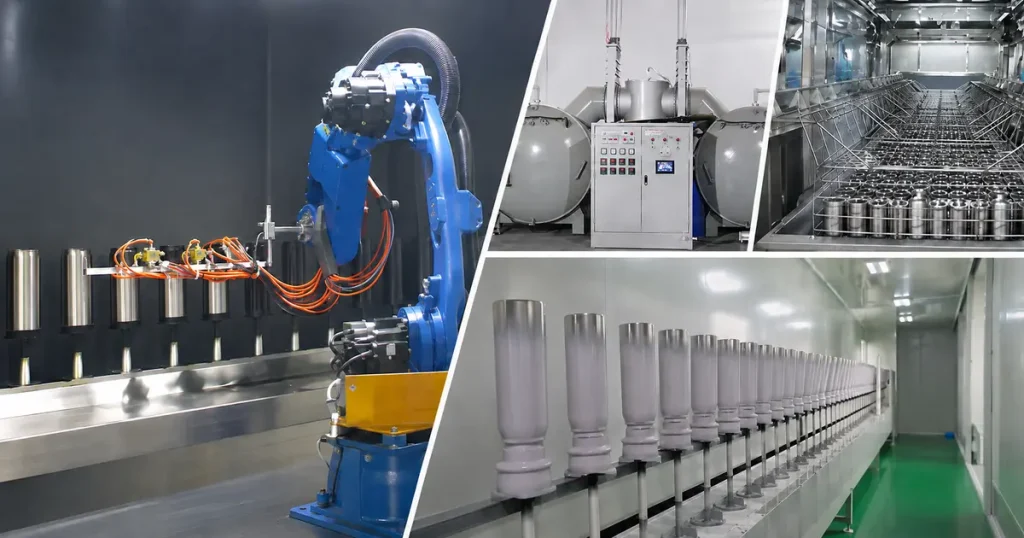
When developing a custom stainless steel bottle, choosing the bottle itself is only part of the project.
The decoration method can have just as much impact on the final appearance, cost, sampling process, and mass-production consistency.
A simple one-color corporate logo, a full-color retail graphic, and a 360° decorative pattern should not automatically use the same printing process.
For most custom drinkware projects, three decoration methods are commonly considered:
- UV digital printing
- Screen printing
- Laser engraving
Each has its own strengths.
The right choice depends on your artwork, order quantity, number of colors, printing area, durability expectations, and target price.
This guide explains the practical differences and helps buyers choose a more suitable decoration method before sampling.
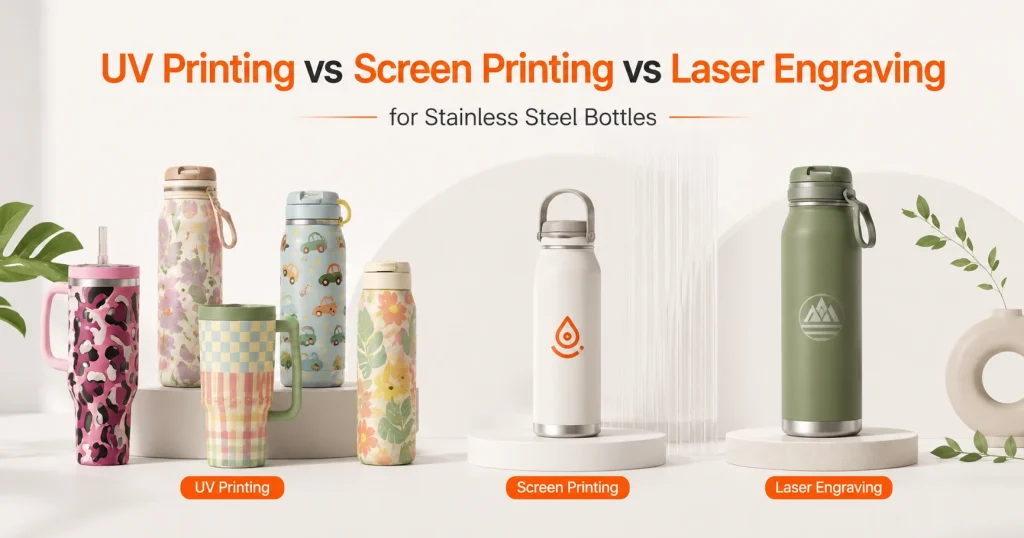
Quick Comparison: UV Printing vs Screen Printing vs Laser Engraving
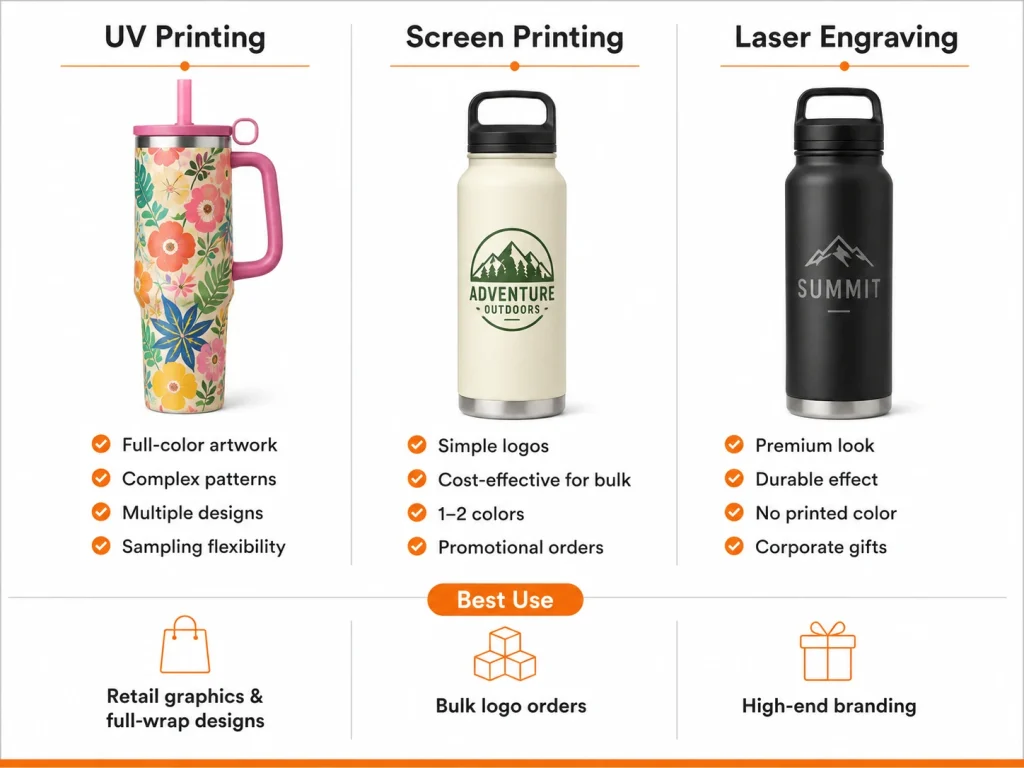
| Factor | UV Digital Printing | Screen Printing | Laser Engraving |
|---|---|---|---|
| Full-color artwork | Excellent | Limited | No |
| Gradients and photographic graphics | Excellent | Not ideal | No |
| Simple 1–2 color logos | Good | Excellent | Excellent |
| Multiple different artworks | Very flexible | Less flexible | Flexible |
| Small-batch sampling | Excellent | Moderate | Good |
| Large-volume simple logo orders | Good | Excellent | Good |
| Printing plate / screen required | No conventional screen plate | Yes | No |
| Full-wrap decorative artwork | Possible on suitable products | Limited | No |
| Surface texture | Printed layer | Printed ink layer | Engraved into surface/coating |
| Premium minimalist appearance | Good | Good | Excellent |
| Typical applications | Retail graphics, seasonal patterns, kids designs | Promotional bottles, corporate logos | Premium gifts, corporate branding |
There is no single method that is best for every project.
The most economical method for a 10,000-piece one-color logo order may be completely different from the best method for testing six full-color patterns during product development.
1. What Is UV Digital Printing?
UV printing is a digital printing process in which ink is applied directly to the product surface and cured using ultraviolet light.
Because the artwork is digitally controlled, UV printing is particularly suitable for complex graphics.
It can reproduce:
- Multiple colors
- Fine details
- Gradients
- Illustrations
- Geometric patterns
- Floral designs
- Leopard or animal prints
- Kids graphics
- Seasonal collections
- Large decorative areas
For brands developing visually distinctive retail drinkware, this flexibility can be extremely useful.
Why UV Printing Is Convenient for Sampling
One of the biggest advantages of UV digital printing is that it does not require a conventional printing screen for every artwork.
Imagine that a buyer wants to compare six patterns on the same tumbler:
- Leopard print
- Floral pattern
- Plaid pattern
- Fruit pattern
- Kids pattern
- Seasonal graphic
With digital UV printing, these designs can usually be prepared without making a separate screen for every graphic.
Instead of paying for multiple screen setups, the buyer can increase the number of samples and test several artworks at the same time.
This makes UV printing especially useful during the early development stage when the final artwork has not yet been selected.
Where UV Printing Works Best
UV printing is particularly suitable for:
- Lifestyle drinkware
- Retail collections
- Full-color promotional products
- Seasonal products
- Kids bottles
- Decorative tumblers
- Limited collections
- Multiple artwork variations
It is also useful when a customer wants several designs within one product program.
2. Does UV Printing Mean There Are No Artwork Requirements?
No.
UV printing is flexible, but good printing still starts with good artwork.
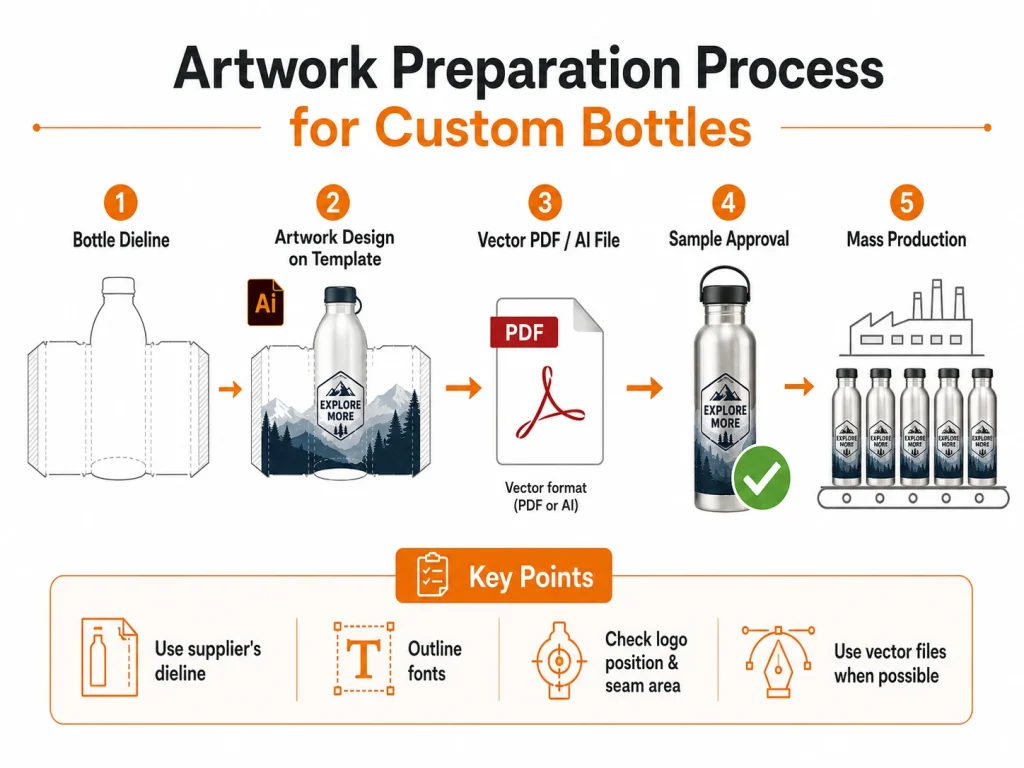
For full-wrap graphics or designs that must align precisely with the bottle structure, the artwork should be created according to the supplier’s printing template or dieline.
For example, if we provide a customer with a bottle printing die line, the designer should normally create the artwork directly within that template.
This helps both sides confirm:
- Printing position
- Printable height
- Artwork scale
- Front and back orientation
- Seam position
- Safe area
- Logo location
- Handle interference
- Lid orientation
For position-sensitive projects, a production-ready vector PDF is often preferred, especially for logos, line graphics, and artwork created directly on a dieline.
Depending on the design, AI, PDF, or suitable high-resolution image files may also be used.
The important point is that the artwork should not simply be sent as a screenshot from a website or social media page.
Poor source artwork can still produce poor printing, even when the printing equipment itself is good.
3. What Is Screen Printing?
Screen printing is one of the most established decoration methods for promotional drinkware.
Ink is transferred through a prepared screen onto the bottle surface.
For simple logos and larger production quantities, it remains extremely practical.
Screen Printing Is Particularly Suitable for Simple Logos
Consider a bottle with the following:
One company logo + one Pantone color + one fixed position.
In this case, screen printing can be a very efficient solution.
It works especially well for:
- Company logos
- Promotional bottles
- Event merchandise
- Sports clubs
- Corporate gift programs
- Simple text
- One-color branding
- Two-color graphics
For repeat orders using the same artwork, screen printing can also provide good production efficiency.
Why Multiple Colors Make Screen Printing More Complicated
Every additional color generally increases process complexity.
Different colors may require separate screens and additional registration.
For example:
A one-color logo is relatively straightforward.
A six-color illustration with gradients and detailed shading is much less suitable.
This is why buyers should not select a decoration process based only on the unit printing price.
Artwork complexity matters.
A simple graphic and a detailed retail pattern are fundamentally different production projects.
4. What Is Laser Engraving?
Laser engraving creates the design by removing or modifying the surface coating rather than applying colored ink.
On powder-coated stainless steel drinkware, the laser can reveal the stainless steel beneath the coating.
The result is clean, permanent-looking, and highly suitable for premium branding.
Advantages of Laser Engraving
Laser engraving is particularly attractive when the buyer wants the following:
- A clean logo
- Minimalist branding
- A premium corporate appearance
- No printed color
- Strong visual consistency
- A durable decorative effect
Because no colored ink is required, there is no need to match multiple print colors.
For premium corporate gifts, a simple laser-engraved logo can sometimes look more sophisticated than a large printed graphic.
Limitations of Laser Engraving
Laser engraving is not suitable when the artwork requires the following:
- Full color
- Gradients
- Photographic images
- Colored illustrations
- Large colorful patterns
The final laser color also depends on the coating and substrate.
Therefore, the engraving effect should still be confirmed during sampling rather than assumed from a computer rendering.
5. Which Method Is Best for Full-Wrap Bottle Designs?
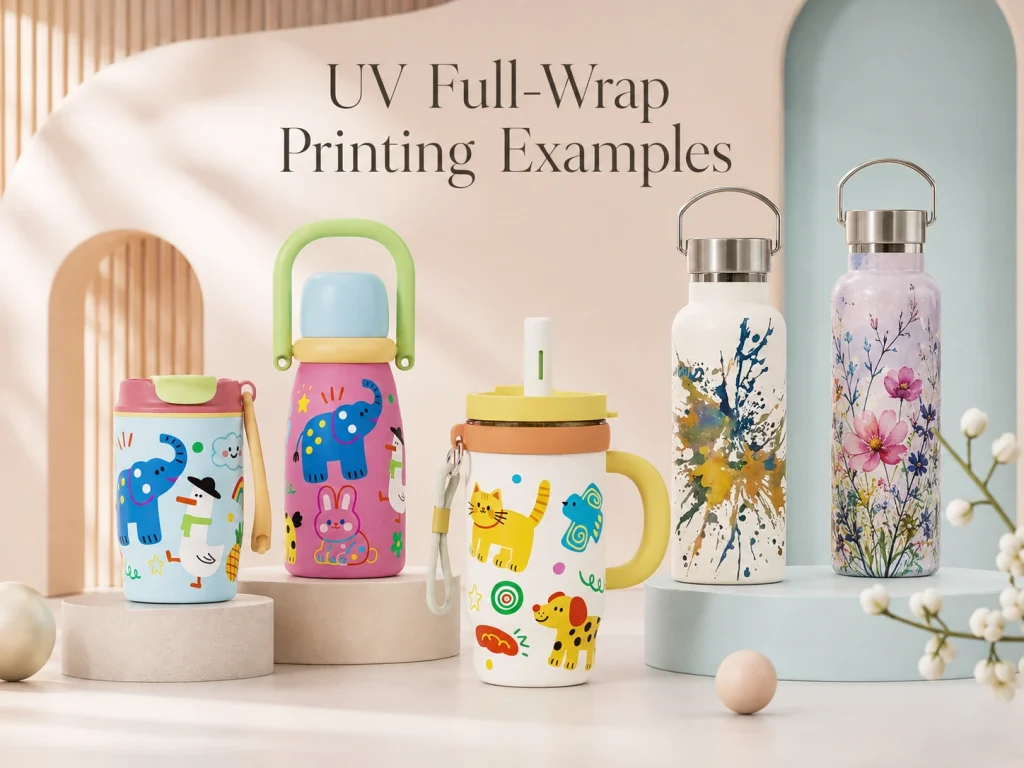
Full-wrap artwork requires more careful evaluation.
Designs such as:
- Leopard prints
- Floral graphics
- Plaid patterns
- Fruit graphics
- Kids illustrations
- Abstract artwork
may cover a large percentage of the bottle surface.
UV digital printing is often a strong option for these projects because it can reproduce complex full-color artwork.
However, this does not mean every bottle can automatically be printed 360° without limitations.
The factory still needs to check the following:
- Bottle diameter
- Tapered areas
- Handle position
- Lid structure
- Printable height
- Bottom curvature
- Machine printing range
- Artwork seam position
A straight cylindrical bottle is generally easier to decorate than a highly tapered mug with a permanently fixed handle.
That is why artwork should be evaluated together with the actual bottle structure.
6. What About Heat Transfer Printing?
Heat transfer is another process frequently used for colorful decorative drinkware.
It can be suitable for large-area graphics and repeated patterns.
Compared with UV printing, however, the setup and production process are different.
The preferred method depends on:
- Artwork
- Bottle shape
- Quantity
- Surface coating
- Required printing area
- Target cost
- Production equipment
For some large-volume full-wrap programs, heat transfer may be worth considering.
For smaller quantities with several different graphics, digital UV printing may provide greater development flexibility.
The supplier should therefore recommend the process after reviewing the actual product and artwork rather than applying one decoration method to every project.
7. How Do Multiple Designs Affect Sampling Costs?
This is an important point that buyers often overlook.
Suppose a buyer wants to develop four bottle patterns.
With some traditional printing methods, four different artworks may require four different setups.
With UV digital printing, producing several graphics during sampling can be considerably more flexible.
Instead of producing only one design, it may make more sense to increase the sample quantity and test several patterns together.
For example:
Option A
2 samples × 1 design
Option B
1 sample × 4 different UV designs
Depending on the project, Option B may provide much more useful information during product development.
The buyer can compare:
- Color performance
- Artwork scale
- Pattern density
- Market appeal
- Logo visibility
- Overall product appearance
before selecting the final artwork for mass production.
This can reduce the risk of discovering design problems after a large order has already started.
8. Sampling and Mass Production Should Use the Same Production Basis
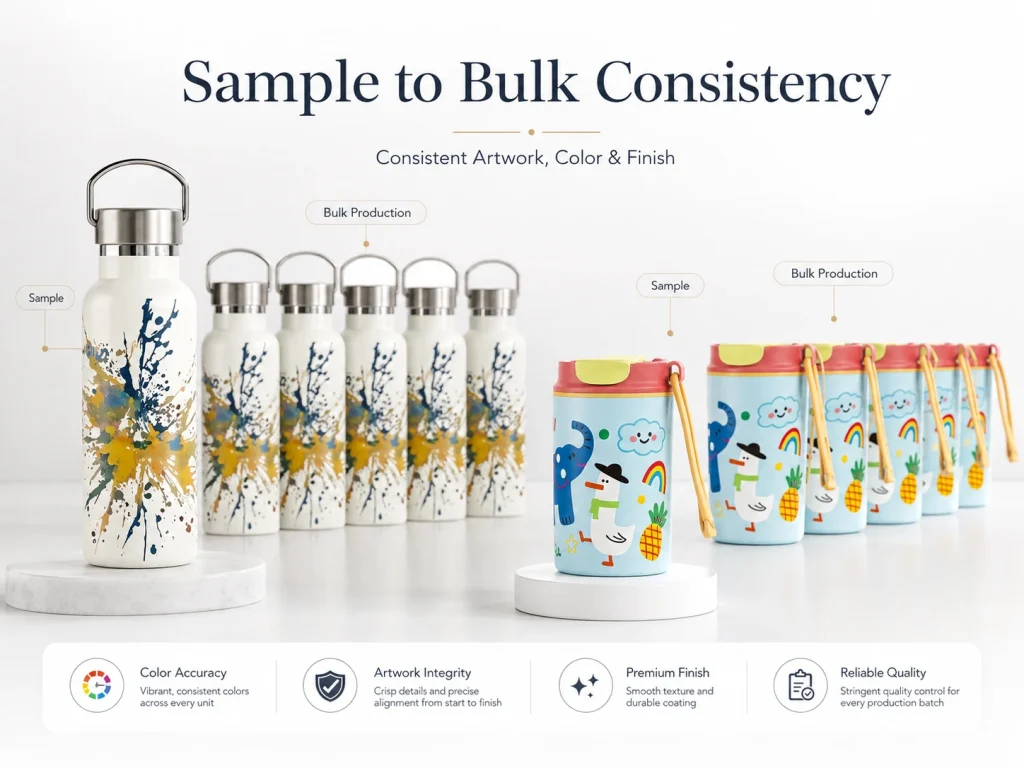
A visually good sample is not enough.
The purpose of sampling is to confirm what will later be reproduced in mass production.
Whenever possible, the sample should therefore follow the same production structure, tooling, and decoration logic planned for the bulk order.
Mixing different molds, structures, or production systems between sampling and mass production can create unnecessary confusion.
This becomes even more important for large orders.
An older mold or slower production system may already take longer during sampling, but the impact can become much greater during mass production because thousands of units must pass through the same process.
A supplier should therefore consider not only the following:
“Can we make one sample?”
but also:
“Can we reproduce this efficiently and consistently for the full order quantity?”
That is a very different question.
9. Durability: Which Printing Method Lasts Longer?
Durability depends on more than the name of the printing process.
Several factors affect the final result:
- Bottle coating
- Surface preparation
- Ink system
- Curing parameters
- Printing area
- Adhesion
- Washing conditions
- Abrasion
- Product use
Laser engraving generally avoids ink adhesion issues because the design is created directly on the surface or coating.
Screen printing and UV printing depend on correct ink adhesion and process control.
For printed products, suppliers may perform relevant adhesion or abrasion tests according to project requirements.
If dishwasher resistance is required, this should be clearly stated before quotation and sampling.
A buyer should never assume that every printed bottle is automatically dishwasher safe.
10. How Should Buyers Choose?
A practical way to select the decoration process is to start with the design objective.
Choose Screen Printing When:
- Your logo is simple.
- You only need one or two colors.
- Your order quantity is relatively large.
- Cost efficiency is important.
- The printing position is fixed.
Choose Laser Engraving When:
- You want a premium minimalist appearance.
- Your design is mainly a logo or text.
- You do not require printed colors.
- Durability is a major consideration.
- You are developing corporate gifts.
Choose UV Digital Printing When:
- Your artwork contains many colors.
- You need gradients or detailed graphics.
- You are developing retail-style products.
- You want to test several patterns.
- Your order contains multiple artworks.
- You need large decorative graphics.
- Sampling flexibility is important.
11. Information to Send Your Supplier Before Sampling
To receive a more accurate recommendation, send the supplier as much information as possible before the sample stage.
At minimum, provide:
- Bottle model
- Required quantity
- Logo or artwork
- Number of artwork versions
- Required printing size
- Preferred decoration effect
- Pantone or color references
- Packaging requirements
- Target market
- Any durability or testing requirements
If full-wrap artwork is required, ask the supplier for the correct printing template before your designer begins.
Designing directly on the supplier’s dieline can avoid unnecessary artwork revisions later.
Final Thoughts
Choosing between UV printing, screen printing, and laser engraving is not simply a question of which technology is more advanced.
The correct process depends on the project.
A simple corporate logo may be perfect for screen printing or laser engraving.
A colorful retail collection with leopard, floral, or seasonal designs may benefit significantly from UV digital printing.
And a large, full-wrap production program may require further evaluation based on artwork, bottle geometry, and order quantity.
The best approach is to evaluate the bottle, artwork, quantity, and expected result together before sampling.
This helps ensure that the sample is not only attractive but also realistic for stable mass production.
At Funzlife, we support custom stainless steel drinkware projects from artwork evaluation and sampling through mass production.
If you are developing a new bottle project, send us your product reference, artwork, quantity, and target decoration effect. We can help evaluate which printing method is more suitable before sampling.