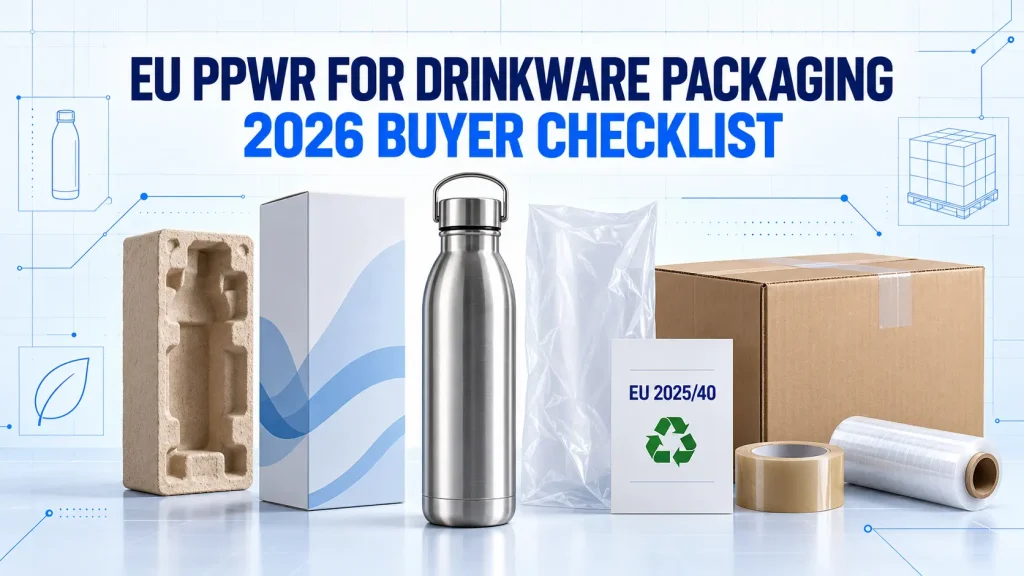
A reusable stainless steel bottle may reduce dependence on disposable drink containers, but that does not automatically make the packaging around it compliant with the European Union’s new packaging rules.
For a custom drinkware project, the retail box is only one part of the packaging system. Sleeves, protective bags, inserts, labels, cartons, tape, pallet wrap, and e-commerce mailers may all need separate review.
The Packaging and Packaging Waste Regulation—Regulation (EU) 2025/40, commonly called the PPWR—entered into force on 11 February 2025 and generally applies from 12 August 2026. It covers packaging placed on the EU market regardless of the material used or whether it was manufactured inside or outside the EU. However, not every obligation starts on the same date. Detailed methods, labelling formats, and other requirements continue to follow their own implementation timetables.
Packaging should therefore be included in the product brief from the beginning, not added as a last-minute graphic design decision.
Short answer: Map every packaging component, assign the responsible parties, collect material and weight information, remove unnecessary packaging, review recyclability and labelling, and agree on the documents and production controls before approving the final pack-out.
This guide is intended for general B2B purchasing and product-development planning. It is not legal advice, and companies placing packaging or packaged products on the EU market should confirm their obligations with qualified EU compliance professionals.
What Counts as Packaging in a Custom Drinkware Project?
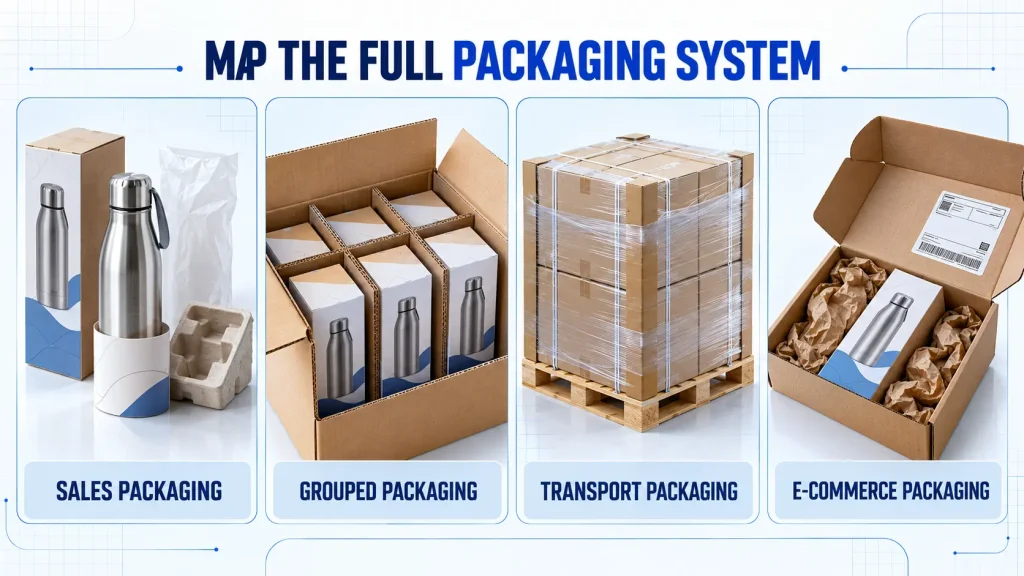
Buyers often concentrate on the gift box because it is the most visible part of the presentation. The PPWR has a much broader scope. A useful review should follow the bottle from the individual retail unit through warehousing, transport, and final delivery.
| Packaging level | Common drinkware examples | Information to collect |
|---|---|---|
| Sales packaging | Printed box, gift box, paper sleeve, pouch, protective bag, label, seal, hangtag, and insert | Material, weight, dimensions, print, coating, supplier, and separation method |
| Grouped packaging | Inner carton, divider, assortment tray, and bundle wrap | Units per pack, material, weight, protection function, and empty space |
| Transport packaging | Master carton, tape, corner board, straps, stretch wrap, and pallet protection | Carton specification, material, weight, pack-out, pallet pattern, and recovery route |
| E-commerce packaging | Mailer, shipping carton, void fill, return packaging, and shipping label | Sales channel, product fit, empty space, return use, and destination market |
A component map should cover everything supplied with the finished goods and anything added before the product reaches the customer. Even a small sticker or foam pad can affect separation and documentation.
For a broader comparison of packaging structures, see our Custom Drinkware Packaging Guide.
A Reusable Bottle Is Not the Same as Reusable Packaging
This distinction is especially important for drinkware brands.
A stainless steel water bottle can be designed for years of repeated consumer use. Its retail box, however, may be used only once. Conversely, a transport crate or pallet system may circulate repeatedly between business partners even though it never reaches the consumer.
The PPWR applies specific conditions to reusable packaging and reuse systems. The bottle’s durability alone does not support a claim that its packaging is reusable. Such a claim needs evidence about the packaging design, intended rotations, and collection or return system.
Use precise wording:
- “Reusable stainless steel bottle” describes the product.
- “Packaging designed for repeated use” requires evidence about the packaging system.
- “Recyclable packaging” should be supported by the applicable assessment method and market conditions, not just by a recycling symbol.
Who Is Responsible for PPWR Compliance?
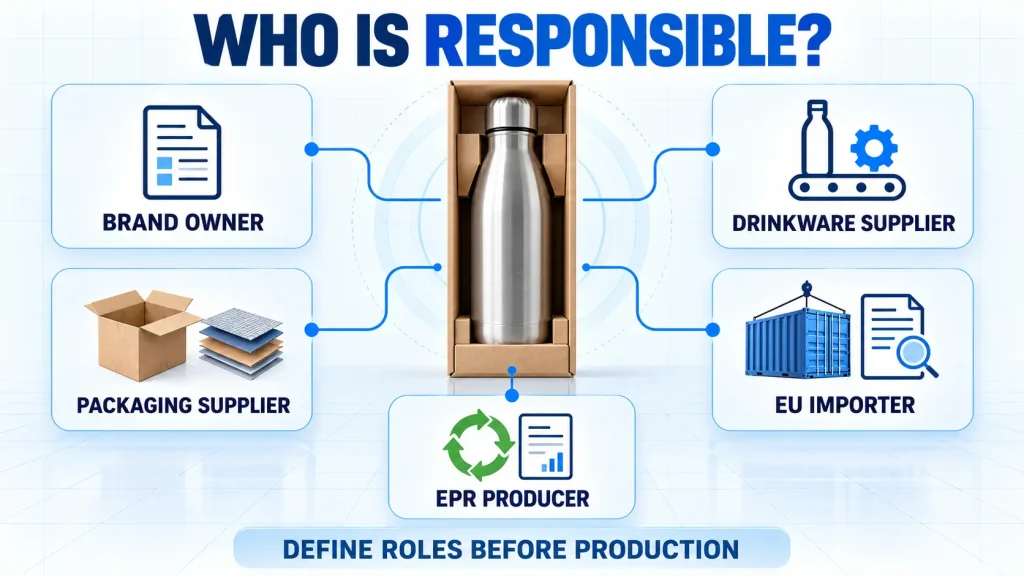
There is rarely one party responsible for every part of a private-label drinkware program. The exact legal roles depend on the commercial arrangement, branding, location of each company, and how the goods enter the EU market.
The parties may include:
- The brand owner, which selects the packaging, approves the artwork and may sell the product under its own name or trademark.
- The drinkware supplier, which coordinates the bottle, accessories, packaging specifications, packing process, and production records.
- The packaging manufacturer, which supplies boxes, bags, inserts, labels, or transport components and should provide relevant material and specification information.
- The EU importer, which brings packaged products from a non-EU country onto the Union market and has verification and record-keeping duties within its role.
- The distributor, retailer, or EPR producer, which may have verification, registration, reporting, and fee obligations depending on the member state and sales model.
These roles should be assigned in writing before documentation is collected. “Our factory is PPWR compliant” is not a complete answer because it does not identify the packaging covered, the applicable requirements, the supporting evidence, or the party holding the final technical file.
A non-EU supplier can provide order-specific packaging specifications and source documents. It cannot automatically take over every obligation of the EU brand owner, importer, or producer.
Seven Areas Buyers Should Review
1. Create a Packaging Bill of Materials
Build a component-level list for each SKU. Record the component name, function, material, weight, dimensions, supplier, print or coating, method of attachment, and whether it can be separated after use.
Do not call a pack simply “paper” when it also contains a plastic window, laminate, magnet, foam, or metallic decoration. The full construction matters.
2. Minimise Packaging Without Increasing Product Damage
The PPWR aims to prevent unnecessary packaging and reduce weight, volume, and empty space. This does not mean removing protection without testing it.
Powder-coated bottles can rub against unprotected cardboard. Handles and lids can create pressure points. Glass-lined drinkware may need a different protection system from a standard stainless steel tumbler. The better approach is to document why each protective component is needed and then optimize it through sample and transport testing.
Ask whether the box can be smaller, two components can be combined, a decorative sleeve is necessary, or a plastic bag can be reduced without causing scratches or contamination.
3. Review Recyclability and Component Separation
The European Commission states that all packaging must be recyclable by 2030, with detailed rules being introduced in stages. Buyers should therefore consider how each packaging format will be collected, sorted, and recycled—not merely whether its main material sounds recyclable.
Mixed constructions—such as paper boxes with plastic windows, laminates, magnets, permanent foam, metallic foil, or difficult-to-remove labels—require particular attention. They are not automatically prohibited, but their function, separation, recyclability, and evidence must be reviewed.
4. Treat Plastic Components Separately
Plastic bags, shrink film, blister components, handles on packaging, stretch wrap, and plastic void fill should be identified separately from paper and board. Where recycled-content rules apply, the relevant plastic packaging category, exemptions, calculation method, and timetable need to be confirmed.
Do not assume that a recycled-content target for plastic packaging automatically applies to the stainless steel bottle itself. The product and its packaging are different regulatory layers.
5. Check Substances and Material Claims
Request clear specifications for packaging materials, inks, coatings, adhesives, and other relevant components. Claims such as “non-toxic,” “biodegradable,” “compostable,” “100% recyclable” or “plastic-free” should not be used without a defined scope and reliable support.
It is also important not to confuse PPWR requirements with food-contact compliance for the drinkware product. A bottle lid, straw, or silicone gasket may require food-contact review, while the surrounding retail carton is assessed as packaging. FDA, LFGB, and EU food-contact requirements do not replace a PPWR packaging assessment.
6. Plan Labelling and Artwork Before Printing
The PPWR introduces harmonized labelling and information requirements, but different provisions and implementing measures follow different dates. Buyers should avoid freezing large quantities of packaging artwork based on assumptions about a future symbol or format.
Before printing, confirm:
- Required material or sorting information
- Economic-operator identification
- Destination-country language needs
- EPR or national collection markings where applicable
- Any digital data carrier requirements
- Environmental claims used on the packaging
- Whether labels, sleeves, or stickers affect separation and recyclability
Keep the editable artwork, approved PDF, color standard, and revision number together. Any regulatory change to the artwork should go through formal approval rather than an informal message to the printer.
7. Build a Technical File, Not a Folder of Random Certificates
A useful packaging file connects each document to a specific component and SKU. Depending on the requirements and the company’s role, it may include:
- Packaging drawings, component list, materials, dimensions, and weights
- Supplier identification and applicable requirements
- Material declarations, specifications, and relevant supporting evidence
- Approved labeling and artwork
- Production control, traceability, and change-control records
- EU declaration of conformity where required
A generic certificate with no product code, component description, or revision cannot reliably demonstrate what was used in production.
What to Request From a Drinkware Supplier
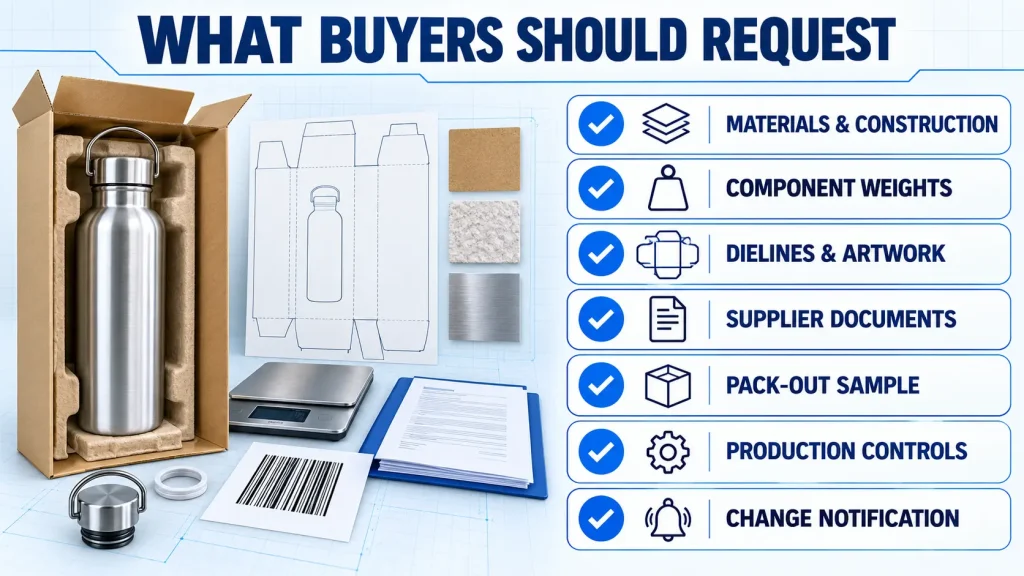
Before approving the packaging sample, send a written request covering the following items:
- A list of sales, grouped and transport packaging components.
- Material, construction, weight and dimensions for each component.
- Packaging-supplier information and available source documents.
- Print, coating, adhesive and decoration details.
- A dieline and final artwork revision.
- Pack-out photographs and a physical sample.
- Master-carton and pallet configuration.
- Production checks and written change-notification rules.
These requirements should also appear in the RFQ or purchase specification. Our Custom Stainless Steel Drinkware Quote Checklist explains the other product details buyers should confirm before requesting a quotation.
Sampling and Production Control Still Matter
Documentation alone does not prove that the approved packaging will protect the product or that the same materials will be used in mass production.
During sampling, check the complete pack-out rather than the empty box. Review fit, movement, abrasion, pressure points, opening experience, printed colour, barcode readability and carton strength. Select transport tests based on the product, route and sales channel.
After approval:
- Retain a signed packaging sample or clear approval record.
- Freeze the material, dimensions, weight and artwork revision.
- Define tolerances for critical measurements.
- Check incoming packaging before packing begins.
- Compare production packaging with the approved sample.
- Record substitutions and obtain approval before use.
- Include packaging in the final drinkware quality-control plan.
Testing should show which protection is genuinely necessary and where material or empty space can be reduced safely.
Common PPWR Red Flags for Drinkware Buyers
Be cautious when you hear any of the following:
- “It is paper, so it is automatically PPWR compliant.”
- “The recycling logo is the only document you need.”
- “One standard gift box works for every EU market.”
- “The bottle is reusable, so its packaging is exempt.”
- “Every PPWR requirement started on 12 August 2026.”
- “LFGB testing proves the packaging is PPWR compliant.”
- “We cannot provide the weight of each packaging component.”
- “The packaging supplier may change materials without approval.”
- “The importer has no responsibility because the goods were packed in China.”
These statements oversimplify the regulation and create avoidable sourcing risk.
A Practical PPWR Workflow for a New Drinkware Project
Before the RFQ
Define the product, EU destinations, sales channels, quantity, packaging levels and protection needs.
During Supplier Selection
Identify standard and custom components, their suppliers and the information available.
During Sampling
Approve the complete pack-out and record materials, weights, dimensions, artwork and test results.
Before Production
Confirm legal roles, close documentation gaps, freeze the specification and set change-control rules.
Before Shipment
Verify production against the approved sample and complete required importer, conformity and EPR checks.
After Launch
Keep records and reassess the packaging when the product, material, artwork, supplier or sales channel changes.
How Funzlife Can Support a Packaging Review
Funzlife supports brands, importers, retailers and corporate-gift buyers with practical product and packaging coordination. Depending on the project, this can include comparing existing packaging options, coordinating custom boxes and inserts, collecting order-specific specifications, arranging samples, confirming pack-out details and including approved packaging requirements in production quality control.
Funzlife does not replace the buyer’s EU legal adviser, conformity-assessment specialist or EPR service provider. The relevant EU economic operator remains responsible for determining its legal role, confirming current requirements and completing the obligations within its scope.
If you are preparing a new project, send us:
- Bottle or tumbler type and capacity
- Target EU countries
- Retail, corporate-gift or e-commerce channel
- Order quantity
- Current packaging design or reference
- Required gift-box presentation
- Damage-protection and logistics requirements
- Artwork and labelling instructions
- Documentation requested by your compliance team
We can help translate those requirements into a clearer packaging brief and coordinate the next steps with suitable manufacturing and packaging partners. Explore our custom drinkware options or contact Funzlife to discuss your project.
Frequently Asked Questions
Does the PPWR apply to custom drinkware gift boxes?
Yes. A gift box used to contain, protect, handle, deliver or present a bottle or tumbler can fall within the PPWR’s packaging scope. Inserts, sleeves, protective bags, labels and transport packaging should also be reviewed.
Does a reusable stainless steel bottle make its packaging exempt?
No. The product’s reusability and the packaging’s reusability are separate questions. A reusable bottle may still be sold in single-use sales packaging.
Does the PPWR require all drinkware packaging to be paper?
No. The PPWR does not simply require one material. Packaging must be assessed against the requirements applicable to its design, substances, minimisation, recyclability, recycled content, labelling, reuse and documentation.
Is a recycling symbol enough to prove compliance?
No. A symbol does not replace component specifications, conformity information, technical documentation, traceability, role assignment or destination-market EPR obligations.
Do all PPWR requirements apply from 12 August 2026?
No. The Regulation generally applies from that date, but individual obligations, transition periods, delegated acts and implementing rules follow different timetables. Companies should check the current official text and guidance for each requirement.
Does an LFGB test report prove PPWR compliance?
No. LFGB-related testing generally concerns food-contact performance and is not a complete assessment of packaging under the PPWR. Product food-contact compliance and packaging compliance should be managed as separate but coordinated workstreams.
Can a Chinese drinkware supplier certify that an EU importer is fully PPWR compliant?
A supplier can provide packaging specifications and supporting information within its scope. It cannot generally determine or complete all legal, importer, producer-registration and EPR obligations for an EU company without a defined arrangement and appropriate professional review.