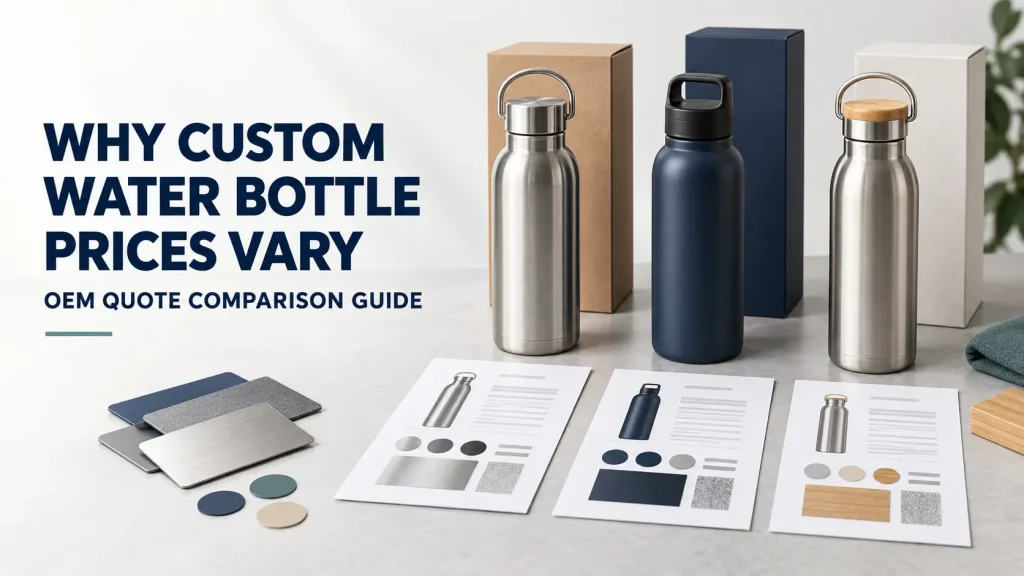
Three suppliers receive the same reference photo for a custom stainless steel bottle. One quotation is noticeably lower, one sits in the middle, and one is significantly higher.
At first glance, choosing the lowest price may seem obvious. But are all three suppliers quoting the same stainless steel grade, bottle weight, lid material, coating, logo process, packaging, testing, and delivery term?
Often, they are not.
A product photo shows the general appearance of a bottle, but it does not reveal the complete specification. Even bottles that look almost identical can have different materials, construction, insulation performance, lid function, coating durability, and quality-control requirements.
That is why reliable custom water bottle pricing should be evaluated as a complete package—not as one isolated unit price.
This guide explains what changes the cost of custom stainless steel drinkware, how to compare OEM quotations on the same basis, which exclusions deserve attention, and how to reduce cost without removing the features that matter to your customer.
The Short Answer
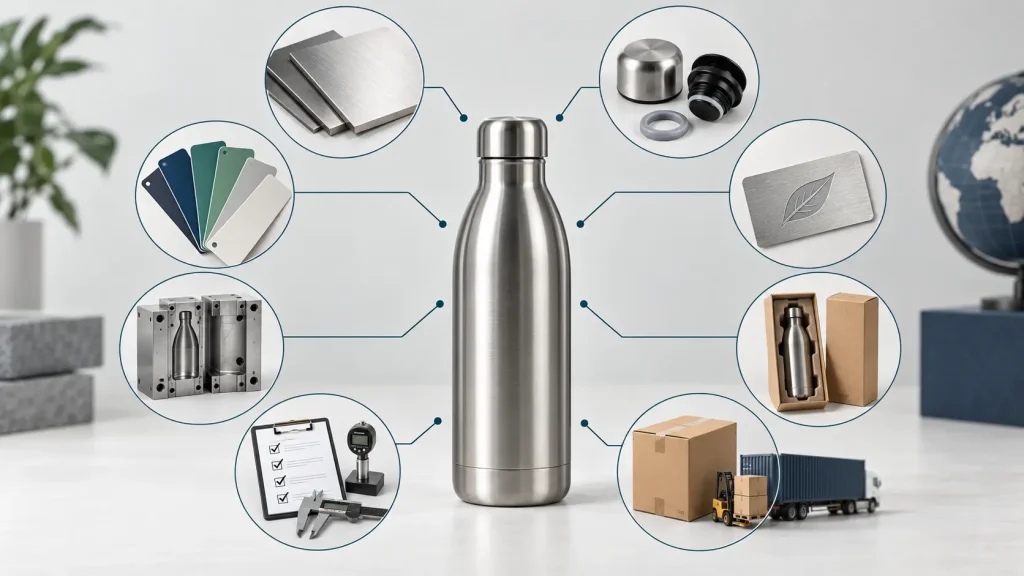
The price of a custom water bottle is normally influenced by eight connected areas:
- Product structure, size, weight, and stainless steel specification
- Lid design, material, and functional requirements
- Order quantity and quantity per color or artwork
- Body finish and logo decoration
- New molds, tooling, and development work
- Packaging and accessories
- Testing, inspection, and target-market requirements
- Incoterm, packing data, shipping method, and delivery schedule
Before comparing prices, ask every supplier to quote from the same written specification. Separate the recurring unit cost from one-time charges, identify what is included or excluded, and compare the expected landed cost—not only the FOB unit price.
If the specification is still being developed, ask the supplier to state every assumption in the quotation and provide alternatives where one decision has a meaningful effect on cost.
What Determines Custom Water Bottle Pricing?
| Cost factor | Questions buyers should ask | Why it changes the quotation |
|---|---|---|
| Bottle construction | Single-wall or double-wall vacuum insulated? What capacity, dimensions, and weight? | More material and processing normally increase cost. |
| Stainless steel | Which grade is used for the inner liner and outer shell? | Material grades and combinations have different costs and applications. |
| Lid | What are the plastic, silicone, and metal components? Is it leakproof, dual-use, or one-handed? | Complex lids require more components, assembly, and testing. |
| Quantity | What is the total order and quantity per color, design, and size? | Shorter production runs create more setup work and material loss per unit. |
| Surface finish | Spray painting, powder coating, polished steel, or a special effect? | Each finish uses a different process and control method. |
| Logo | Laser engraving, screen printing, UV printing, heat transfer, or full wrap? | Artwork size, colors, registration, and setup affect cost |
| Tooling | Standard mold, modified component, or completely new design? | New molds and engineering create one-time development charges. |
| Packaging | Bulk packing, white box, color box, or gift set? | Boxes, inserts, printing, and carton volume affect both product and freight cost. |
| Compliance | Which market reports, product tests, and inspections are required? | Project-specific testing and documentation add cost and lead time. |
| Commercial terms | EXW, FOB, CIF, or delivered price? | Different terms include different transport responsibilities and charges. |
1. Similar Appearance Does Not Mean the Same Construction
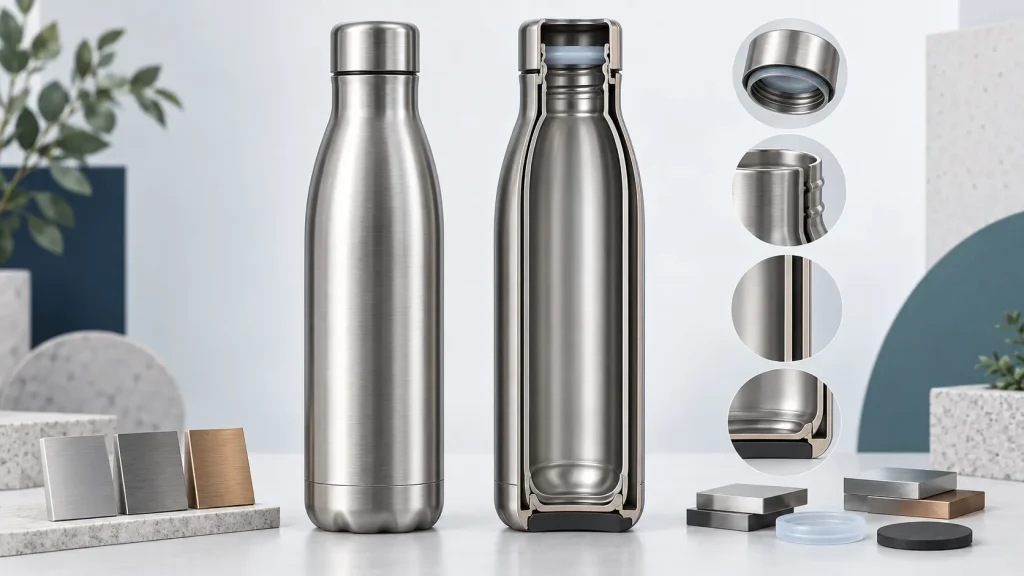
A bottle image cannot show everything inside the product.
Two 500 ml bottles with the same silhouette may differ in:
- Inner-liner and outer-shell material
- Steel thickness and finished product weight
- Single-wall or double-wall construction
- Vacuum quality and insulation performance
- Interior polishing and cleaning
- Welding and bottle-mouth finishing
- Copper-plated or unplated vacuum layer
- Bottom structure and protective base
- Lid and gasket quality
These differences can affect durability, heat retention, corrosion resistance, production consistency, and unit cost.
For example, specifying 316 stainless steel for the inner liner normally creates a different material cost from a standard 304 inner liner. Using 304 for both the inner and outer walls may also differ from a 304-inside/201-outside construction.
The correct option depends on the intended beverage, target market, brand position, and price level. A higher material grade should not be treated as a substitute for good welding, polishing, lid performance, or quality control.
Our guide to 304 vs 316 stainless steel water bottles explains how to select and specify the material for an OEM project.
When comparing quotations, ask each supplier to state:
- Capacity and dimensional tolerance
- Finished bottle weight or agreed weight range
- Inner-liner material
- Outer-shell material
- Vacuum-insulated or non-insulated construction
- Declared insulation performance and test conditions
- Interior treatment
- Included base, boot, or bottom pad
If these details are absent, the quotations may describe visibly similar but technically different products.
2. The Lid Can Change Both Cost and Complaint Risk
Buyers often focus on the stainless steel body and treat the lid as a small accessory. In practice, the lid may be one of the most complex parts of the product.
A simple screw cap, a flip spout, a straw lid, a sliding tumbler lid, and a dual-drinking lid do not use the same components or production process.
Lid pricing can be affected by:
- PP, AS, PS, Tritan, or stainless steel components
- Number of molded parts
- Silicone gasket and valve structure
- Straw, mouthpiece, dust cover, or lock
- Handle or carry loop
- One-handed opening mechanism
- Custom plastic color
- Logo on the lid
- Required opening force or closing torque
- Leak, cycle, drop, and hot-liquid testing
- Spare gaskets, straws, or replacement parts
A cheaper lid may reduce the first quotation but increase the risk of leakage, difficult cleaning, broken hinges, or poor user experience.
Terms such as “leakproof” and “spill-resistant” should also be defined. A lid that performs well while upright may not be suitable for horizontal carrying inside a backpack.
Before comparing prices, state the expected use position, liquid temperature, test duration, and opening-and-closing cycle requirement. See our OEM guide to leak-proof drinkware lids for a practical specification checklist.
3. Total Quantity Is Not the Only MOQ That Matters
An order for 3,000 bottles in one color is not equivalent to an order for 3,000 bottles divided among ten colors.
Both projects have the same total quantity, but the second requires more:
- Color preparation and matching
- Production-line changes
- First-piece approvals
- Cleaning between coating colors
- Component sorting
- Packaging and SKU control
- Inspection records
MOQ may apply separately to the bottle model, each body color, custom lid color, artwork version, packaging design, or newly molded component.
This is why a supplier may quote different prices for:
- 3,000 pieces in one color
- 3,000 pieces in three colors
- 3,000 pieces in ten colors
When requesting a price, always show the quantity breakdown. If the final color plan is not confirmed, ask for two or three scenarios so the cost of variety is visible.
Our custom water bottle MOQ guide explains how materials, coating, printing, lids, and packaging can each create a different practical minimum.
4. Surface Finish Changes More Than Appearance
The body finish affects appearance, tactile feel, durability, production control, and cost.
Common options include:
- Spray painting
- Powder coating
- Brushed or polished stainless steel
- Rubberized or soft-touch coating
- Gradient finish
- Metallic or pearlescent effect
- Sublimation coating
- Full-body decorative transfer
“Matte black” is not a complete specification. One quotation may include basic spray painting, while another may use a textured powder coating with stronger adhesion requirements.
Buyers should confirm:
- Coating type
- Pantone or approved physical color standard
- Matte, glossy, textured, or soft-touch appearance
- Acceptable color tolerance
- Adhesion requirement
- Abrasion or scratch expectation
- Dishwasher claim, if any
- Whether the quoted finish includes a protective topcoat
If performance matters, ask how it will be tested and recorded. Our comparison of powder coating and spray painting covers the trade-offs in more detail.
5. Logo Pricing Depends on the Artwork, Not Only the Method
“Logo included” may describe a small one-color mark or a large multicolor wrap. Those are not commercially equivalent.
Logo cost can depend on:
- Printing or engraving method
- Logo dimensions
- Number of print colors
- One-sided, two-sided, or full-wrap placement
- Registration accuracy
- Bottle shape and printable area
- Base coating and surface texture
- Artwork changes between SKUs
- Setup, screen, film, plate, or fixture charges
- Required durability
Typical decoration methods include laser engraving, screen printing, UV printing, heat transfer printing, sublimation, and three-dimensional emblems.
A method that is cost-effective for a simple one-color logo may be unsuitable for a detailed gradient illustration. Likewise, the cheapest initial method may not deliver the durability expected for a retail or outdoor product.
Send vector artwork where possible and ask the supplier to state the quoted logo size, position, colors, and process. If two methods are suitable, request separate options instead of allowing the decision to remain unspecified.
You can compare common processes in our guide to UV printing, screen printing, and laser engraving.
6. Separate Unit Cost from Tooling and Development Charges
Private-label drinkware projects fall into different development levels:
- Standard product with a custom logo: existing bottle, existing lid, and standard packaging
- Standard product with custom colors and packaging: existing molds with more branded components
- Modified product: an existing platform with a changed lid, handle, accessory, or body detail
- Fully custom product: new structure, tooling, engineering, and validation
These routes should not be compared as though they involve the same work.
Possible one-time charges include:
- Bottle-body tooling
- Plastic injection molds
- Silicone molds
- Prototype development
- Engineering drawings
- Color matching
- Printing screens, films, plates, or fixtures
- Packaging cutting die and printing setup
- Product-specific laboratory testing
Ask the supplier to separate these charges from the recurring unit price. Also confirm:
- Who owns the mold
- Whether maintenance is included
- Expected mold life
- Whether the tooling can be used for future orders
- What happens if the design changes
- Whether any charge is refundable or creditable against a production order
A low unit price does not automatically mean a lower project cost if the tooling, samples, and setup charges are high.
7. Packaging Affects Unit Cost, Freight, and Inventory Risk
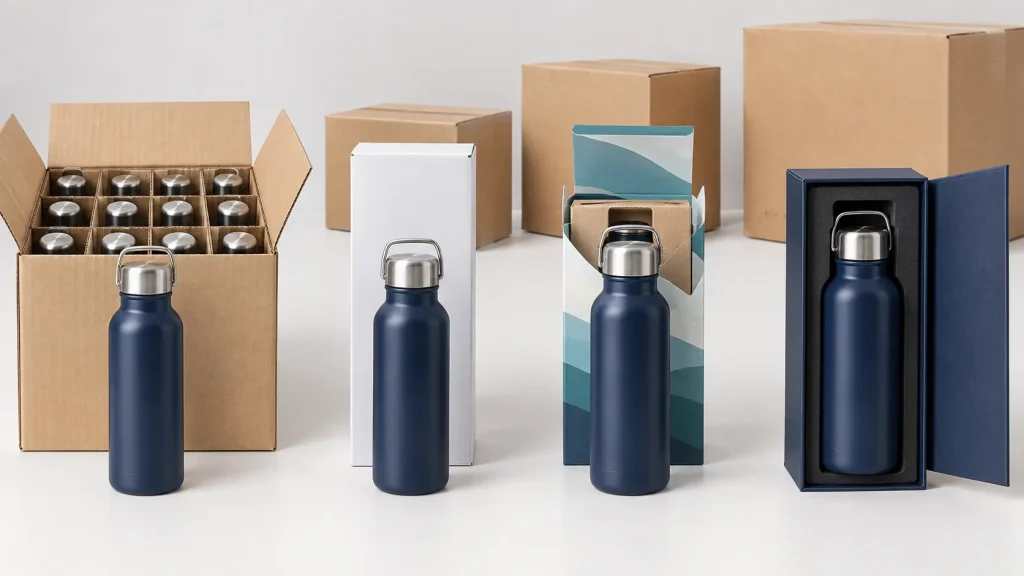
Packaging should be compared as a complete system, not as the phrase “individual box.”
The quotation may need to identify:
- Surface-protection material
- White, kraft, or printed color box
- Internal insert
- Straw or accessory compartment
- Instruction sheet or care card
- Barcode and SKU labels
- Gift sleeve or message card
- Master carton and dividers
- Units per carton
- Carton dimensions and gross weight
A premium gift box may improve presentation but also reduce the number of units per carton and increase total shipment volume. A low-cost box may become expensive if it does not prevent scratches, dents, or returns.
Custom boxes can also have a separate MOQ. If each bottle color needs different artwork, the packaging printer may treat each design as a separate short production run.
For a smaller launch, one common printed box with a color-identification label—or a standard box with a custom sleeve—may reduce packaging inventory risk.
See our custom drinkware packaging guide for packaging options, approval steps, and freight considerations.
8. Testing and Quality Control Must Be Included in the Comparison
Two suppliers may offer the same material description while applying different levels of process control and finished-product inspection.
The quotation should clarify which checks are included and which tests require additional cost. Depending on the project, these may cover:
- Material verification
- Capacity and dimensional checks
- Leak testing
- Insulation testing
- Lid function and cycle testing
- Coating adhesion
- Logo adhesion or abrasion
- Drop or impact testing
- Odor and cleanliness review
- Packaging verification
- Final random inspection
- Third-party laboratory testing
Target-market requirements also matter. A general test report for a material or a different product may not cover the exact finished item, color, lid, or intended use in your order.
Tell the supplier where the product will be sold and which documents are required. If project-specific testing is necessary, confirm the test scope, sample quantity, laboratory, lead time, and fee before sample approval.
Our guide to stainless steel bottle quality control explains how the approved sample, written specification, in-process checks, and final inspection should work together.
9. Lead Time Can Influence the Real Cost
An urgent order can create costs that are not visible in the original unit price.
Short schedules may require:
- Faster sample preparation
- Priority material purchasing
- Additional production changes
- Split shipments
- Airfreight instead of sea freight
- Overtime or special coordination
- Approval of components without enough validation time
The cheapest quotation is not useful if the supplier cannot meet the product-launch date.
Ask for a realistic schedule that separates:
- Existing sample preparation
- Customized sample preparation
- Sample approval time
- Material and packaging preparation
- Mass production
- Final inspection
- Booking and shipment
If the deadline is fixed, provide the required arrival date and destination—not only “urgent.” The supplier can then work backward and identify the latest safe approval date.
10. Compare the Same Incoterm and Named Place
A unit price is incomplete without its commercial basis.
EXW, FOB, CIF, and delivered quotations include different responsibilities and costs. Even two FOB quotations may not be comparable if they use different loading ports or exclude different local charges.
Check:
- Incoterm and named place or port
- Export packing included
- Export customs handling included
- Destination freight included or excluded
- Insurance included or excluded
- Duties and local taxes included or excluded
- Pallets required or optional
- Estimated carton quantity, dimensions, and weight
- Quotation validity
For freight comparison, request packing data rather than estimating from the bottle dimensions alone. Handles, lids, gift boxes, and accessories can change carton efficiency significantly.
The lowest FOB price may not create the lowest landed cost if the packaging is bulky, the carton count is high or the quotation excludes essential charges.
11. Watch for Missing Items and Vague Wording
A quotation does not need to be long, but it should be specific enough to show what the price represents.
Phrases that need clarification include:
- “Food-grade stainless steel” without a stated grade
- “BPA-free lid” without component materials
- “Leakproof” without use and test conditions
- “Custom logo included” without method, size, and colors
- “Custom packaging” without box and insert details
- “Testing available” without the report scope
- “MOQ 1,000” without color or artwork limitations
- “Lead time 30 days” without the starting point
- “FOB price” without the named port
Also ask whether the price excludes:
- Sample and courier cost
- Color matching
- Logo setup
- Tooling
- Packaging setup
- Third-party testing
- Inspection
- Pallets
- Spare parts
- Freight and insurance
An excluded item is not necessarily a problem. The problem is discovering it only after the supplier has been selected or the sample has been approved.
How to Compare OEM Water Bottle Quotes Side by Side
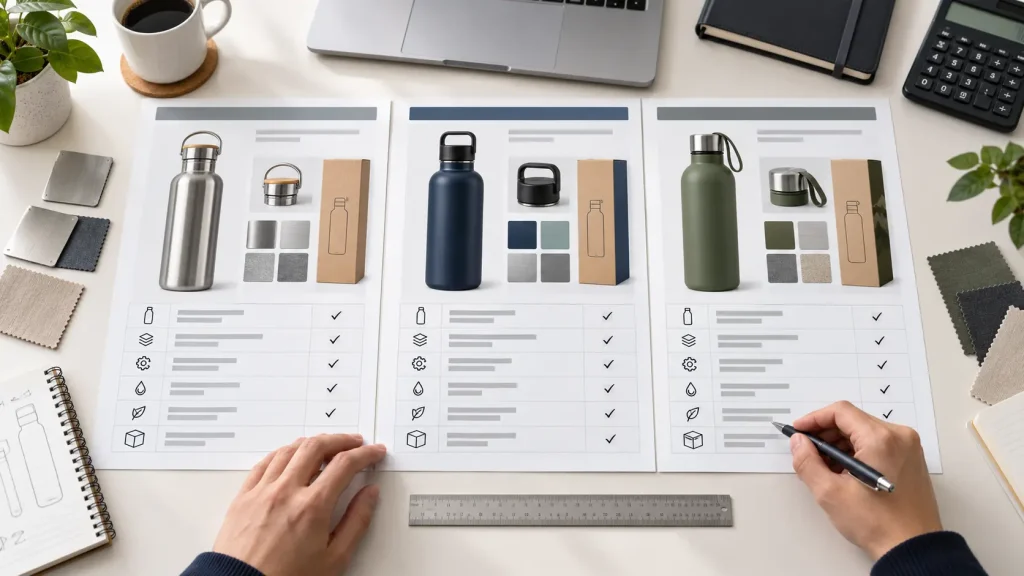
Create one comparison sheet and normalize every quotation to the same specification.
| Comparison item | Supplier A | Supplier B | Supplier C |
|---|---|---|---|
| Product model and capacity | |||
| Inner/outer steel grades | |||
| Finished weight or weight range | |||
| Lid materials and function | |||
| Leak test conditions | |||
| Body finish and color | |||
| Logo method, size, and colors | |||
| Quantity and color split | |||
| Accessories included | |||
| Unit packaging | |||
| Units per master carton | |||
| Tooling and setup charges | |||
| Sample cost and timing | |||
| Testing and inspection | |||
| Mass-production lead time | |||
| Incoterm and named place | |||
| Payment terms | |||
| Quotation validity | |||
| Stated exclusions |
If a supplier does not provide a detail, mark it as “not confirmed” rather than assuming it is included.
After the specification has been normalized, compare:
- Recurring product cost
- One-time development and setup cost
- Packaging and testing cost
- Estimated logistics cost
- Payment and inventory commitment
- Delivery risk
- Quality and after-sales risk
This gives a more useful decision than ranking suppliers by unit price alone.
A Simple Example: The Lowest Quote May Not Be the Lowest Project Cost
Imagine two suppliers quoting the same 20 oz vacuum-insulated tumbler.
Supplier A shows a lower unit price, but the quotation is based on spray painting, a standard lid, one-color logo, bulk-divider packing, and no project-specific testing. The logo setup, individual box, and inspection are quoted later.
Supplier B shows a higher unit price, but it includes powder coating, the specified lid, laser engraving, an individual white box, defined leak and insulation tests, and final inspection.
Supplier A may still be a suitable option if the simpler specification fits the project. Supplier B may offer better value if those additional requirements are necessary.
The key point is not that a higher quotation is always better. It is that the buyer must make the product and service scope comparable before deciding.
How to Reduce Cost Without Creating a Weak Product
Cost optimization should begin with the customer and sales channel, not with random specification cuts.
Practical options may include:
- Use an existing bottle and lid mold instead of developing a new structure
- Begin with fewer body colors
- Use one common packaging design across several colors
- Choose a standard lid color
- Use laser engraving or a simple one-color logo where suitable
- Replace a rigid gift box with an efficient color box or branded sleeve
- Prioritize a 304 inner liner for normal daily-use projects when 316 is not technically or commercially necessary
- Keep essential leak, insulation, and coating controls while removing low-value decorative details
- Consolidate accessories instead of adding items that customers may not use
- Plan earlier to avoid urgent production and airfreight
- Forecast repeat demand so tooling and setup costs can be evaluated across more than one order
Do not reduce cost by leaving materials, lid performance, packaging protection, or acceptance criteria undefined. An unclear specification may create a cheaper quotation, but it also transfers risk to sampling, production, and after-sales service.
What to Send for a Comparable Quotation
For an efficient first review, send:
- Product photo, link, drawing, or physical reference
- Product type and capacity
- Intended market and sales channel
- Expected order quantity
- Quantity per color and artwork
- Preferred material and insulation requirement
- Lid function and leak-resistance expectation
- Body color and finish
- Logo artwork, approximate size, and placement
- Accessories
- Packaging requirement
- Required reports, testing, or inspection
- Destination and required delivery date
- Required quotation basis, such as FOB Ningbo or CIF Hamburg
If some details are undecided, say so. A useful supplier response should identify the missing decisions, state its assumptions, and present practical alternatives.
For a complete template, use our custom stainless steel drinkware RFQ checklist.
Frequently Asked Questions
How much does it cost to manufacture a custom stainless steel water bottle?
There is no reliable universal price for a custom bottle. Capacity, construction, steel grades, lid, coating, logo, quantity, color split, packaging, testing, and commercial terms all affect the quotation. A price range is useful only when the specification and included services are clearly stated.
Why is one OEM water bottle quote much lower than another?
The suppliers may be quoting different materials, product weights, lids, finishes, logo methods, packaging, or inspection levels. One quotation may also exclude setup, testing, or packing charges. Compare the scope line by line before concluding that one supplier is cheaper.
Does a larger quantity always reduce the unit price?
A larger order often distributes setup work across more units, but the result also depends on the number of colors, artwork versions, packaging designs, and production processes. A large total quantity divided into many small SKUs may not achieve the same efficiency as one long production run.
Should tooling be included in the unit price?
Tooling is normally clearer when shown as a separate one-time charge. Buyers should confirm mold ownership, maintenance, expected life, and future-order use. For internal cost planning, the tooling can then be allocated across the expected production volume.
Is the cheapest logo method always the best choice?
No. The correct method depends on the artwork, bottle surface, quantity, appearance, and durability requirement. A simple screen print may be efficient for one design, while laser engraving, UV printing, or heat transfer may be more suitable for another.
What should an OEM quotation include?
It should identify the product specification, quantity tier, color limitation, lid and accessories, finish, logo, packaging, MOQ, sample cost, one-time charges, lead time, packing data, Incoterm, payment terms, validity, and exclusions.
How can a buyer get a more accurate quote quickly?
Send a clear product reference together with the quantity, color breakdown, logo artwork, packaging requirement, target market, destination, and deadline. If a detail is unknown, ask the supplier to quote a stated standard option and list alternatives separately.
Request an Itemized Custom Drinkware Quote
Funzlife supports custom stainless steel bottles, tumblers, travel mugs, and food jars for promotional, retail, and private-label projects.
We can help evaluate standard models, materials, lids, colors, logo methods, packaging, and practical order quantities based on your target market and budget. Our goal is to make the quotation clear enough for you to understand what is included, what is optional, and which decisions have the greatest effect on cost.
Browse our custom stainless steel drinkware or contact us with the following details:
- Product reference or preferred model
- Estimated quantity and color split
- Logo artwork
- Packaging idea
- Destination market
- Required delivery date
We will review the project and prepare an itemized quotation with the relevant options, MOQ, sample plan, and lead time.