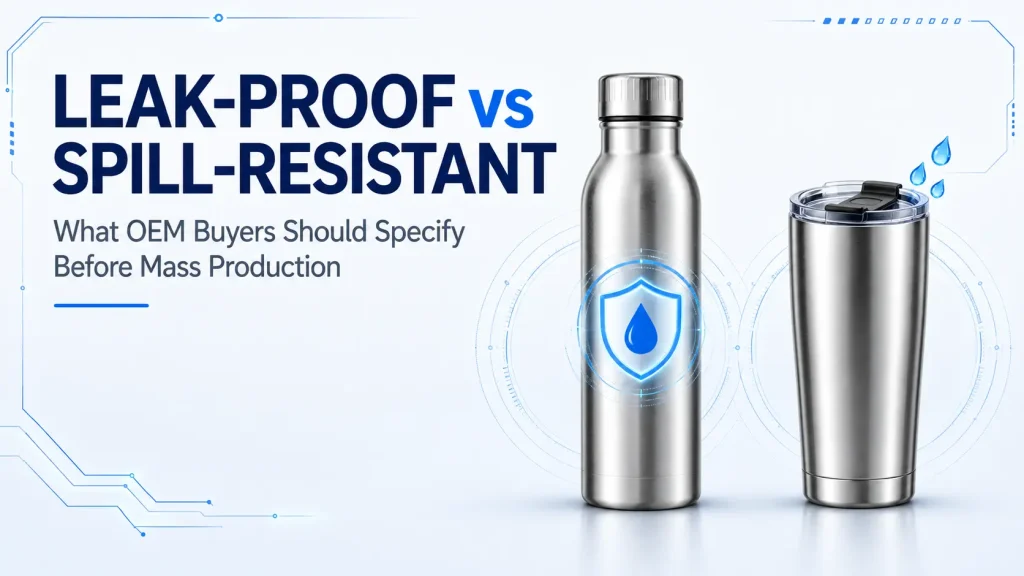
A stainless steel bottle can have the correct stainless steel material, an attractive and durable coating, a clean custom logo and good insulation—and still generate complaints because the lid leaks.
For buyers, the difficulty is that words such as “leak-proof,” “spill-resistant,” “splash-resistant” and “travel-safe” are often used without clear test conditions. A lid may perform well when the bottle remains upright on a desk but release liquid when placed horizontally in a bag. Another may pass a room-temperature water test but leak after being filled with a hot beverage. A straw lid may seal correctly only when the mouthpiece is fully closed, while a sliding tumbler lid may be designed to reduce splashes rather than withstand inversion.
The useful question is therefore not simply:
Is this lid leak-proof?
It is:
In which position, with which liquid, at what temperature, for how long and after how many use cycles should the finished product remain sealed?
For an OEM or private-label project, leak resistance should be treated as a measurable product requirement—not as a vague catalog description.
This guide explains how lid design affects sealing, why samples and mass production may perform differently, which tests buyers should consider, and what should be written into the product specification before production begins.
The Short Answer
A drinkware lid should be described according to its intended use and verified performance.
- Leak-proof normally means the fully closed product is intended to prevent liquid from escaping under defined conditions, which may include horizontal carrying or inversion.
- Spill-resistant normally means the lid helps reduce accidental splashes during normal upright use, but it may not be suitable for carrying inside a bag.
- Splash-resistant generally refers to limiting liquid movement through a drinking opening while the product is upright or being moved gently.
- Open drinking modes—including an open straw, raised spout or uncovered sipping port—should not be assumed to remain sealed.
These terms are useful only when the supplier and buyer agree on:
- The lid’s fully closed position
- The filling level
- The test liquid
- The liquid temperature
- The bottle orientation
- The test duration
- Any shaking, impact or pressure condition
- The number of opening and closing cycles
- The acceptable result
A single sample that does not leak once is not enough to establish reliable mass-production performance.
Leak-Proof and Spill-Resistant Are Not the Same
The distinction matters because different drinkware products are designed for different user behaviors.
A commuter bottle may be expected to lie horizontally in a backpack. A handled tumbler may normally remain upright in a car cup holder. A desk mug may only need to reduce splashes during walking. A children’s straw bottle may need secure sealing after repeated drops and hundreds of opening cycles.
If these products are all marketed with the same “leak-proof” claim, the claim may create expectations that the design was never intended to meet.
A Practical Performance Hierarchy
| Description | Normal expectation | Typical use | Suitable for carrying inside a bag? |
|---|---|---|---|
| Open cup or open tumbler | No sealing function | Desk, dining or controlled upright use | No |
| Splash-resistant lid | Reduces splashing through the drinking opening | Desk, events and short-distance carrying | Usually no |
| Spill-resistant lid | Helps limit accidental spills during normal upright use | Office, car cup holder and casual travel | Not unless specifically verified |
| Leak-resistant lid | Controls leakage under selected conditions, but limitations may apply | Daily carry with defined restrictions | Depends on the tested conditions |
| Leak-proof lid | Intended to remain sealed when fully closed under agreed conditions | Bags, commuting, school or outdoor use | Yes, if the actual product has been verified for that use |
This hierarchy is not a universal legal classification. It is a practical way for buyers and suppliers to discuss performance more precisely.
What Actually Makes a Drinkware Lid Seal?
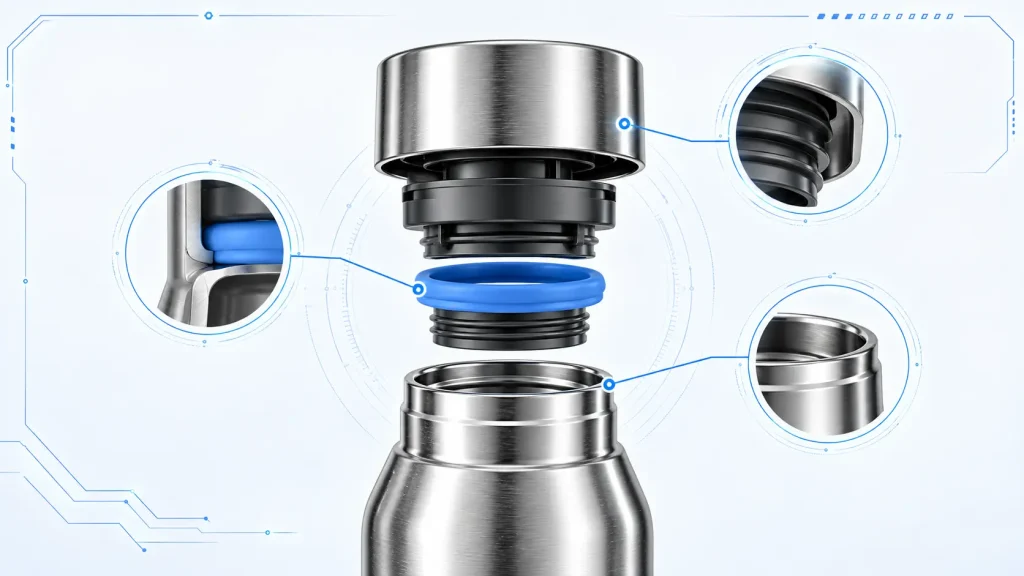

A reliable seal depends on the complete lid-to-bottle interface—not only one silicone gasket.
Leak resistance depends on the complete interface between the bottle and the lid. Improving one part cannot compensate for every other weakness.
1. The Main Gasket
The silicone gasket between the lid and bottle mouth is usually the primary seal. Its performance depends on:
- Cross-section and profile
- Diameter and dimensional tolerance
- Hardness and elasticity
- Compression after the lid is tightened
- Retention inside the gasket groove
- Resistance to heat, cleaning and repeated use
- Correct installation during assembly
A gasket that is too soft may deform or move out of position. One that is too hard may not compress sufficiently. If it is too small, twisted or installed unevenly, an otherwise well-designed lid can leak.
The gasket should also be removable enough for cleaning when the design requires it, but secure enough that it does not fall out unnoticed during washing.
2. Thread Fit and Neck Dimensions
For screw lids, the bottle neck and lid threads must engage smoothly and consistently.
Important variables include:
- Thread diameter and pitch
- Thread start position
- Roundness of the bottle mouth
- Neck height
- Sealing-surface flatness
- Plastic shrinkage after molding
- Dimensional variation between cavities or production batches
If the lid reaches its stopping point before the gasket is compressed correctly, tightening it further will not necessarily improve sealing. If the thread fit is too loose, the lid may feel unstable. If it is too tight, consumers may struggle to close or open it correctly.
3. Drinking Openings and Secondary Seals
Flip spouts, straws, sliders, buttons and rotating selectors introduce additional leakage paths.
A lid may therefore contain several separate seals:
- Main lid-to-bottle gasket
- Straw-port seal
- Spout valve
- Vent valve
- Slider seal
- Rotating-disc seal
- Hinge or button interface
Each path should be checked independently. A dual-drink lid, for example, may seal correctly around the bottle mouth while still leaking through the straw channel or direct-drink opening.
4. Air Vents and Pressure Management
Many drinking systems need an air vent to maintain smooth liquid flow. Without controlled airflow, users may experience slow pouring, interrupted flow or sudden “glugging.”
However, every vent is also a potential leakage path.
The design must balance:
- Drinking flow
- Pressure equalization
- Valve sensitivity
- Ease of cleaning
- Leakage control
Hot liquids can make this more demanding because the air inside the container may expand. A lid that performs well with cold water should not automatically be approved for hot beverages without separate evaluation.
5. Assembly and Closing Force
A good design can fail if the user cannot tell whether the lid is fully closed.
Buyers should review:
- Whether the lid closes with clear visual or tactile feedback
- Whether a spout, straw or selector can remain partially open
- Whether the required tightening force is reasonable
- Whether the lid can be cross-threaded
- Whether the closing direction is intuitive
- Whether the logo or handle position depends on final lid alignment
For suitable screw-lid projects, closing torque can be monitored during production. However, there is no single torque value that should be copied across all lids. The correct range depends on the thread, gasket, lid diameter, product design and intended user.
Comparing Common Drinkware Lid Types
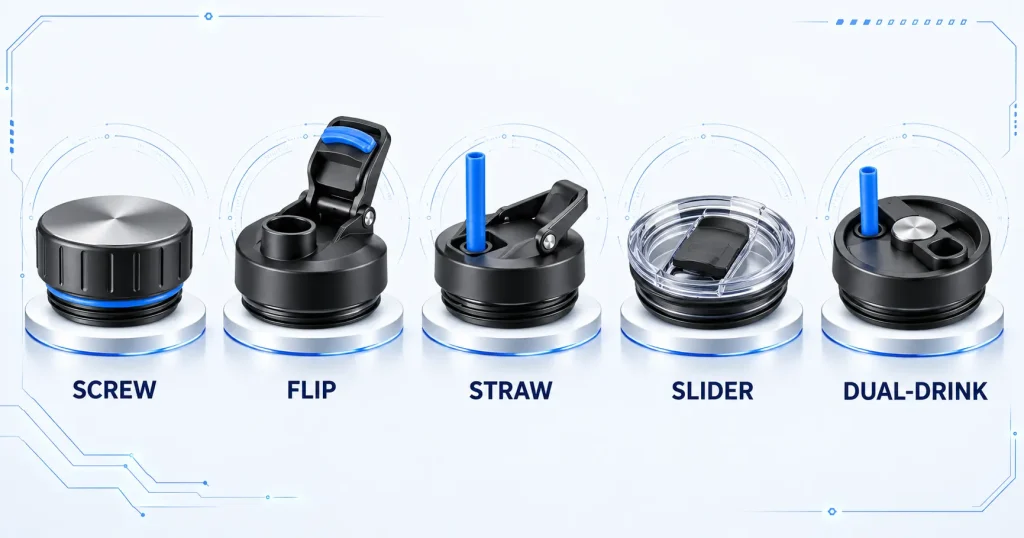

Different lid structures offer different levels of convenience, cleaning access and leakage control.
Screw Cap
A simple screw cap with a correctly designed gasket can provide strong sealing performance because it has relatively few moving parts.
Advantages:
- Simple structure
- Good potential for leak-proof performance
- Easy to understand
- Relatively straightforward to clean
Points to check:
- Thread consistency
- Gasket compression
- Opening and closing force
- Cross-threading risk
- Carry-loop or handle strength, where applicable
Flip-Top or Spout Lid
A flip-top lid allows convenient one-handed drinking and is common in sports, school and outdoor bottles.
Advantages:
- Fast access
- Protected drinking surface when closed
- Suitable for active use
Points to check:
- Spout plug or valve compression
- Hinge durability
- Locking mechanism
- Vent sealing
- Cleaning access around the spout
The closed position should be obvious. A lid that looks closed while the spout is not fully engaged creates a high complaint risk.
Straw Lid
Straw lids are popular for hydration bottles and handled tumblers, but their sealing performance varies significantly.
Advantages:
- Convenient drinking without tipping the bottle
- Suitable for sports and driving
- Strong consumer familiarity
Points to check:
- Whether the straw opening seals when folded or covered
- Silicone valve performance
- Connection between the internal straw and lid
- Air-vent leakage
- Cleaning and replacement of the straw
Some straw lids are leak-proof only when the mouthpiece is fully closed. Others are primarily spill-resistant and should remain upright.
Slider Lid
Slider lids are often used on coffee tumblers and desk mugs.
Advantages:
- Easy sipping
- Simple visual operation
- Suitable for desk and car use
Points to check:
- Whether the slider is removable for cleaning
- Liquid trapped below the slider
- Steam and pressure behavior
- Whether the lid is press-fit or threaded
- Whether the product is genuinely intended for inversion
Many slider lids reduce splashes but are not designed to be carried horizontally. Calling them leak-proof without testing can create unrealistic expectations.
Push-Pull Sports Lid
Push-pull closures provide quick access for cycling, fitness and outdoor activities.
Advantages:
- Fast one-handed use
- Familiar sports-bottle function
- Good flow when open
Points to check:
- Force required to open and close the valve
- Valve wear after repeated cycles
- Dirt accumulation around the drinking tip
- Leakage when the valve is not pressed completely closed
- Suitability for hot liquids
Dual-Drink or Multi-Function Lid
A dual-drink lid may offer a straw mode and a direct-drink mode in one product. It can create meaningful differentiation for retail brands, but its additional components require more detailed validation.
Advantages:
- Multiple drinking experiences
- Strong retail and promotional differentiation
- Flexible use for different users and occasions
Points to check:
- Independent sealing of every drinking channel
- Selector alignment
- Accidental opening risk
- Interaction between the straw, vent and direct-drink path
- Ease of disassembly and cleaning
- Repeatability after prolonged use
Complexity is not automatically a weakness. It simply means that the test plan must reflect the complete structure rather than checking only the main gasket.
Why a Sample Can Pass but Mass Production Can Still Leak
An approved sample is important, but it represents only one set of components.
Mass production introduces variation from:
- Stainless steel forming and bottle-neck roundness
- Plastic molding shrinkage
- Different mold cavities
- Silicone gasket dimensions
- Component storage conditions
- Manual or automated assembly
- Closing force during testing
- Material changes between batches
- Wear in tooling
These variables are connected to the complete stainless steel water bottle manufacturing process, from body forming and plastic molding to component assembly and final inspection.
Suppose one sample uses a bottle neck near the middle of its dimensional tolerance and a gasket near the upper end of its thickness tolerance. The combination may seal perfectly. In mass production, a bottle neck at one end of the allowed range combined with a thinner gasket may produce less compression.
This is why leak resistance should be controlled through:
- Approved components and dimensions
- Written tolerances
- First-article checks
- In-process functional testing
- Representative final inspection
The approved sample remains the appearance and user-experience reference, but it should be supported by measurable requirements.
Recommended Leak-Resistance Tests Before Mass Production
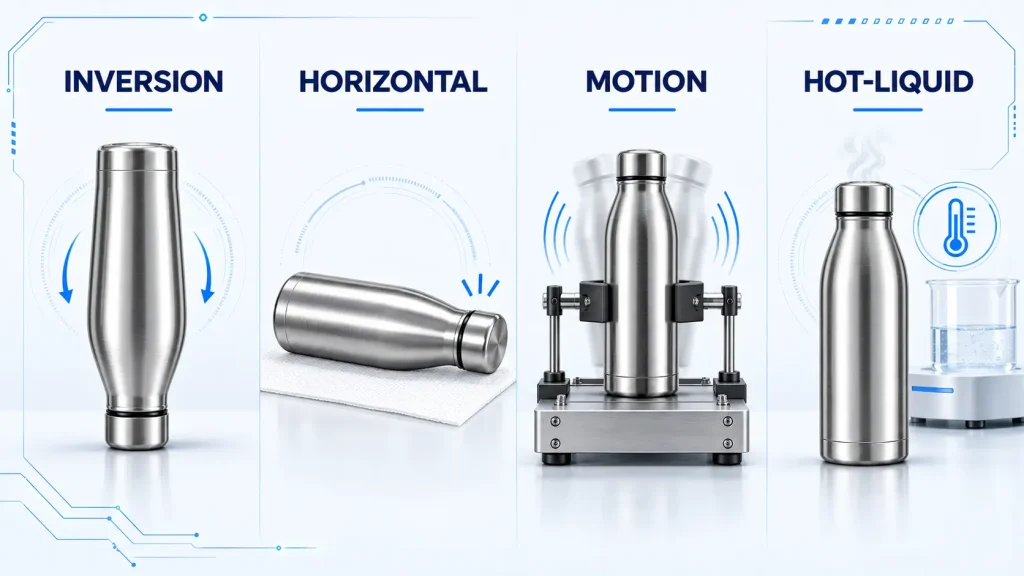

Test conditions should match the product’s intended use and be written into the approved specification.
There is no single test plan suitable for every bottle, tumbler or mug. The following methods can be combined according to the intended use.
1. Visual and Assembly Inspection
Before adding liquid, check:
- Gasket presence and correct orientation
- Gasket seating without twists or gaps
- Thread engagement
- Lid alignment
- Spout, slider or selector closure
- Cracks, flash or deformation on plastic parts
- Damage to the bottle mouth
This basic inspection often identifies assembly errors that would otherwise be described only as “random leakage.”
2. Inversion Test
Fill the product to the agreed level, close it according to the user instructions and invert it for a defined period.
The specification should state:
- Water quantity or filling percentage
- Water temperature
- Closing method or torque condition, where relevant
- Inversion angle
- Test time
- Acceptable result
Avoid writing only “100% leak-proof test.” The test should be reproducible by the factory, inspector and buyer.
3. Horizontal Rest Test
Place the filled product horizontally on absorbent paper or another visible inspection surface for a defined time.
This test is particularly relevant for bottles intended to be carried inside backpacks, handbags or laptop bags.
The test should include the complete retail configuration, including the production lid, gasket, straw and any selector components.
4. Shaking or Motion Test
A stationary bottle may not reveal leakage caused by movement. A controlled shaking test can simulate part of the stress experienced during carrying.
The buyer and supplier should agree on:
- Fill level
- Liquid temperature
- Shaking direction and intensity
- Duration or number of cycles
- Rest period before inspection
The objective is repeatability, not simply shaking one bottle by hand until it appears acceptable.
5. Hot-Liquid Test
If the product is intended for coffee, tea or other hot beverages, it should be evaluated at an agreed temperature appropriate for its intended use.
Hot-liquid testing can reveal:
- Increased internal pressure
- Changes in silicone flexibility
- Plastic distortion
- Steam release through vents
- Differences in opening force
- Liquid discharge when the lid is opened
This test requires controlled handling. A sealed container should never be opened carelessly after hot-liquid testing because pressure may have developed inside.
6. Opening and Closing Cycle Test
A new lid may seal well but lose performance after repeated use.
Cycle testing may cover:
- Screw-lid opening and closing
- Flip-spout movement
- Straw-mouthpiece folding
- Slider operation
- Button or lock activation
- Rotating-selector movement
After the agreed number of cycles, repeat the leakage test and inspect the gasket, hinge, valve and closing feel.
The cycle count should reflect the product positioning. A short promotional campaign and a premium retail bottle may justify different durability requirements.
7. Drop and Post-Impact Leakage Test
A bottle may remain visually attractive after a drop but develop a small sealing problem because the lid, hinge, bottle mouth or thread has shifted.
If drop resistance is relevant, define:
- Filled or empty condition
- Drop height
- Impact surface
- Product orientation
- Number of drops
- Allowed cosmetic damage
- Functional requirements after impact
Leakage testing should be repeated after the drop sequence. A product should not be described as bag-safe after impact unless that condition has been evaluated.
8. Temperature-Aging and Cleaning Evaluation
Heat, detergent and repeated cleaning may affect plastic parts and silicone seals.
If a product will carry a dishwasher-safe claim, the claim should be assessed for the complete decorated product—not assumed from the stainless steel body alone.
After aging or cleaning cycles, inspect:
- Gasket elasticity
- Plastic deformation
- Seal compression
- Lid fit
- Valve performance
- Odor retention
- Logo and coating condition
- Leakage performance
Test the Intended Beverage—not Only Cold Water
Cold water is a sensible baseline, but the intended beverage can change performance and cleaning requirements.
Buyers should tell the supplier if the bottle may be used for:
- Hot coffee or tea
- Milk-based drinks
- Juice or acidic beverages
- Electrolyte or sports drinks
- Carbonated beverages
- Thick smoothies or protein drinks
Do not assume a sealed bottle is suitable for carbonated liquids. Carbonation can create internal pressure, and many conventional lids are not designed or validated for it. Suitability should be specifically confirmed for the complete product.
The intended beverage also affects valve design, odor retention, cleaning access and material verification. Buyers should review the complete product—not only the stainless steel body—when assessing FDA, LFGB and other food-contact requirements.
What Should Be Checked During Sample Approval?
Before approving an OEM drinkware sample, buyers should confirm more than whether it leaks during one quick test.
Lid and User Experience
- Is the fully closed position clear?
- Can the lid be cross-threaded?
- Is the opening force suitable for the intended user?
- Can the product be operated with one hand if required?
- Does the handle interfere with opening or closing?
- Does the lid align correctly with the logo or drinking position?
- Are all drinking surfaces protected when closed?
Cleaning and Maintenance
- Can the gasket be removed and reinstalled correctly?
- Are hidden liquid traps present?
- Can the straw, valve and vent be cleaned?
- Are replacement straws or gaskets required?
- Will the user understand how to reassemble the lid?
Performance
- Does it remain sealed when inverted?
- Does it remain sealed horizontally?
- Does shaking affect the result?
- Is the performance different with hot and cold liquids?
- Does the lid continue to seal after repeated cycles?
- Does impact change the sealing performance?
Production Control
- Are critical dimensions identified?
- Are the gasket material and dimensions fixed?
- Are approved production components being used?
- Is a first-production sample required?
- What sampling level will be used for final inspection?
- What result constitutes a defect?
How to Write a Better Leak-Proof Requirement
A weak specification might state:
Lid must be leak-proof.
This does not define how the result will be assessed.
A more useful requirement might state:
When filled with the agreed volume of room-temperature water and fully closed according to the approved user instructions, the finished bottle must show no visible leakage during the agreed inversion and horizontal-rest tests. The same functional test will be repeated after the defined opening-and-closing cycle test. Hot-liquid performance, where required, will be evaluated separately under agreed conditions.
The final production specification should include the actual quantities, temperatures, durations, cycles, sampling plan and acceptance criteria agreed for that product.
This approach makes expectations clearer for the buyer, manufacturer and inspection company.
Mass-Production Quality Control for Lids
Leak testing should not be postponed until the order is completely packed.
A practical control plan may include:
Incoming Components
- Confirm lid model and color
- Check silicone gasket material and dimensions
- Inspect plastic molding condition
- Verify straws, valves and accessories
- Separate damaged or deformed components
First Production Pieces
- Assemble lids onto production bottle bodies
- Check thread fit and gasket compression
- Confirm lid and logo alignment where required
- Test every drinking mode
- Perform the agreed functional tests
In-Process Checks
- Monitor gasket installation
- Check closing function and tactile feedback
- Test representative units from different times, lines or component batches
- Record recurring defects and corrective actions
Final Inspection
- Use representative random samples from finished cartons
- Confirm that the test samples include different colors and production batches where relevant
- Check appearance, assembly and function together
- Record test conditions and results
- Rework or investigate failed units before shipment release
For a broader view of production control, see our guide to quality control for custom stainless steel drinkware.
Choosing the Right Lid for the Sales Channel
Promotional Merchandise
Promotional projects often prioritize cost, logo visibility, broad user appeal and delivery speed.
A simple, reliable lid may create more value than a complex feature that increases assembly risk. Buyers should also consider whether recipients will receive clear care instructions and whether replacement components are practical.
Retail Brands
Retail products face stronger consumer comparison and review pressure. Lid experience can influence ratings as much as insulation or appearance.
Retail buyers should consider:
- Distinctive but intuitive function
- Bag-carry expectations
- Long-term cycle performance
- Cleaning access
- Replacement gaskets or straws
- Accurate packaging claims
Corporate Gifts and Employee Kits
These projects often need a balance of presentation, reliability and broad usability. A bottle that leaks inside an employee’s laptop bag can damage both the product experience and the gifting brand.
If the bottle will be included in a gift set, test it after the complete packaging and transport process. The packaging should protect both the bottle body and lid while maintaining a practical balance between presentation, carton efficiency and landed cost; see our custom drinkware packaging guide for a detailed comparison.
Children’s Drinkware
For children, buyers should pay particular attention to:
- Opening force
- Small removable components
- Straw and valve security
- Drop resistance
- Cleaning access
- Gasket retention
- Intended age group
- Applicable market requirements
A leak-proof claim should not replace a complete product-safety review.
What OEM Buyers Should Include in the RFQ
To receive an accurate lid recommendation and quotation, provide the information below. For the complete product brief—not only the lid—use our custom stainless steel drinkware quotation checklist.
- Product type and capacity
- Intended user and use scenario
- Required drinking method
- Expected carrying position
- Leak-proof, leak-resistant or spill-resistant requirement
- Hot- or cold-drink use
- Intended beverages
- One-handed opening requirement
- Handle, carry loop or lock requirement
- Straw material and length
- Cleaning and dishwasher expectations
- Required opening and closing cycles
- Drop or impact requirement
- Target market
- Required food-contact documentation
- Order quantity and quantity per color
- Custom lid color requirements
- Logo position relative to the lid or handle
- Packaging and user-instruction requirements
- Required inspection and acceptance criteria
If you are unsure which lid is suitable, describe the real use scenario rather than selecting a lid only from a catalog image.
For example:
We need a 600 ml insulated bottle for commuters. It will be carried inside a backpack, used mainly for cold water, opened with one hand and sold through retail and e-commerce in the UK.
This is more useful than simply asking for “a leak-proof sports lid.”
Frequently Asked Questions
Are all straw lids leak-proof?
No. Some straw lids seal when the mouthpiece is fully folded or covered, while others are designed mainly to reduce spills during upright use. The main gasket, straw opening, valve and vent should all be evaluated.
Can a tumbler with a slider lid be leak-proof?
Some designs provide strong sealing, but many slider lids are intended primarily for splash resistance. Buyers should not assume that a handled tumbler or coffee cup can be carried horizontally unless the finished product has passed the agreed test.
Why does a bottle leak only when filled with hot water?
Heat can change internal pressure, silicone flexibility and plastic dimensions. Steam or expanding air may also move through vents or drinking openings. Hot-use products should be tested under controlled conditions appropriate for their intended use.
Does tightening the lid more always stop leakage?
No. Excessive tightening cannot correct an incorrectly installed gasket, damaged thread, deformed bottle mouth or poorly designed seal. It may also make the product difficult to open or damage components.
Should every bottle be leak-tested?
The appropriate inspection method depends on product risk, design, order size, production process and buyer requirements. Some projects use defined in-line testing combined with representative final sampling; higher-risk products may justify more extensive inspection. The plan should be agreed before production.
Is food-grade silicone enough to guarantee a reliable gasket?
No. Material suitability is important, but sealing also depends on gasket profile, dimensions, hardness, compression, installation and long-term performance. Food-contact documentation and functional testing address different questions.
Can a leak-proof bottle be used for carbonated drinks?
Not automatically. Carbonated beverages can create pressure inside the container. Use should be allowed only when the complete bottle and lid have been specifically designed and evaluated for that purpose.
Can one lid fit several bottle sizes?
Yes, if the bottle models share a compatible neck finish and the complete combinations have been verified. Buyers should still approve every intended bottle-and-lid combination because differences in neck dimensions, bottle shape, straw length and user behavior may affect performance.
Final Thoughts
Leak resistance is not determined by one gasket or one successful sample.
It is the result of a complete system: bottle-neck dimensions, thread fit, gasket design, drinking openings, vents, plastic components, assembly, user operation and production consistency.
For OEM buyers, the most reliable approach is to define the real use scenario first. Decide whether the product will remain upright on a desk, sit in a car cup holder, travel inside a backpack, hold hot coffee or be used by children. Then select the lid structure and test conditions that match that scenario.
Clear terminology also protects the brand. If a lid is designed to reduce splashes but not withstand inversion, describe it accurately. If bag-safe leak-proof performance is essential, write the condition into the specification and verify it again during mass production.
Funzlife supports brands, importers, retailers and promotional product companies with custom stainless steel drinkware, including bottle and lid selection, custom colors, logo decoration, packaging, sampling and production coordination.
Explore our insulated water bottles or contact us with your product reference, target market, quantity and intended use. We can help compare suitable lid structures and prepare a practical sampling and production plan for your project.