“Is this bottle FDA and LFGB certified?” is one of the most common questions in custom drinkware sourcing.
It is also one of the easiest questions to answer badly.
A supplier may send a one-page certificate, show an FDA logo on a product page, or say that the stainless steel is “food grade.” None of these statements, by itself, proves that the finished custom bottle is suitable for the buyer’s intended market and use.
A reusable bottle is a multi-material food-contact article. It may combine a stainless steel inner wall, a plastic lid, a silicone gasket, a straw, a valve, pigments, coatings, and printing. Each component has its own material formulation and intended conditions of use. Customization can change that compliance picture.
The practical question is therefore not simply:
Does the factory have an FDA or LFGB certificate?
It is:
Do the materials, components, and finished configuration in my order have appropriate compliance evidence for my target market and intended use?
This guide explains how B2B buyers can answer that question before approving a custom stainless steel bottle or tumbler project.
First, “FDA” and “LFGB” Are Not the Same Type of Requirement
The terms are often placed next to each other in supplier catalogs, but they belong to different regulatory systems.
What FDA compliance means in the United States
The U.S. Food and Drug Administration regulates substances used in food-contact applications under the Federal Food, Drug, and Cosmetic Act and related provisions in Title 21 of the Code of Federal Regulations.
The FDA does not normally issue one universal “FDA-approved bottle certificate” for a finished reusable water bottle. The regulatory status of the finished article depends on the status of the individual substances that may reasonably migrate into food under the intended conditions of use.
According to the FDA, a food-contact substance may be covered by an applicable regulation, an effective Food Contact Substance Notification, a Threshold of Regulation exemption, a prior sanction, or another recognized legal basis. The identity of the substance, its specifications, and its limitations of use all matter.
For buyers, this means that the phrase “FDA compliant” should be supported by component-level material information and documentation—not only a logo or a generic statement.
Official reference: FDA guidance on determining the regulatory status of food-contact material components.
What the EU framework requires
In the European Union, Regulation (EC) No. 1935/2004 provides the general framework for food-contact materials and articles.
Under normal or foreseeable conditions of use, a food-contact material must not transfer constituents to food in quantities that could
- Endanger human health
- Cause an unacceptable change in the composition of the food
- Impair its taste, odor, or other organoleptic properties
The EU framework works together with Regulation (EC) No. 2023/2006, which covers good manufacturing practice for food-contact materials.
For plastic parts, Regulation (EU) No 10/2011 establishes specific rules, including authorized substances, migration limits, and Declaration of Compliance requirements at non-retail stages.
That distinction matters for a bottle. The stainless steel body, PP or Tritan lid, silicone seal, and printed decoration are not automatically covered by one identical test method or document.
What “LFGB tested” usually means
LFGB is the common abbreviation for the German Food, Commodities, and Feed Code. In international drinkware trade, “LFGB certified” is often used as shorthand for testing intended to demonstrate suitability for the German market.
However, there is no single universal LFGB product certificate issued by the German government for every reusable bottle.
Germany applies the EU food-contact framework together with national law. The German Federal Institute for Risk Assessment, or BfR, also publishes material-specific recommendations for areas that are not fully harmonized at the EU level, including certain silicones, rubbers, and papers.
Importantly, BfR states that its recommendations are not legally binding standards. They represent the current state of science and technology and can be used to assess whether particular materials meet the safety objectives of the EU framework and German law.
Official reference: BfR Recommendations on Food Contact Materials.
The useful buyer question is therefore not “Do you have LFGB?” but
Which components were tested, under which requirements and test conditions, and does the report match the product I am ordering?
A Custom Bottle Must Be Reviewed as a System
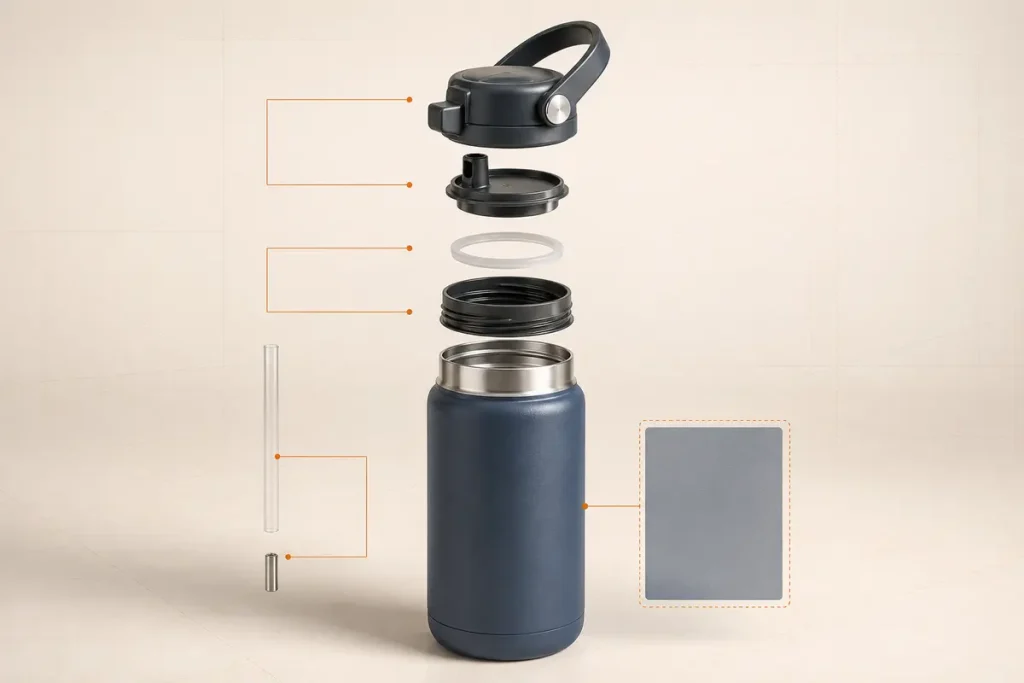
Consider a typical 650 ml vacuum-insulated bottle:
| Component | Possible material | Food-contact relevance |
|---|---|---|
| Inner wall and drinking rim | 304 stainless steel | Direct contact with the beverage and mouth |
| Outer wall | Stainless steel with coating | Usually indirect, but rim and transition areas require attention |
| Lid body | PP, Tritan or another polymer | Direct or foreseeable beverage contact |
| Gasket and valve | Silicone or elastomer | Direct contact and repeated compression |
| Straw | PE, PP, Tritan, silicone or metal | Direct beverage contact |
| Spring, pin or insert | Stainless steel or another metal | May be exposed depending on the lid design |
| Logo and decoration | Ink, laser marking or coating | Usually external, but placement and foreseeable transfer still matter |
A report covering only the stainless steel sheet does not establish compliance for the assembled lid. A plastic resin declaration does not prove that the finished colored lid has been assessed under the correct conditions. A test report for a standard black bottle may not automatically cover a newly developed beige lid, silicone valve, and printed drinking rim.
This is why an accurate quotation and compliance review both start with a complete specification. Our guide to requesting an accurate custom drinkware quotation explains the product details that should be confirmed before sampling.
Five Ways Customisation Can Change the Compliance Scope
1. A custom lid colour can change the material formulation
Changing a lid from stock black to a custom Pantone color is not only a visual change. The color masterbatch and pigments become part of the plastic formulation.
The base polymer may remain the same, but the compliance evidence should still be reviewed to determine whether the new color is covered. The same applies to silicone gaskets and straws. A supplier should not assume that one report for a natural or white component automatically covers every possible color.
This is also one reason custom lid colors often have a separate minimum order quantity. The relationship between component production and final order quantity is explained in our custom water bottle MOQ guide.
2. A new lid structure creates new contact points
A simple screw cap may contain only a lid body and gasket. A push-button or straw lid may include several molded parts, a silicone valve, a metal spring, and hidden internal channels.
Every new part creates a possible food-contact surface, migration consideration, cleaning challenge, or material traceability requirement. A completely new lid should therefore be evaluated as a new system, not treated as a cosmetic variation of the bottle body.
3. Printing near the rim requires closer review
Laser engraving on the external body is different from full-wrap UV printing, a coated drinking rim, or decoration close to the mouth.
Buyers should confirm the print area and foreseeable contact during drinking, filling, washing, stacking, and packaging. If decoration is positioned close to a food-contact or lip-contact area, the laboratory or compliance specialist should determine whether additional evaluation is needed.
4. Intended use changes the test conditions
A report is meaningful only when its test conditions are relevant to the product’s intended use.
A bottle intended only for cold water presents a different use case from a tumbler designed for hot coffee, acidic beverages, or repeated dishwasher cleaning. Time, temperature, food type, and repeated-use cycles can affect the appropriate migration or performance test conditions.
The FDA, for example, categorizes food types and conditions of use when assessing food-contact substances. EU testing also uses defined simulants, contact times, and temperatures.
A buyer should, therefore, state the following:
- Whether the product is for hot, cold or both types of beverages
- The expected maximum filling temperature
- Whether acidic, alcoholic or dairy drinks are intended
- Whether the product is reusable and dishwasher-safe
- Whether it is designed for children or another sensitive user group
5. A material or supplier change can invalidate earlier assumptions
The bottle may look identical even after the resin supplier, silicone formulation, coating powder, or steel source has changed.
That is why report age alone is not the best validity check. There is no universal rule that every report automatically expires after a fixed number of months. More important questions are the following:
- Has the material formulation changed?
- Is the named material supplier still the same?
- Does the report identify the same product or component?
- Are the cited regulations and test methods still current?
- Do the intended use conditions still match?
A three-year-old report for an unchanged material may remain useful supporting evidence, while a recent report for a different resin, color, or lid structure may be irrelevant to the current order.
What Documents Should a Buyer Request?
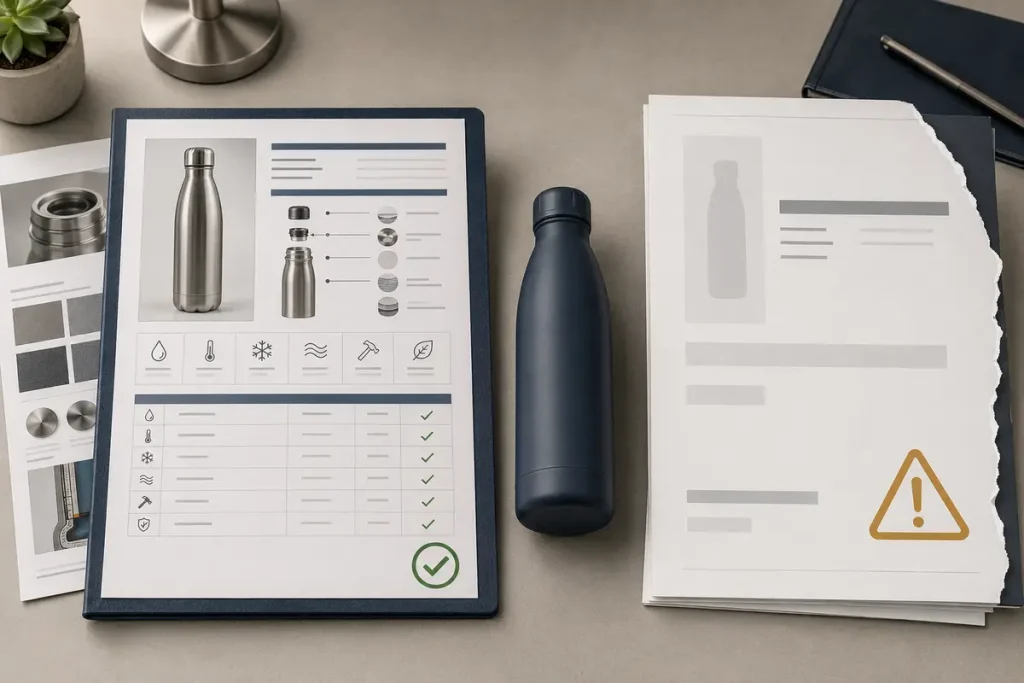
A strong compliance file is a chain of evidence. The exact documents depend on the target market, materials, and retailer requirements, but the following structure is a useful starting point.
1. Final product specification and food-contact map
The specification should identify the bottle model, capacity, materials, lid version, gasket, straw, colors, surface finish, and intended use.
It should also show which surfaces have direct, indirect, or foreseeable contact with the beverage or user’s mouth.
2. Bill of materials and component declarations
Request material specifications or supplier declarations for all relevant components. For an EU plastic food-contact part, the appropriate Declaration of Compliance and supporting information should be available through the supply chain.
The commercial buyer may not receive every confidential formulation detail, but the supplier should be able to establish the regulatory basis and traceability of the materials used.
3. Complete laboratory reports
Do not review only the report cover page or a cropped “PASS” screenshot. Check the complete report for:
- Laboratory name and report number
- Issue date
- Applicant and manufacturer information, where shown
- Product name, model, photographs and sample description
- Materials and colours tested
- Regulations, standards and test methods used
- Food simulants, time and temperature conditions
- Number of repeated-use cycles, where relevant
- Detection limits, measured results and pass/fail conclusions
If the model photo, color, or component description does not match the order, ask the supplier or laboratory to explain the basis on which the report is considered applicable.
4. Change-control confirmation
The approved sample should be linked to the materials and component versions used in mass production. Any change to resin, pigment, gasket, coating, steel grade, or supplier should trigger a documented review.
This is where compliance control connects with production quality control. Our article on quality control for custom stainless steel drinkware explains how an approved sample should be converted into measurable production standards.
5. Batch and production traceability
For repeat orders, the supplier should be able to connect raw materials, component batches, production dates, and finished goods. Traceability makes it possible to investigate a complaint or isolate an affected batch without treating every order as identical.
Do Not Confuse Product Compliance with Factory Credentials
Several documents may be valuable during supplier evaluation, but they answer different questions.
| Document or claim | What it can indicate | What it does not prove by itself |
| BSCI or Sedex audit | Social compliance practices at a facility | Food-contact safety of the bottle |
| ISO 9001 | Quality-management system | Compliance of a specific product or material |
| GRS or RCS | Recycled-content chain of custody | Suitability of recycled material for food contact |
| Material certificate | Nominal material grade or composition | Migration performance of the assembled product |
| Laboratory test report | Results for the tested sample and scope | Automatic coverage of every colour, lid or future batch |
| CE marking | Compliance where relevant EU CE legislation applies | General food-contact approval for a standard non-electrical bottle |
A responsible supplier should not use one type of document as a substitute for another.
A Practical Example: Reviewing a Custom Bottle Order
Imagine a brand orders the following product:
- Existing 650 ml stainless steel vacuum bottle
- Four custom powder-coated body colours
- One custom-coloured push-button lid
- Silicone gasket and straw
- Full-colour UV logo
- Printed retail box
The compliance review should not stop at an existing report for the stainless steel body.
The buyer and supplier should confirm:
- Whether the inner steel and drinking rim are covered by appropriate material and finished-product evidence.
- Whether the exact plastic lid resin and new color masterbatch have a suitable regulatory basis.
- Whether the silicone gasket and straw are covered for the intended beverage temperature and repeated use.
- Whether the UV print remains outside direct and foreseeable food or lip contact.
- Whether the approved sample and mass-production materials will be controlled under the same specifications.
- Whether the target retailer or importer requires additional market-specific tests or documentation.
If the buyer later changes the lid supplier, switches the gasket color, or moves the logo closer to the rim, the compliance file should be reviewed again.
Special Note on the EU’s Updated BPA Rules
The EU adopted Regulation (EU) 2024/3190, which restricts the use of BPA and certain other bisphenols in food-contact materials and articles. The regulation includes application-specific requirements, supporting-document obligations, and transitional provisions.
For new drinkware projects, “BPA-free” should therefore not be treated only as a marketing phrase. Buyers should ask how the supplier verifies the relevant plastic, silicone, coating, adhesive, or ink components and whether the supporting documents match the current formulation.
Because regulatory requirements and transition periods can change, the final test program should be confirmed with the importer, retailer, or qualified laboratory for the exact market and launch date.
What About the UK?
Great Britain maintains its own food-contact regulatory framework and official registers, while Northern Ireland may follow a different route for some requirements. Buyers should not assume that one EU report automatically completes every UK obligation.
For plastic food-contact materials, the UK Food Standards Agency maintains an official register and guidance for authorized substances in Great Britain. The importer or testing laboratory should confirm which UK requirements apply to the product at the planned time of market entry.
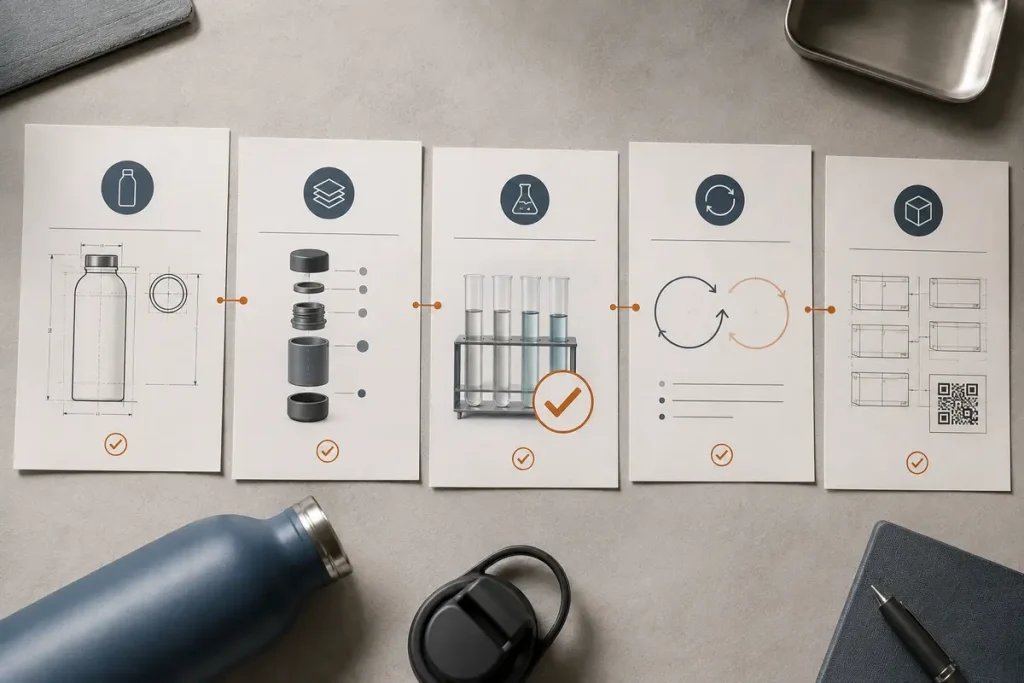
Seven Red Flags in Supplier Compliance Documents
Be cautious when:
- One report is claimed to cover an entire catalog of unrelated products.
- Only the certificate cover page is provided, and the test scope is hidden.
- The report photographs or model numbers do not match the quoted bottle.
- The lid report covers only the base polymer and does not identify the actual colored component.
- The supplier cannot explain the simulants, time, or temperature used.
- A BSCI, ISO, or CE document is presented as proof of food-contact compliance.
- Material substitutions are allowed after sample approval without written review.
These points do not automatically mean that the product is non-compliant. They mean the evidence is incomplete and should be clarified before the deposit, not after production.
A Better Compliance Question for Your Next RFQ
Instead of asking only, “Do you have FDA and LFGB certificates?”, Send a more specific request:
Please provide the available food-contact compliance documents for the exact bottle body, lid, gasket, and straw. Please confirm the materials and colors covered, the target market, the test conditions, and whether the reports remain applicable after our requested customization.
This question gives the supplier enough information to review the project properly and makes competing quotations easier to compare.
Final Thoughts
Food-contact compliance is not a badge attached to a bottle. It is a documented relationship between the product configuration, component materials, intended use, target market, and production controls.
FDA, EU, and German requirements should not be reduced to interchangeable logos. The useful evidence is the material-specific documentation and test scope behind the claim.
For brands, importers and promotional distributors, the most effective approach is to define the market and use conditions early, map every food-contact component, review the complete reports, and control material changes after sample approval.
At Funzlife, we help buyers review bottle models, lid structures, materials, decorations, and packaging before sampling begins. If you are developing a custom stainless steel bottle or tumbler, send us your target market, product specifications, and customization requirements for a practical documentation review.
This article provides general sourcing information and is not legal advice. Final compliance responsibility and test requirements should be confirmed with the importer, retailer, accredited laboratory, or qualified regulatory specialist in the target market.