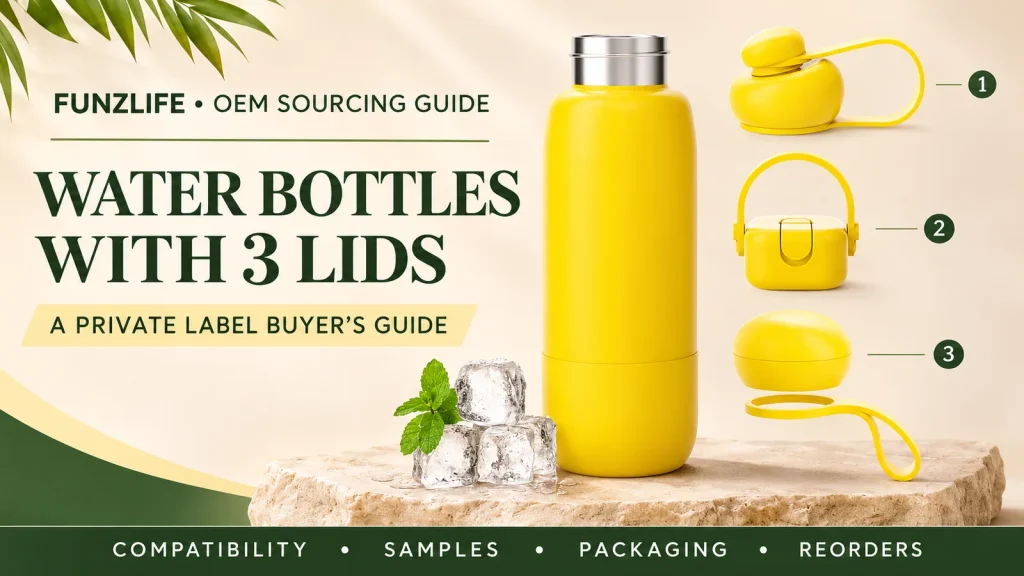
A water bottle with three interchangeable lids can give one body several use cases. It may serve commuters, outdoor users, and sports customers without requiring three separate bottle designs. For a private-label buyer, however, the extra flexibility also creates more components, combinations, and approval points.

The sourcing question is not simply, “Does it include three lids?” Buyers need to define how the set will be sold, which lid fits each capacity, what each configuration is expected to do, and how every component will be packed and reordered.
Choose the Commercial Format First
Start with the offer you want the customer to receive.
| Format | What the customer buys | Main sourcing implication |
|---|---|---|
| Complete three-lid set | One bottle plus all three lids | Higher pack-out complexity; every lid and accessory must be present. |
| Buyer-selected lid | One bottle plus one chosen lid | More quotation and SKU combinations; simpler unit packaging |
| Bottle plus accessory range | One standard bottle, with extra lids sold separately | Requires replacement-part packaging, labels, and reorder control |
A complete set can create a strong gift or retail proposition. A selected-lid program may be better for promotions where unit cost and packing efficiency matter. Separate accessory SKUs can support repeat sales, but only if lid compatibility and future supply are controlled.
Funzlife’s 3-in-1 stainless steel water bottle with three lids is available in 18, 24, and 32 oz versions. Its handle, loop, and sport lids illustrate how one bottle family can address different carrying and drinking preferences. Buyers should still approve the exact commercial set rather than assume every possible combination is included in one quotation.
Build a Lid-to-Bottle Compatibility Matrix
“Interchangeable” should be documented, not inferred from appearance. Two lids may look similar while using a different thread diameter, thread start, gasket position, or stopping point. The same lid may fit several capacities, but a straw or internal tube may require a different length.
Create a matrix before sampling:
| Bottle capacity and revision | Handle lid code. | Loop lid code | Sport lid code | Straw or tube code |
|---|---|---|---|---|
| 18 oz | Confirm | Confirm | Confirm | Confirm length. |
| 24 oz | Confirm | Confirm | Confirm | Confirm length. |
| 32 oz | Confirm | Confirm | Confirm | Confirm length. |
Replace “Confirm” with the supplier’s controlled component codes. Add the gasket, valve, plug, and any removable small parts to the bill of materials. If colors change, record the color version as well as the mold or component revision.
This prevents a common problem: approving one bottle with one lid, then assuming the other eight capacity-and-lid combinations behave identically.
Test Every Configuration You Will Sell

Each sellable combination deserves a production-representative sample. Check the actual bottle body, lid, gasket, straw or spout, silicone boot, logo, and packaging—not a mixture of provisional parts.
For each configuration, define:
- the fully closed position and correct assembly sequence;
- opening, closing, and carrying behavior;
- leakage conditions, including fill level, liquid temperature, orientation, duration, and any movement;
- repeated opening and closing where relevant;
- gasket retention and access for cleaning;
- hot- or cold-drink limits and care instructions;
- Handle, loop, spout, and straw checks are appropriate to the intended use;
- bottle height and clearance after the selected lid is installed.
One lid may be designed for sealed carrying while another is intended for quick drinking in an upright position. Do not apply one “leak-proof” statement to all three without verifying the complete products under defined conditions. The OEM guide to leak-proof and spill-resistant lids provides a more detailed test brief.
Thermal claims should also identify the tested lid. The vacuum body may be unchanged, but the drinking opening, internal air space, and seal design can influence the finished product’s measured performance.
Control Custom Colors and Branding by Component
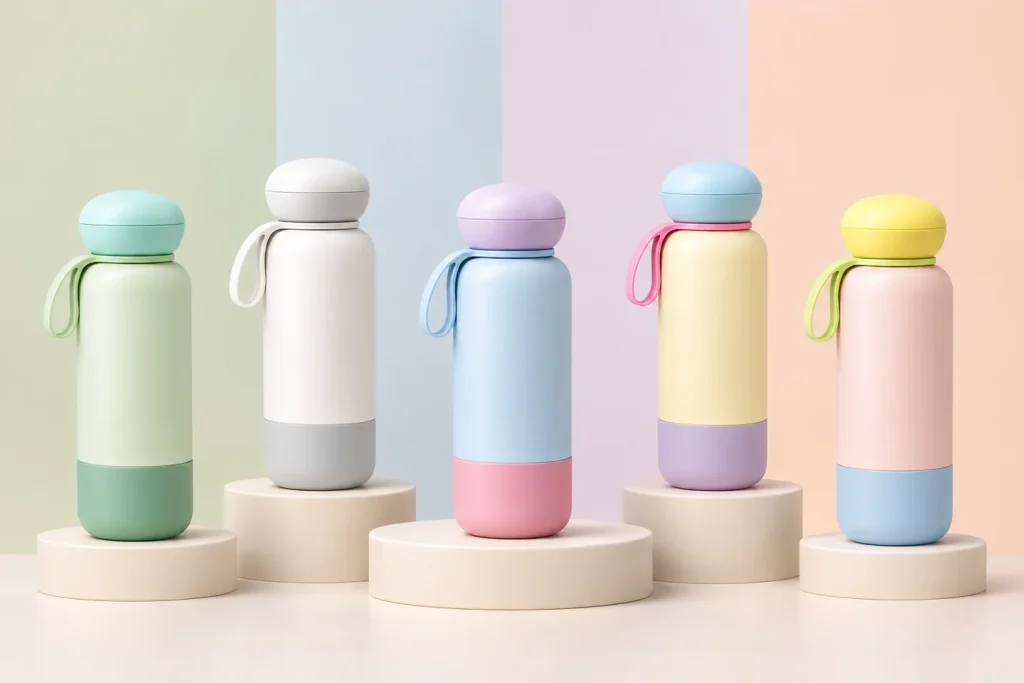
A multi-lid set contains several material surfaces: coated steel, molded plastic, silicone, and sometimes a metal insert. The same color reference can look different on each one because of gloss, texture, pigment, and substrate.
Decide whether the lids will be neutral, matched to the bottle body, or used as contrasting accents. Retain physical approval samples and identify the master color reference. The custom water bottle color-matching guide explains why a Pantone number alone does not guarantee an identical appearance across materials.
Branding may be placed on the bottle body, lid, silicone boot, or packaging. Check the available decoration area on the real part and make sure the mark remains readable after assembly. A logo that looks centered on a flat drawing can appear misaligned beside a handle or drinking spout.
Custom-colored plastic lid parts may have a different practical minimum from the steel bottle coating. Ask for the MOQ and setup terms for every lid color, gasket color, body color, and packaging version. The custom water bottle MOQ guide explains how the highest component minimum can control the whole project.
Design the Pack-Out Around Three Lids
Three loose lids should not be dropped into a box around the bottle. They can scratch the coating, deform silicone parts, create noise, or be missed during packing.
Approve a pack-out diagram showing:
- Which lid is installed on the bottle
- where the other lids and small parts sit;
- whether each component needs a bag, sleeve, or divider;
- how the insert prevents movement and pressure;
- the included-parts checklist and SKU label;
- individual-box and master-carton dimensions after the final arrangement.
If extra lids will be sold separately, define their retail pack, compatible bottle codes, barcode owner, care information, and carton quantity. Use the custom drinkware packaging guide to connect accessory protection with box size, MOQ, and freight planning.
Match Compliance Evidence to the Final Set
For EU projects, the food-contact review should cover the components that are intended or reasonably expected to contact the beverage. Regulation (EC) No 1935/2004 provides the general framework, while Regulation (EU) No 10/2011 contains specific requirements for plastic food-contact materials and articles.
Do not treat a report for one black lid as automatic evidence for every resin, pigment, gasket, and straw combination. Ask whether the documents identify the relevant formulation, color, component, and intended conditions of use. The completed consumer product may also require a GPSR safety and traceability review.
These are legal-scope questions, not marketing badges. Final requirements should be confirmed with the importer, retailer, laboratory, or qualified compliance adviser for the target market.
Plan Inspection, Reorders, and Spare Parts
Final inspection should verify both quantity and combination accuracy: correct body, correct three lids, correct gaskets, correct color, and correct pack-out. If acceptance sampling is used, define the inspection lot, defect categories, inspection level, and sampling plan. ISO 2859-1:2026 is the current edition for AQL-indexed lot-by-lot inspection, but it does not replace product-specific performance requirements.
Before ordering, also agree on lid availability after the first production run. Record tooling ownership where relevant, component revision control, color references, minimum reorder quantity, and change-notification requirements. A replacement lid is useful only when it continues to fit the customer’s bottle.
RFQ Checklist for a Three-Lid Bottle
Send the supplier the bottle model and capacity, quantity by color, required lid combination, component colors, logo method, target market, intended drinks, performance claims, sample plan, pack-out, spare-part quantity, and required delivery date. Ask for the quotation to separate the bottle, each lid, decoration, packaging, testing, tooling, and shipping inputs. The broader custom stainless steel drinkware RFQ checklist covers the remaining project details.
Frequently Asked Questions
Can one set of lids fit all bottle capacities?
Sometimes, but only a documented compatibility matrix and physical checks can confirm it. Straw lengths, internal clearances, and packaging may still differ by capacity.
Should a private-label brand sell all three lids together?
Not always. A complete set supports versatility and gifting; a selected-lid program can reduce cost and packaging complexity. Choose the format around the sales channel and target price.
Does every lid need a separate leak test?
Yes, if each lid carries a sealing claim. Different openings, valves, gaskets, and closed positions create different leakage paths and user behavior.
Can replacement lids be reordered later?
They can be if the supplier retains compatible tooling and controls component revisions, materials, and colors. Agree on spare-part and reorder terms before the first order.
Develop the Bottle, Lids, and Packaging as One System
A three-lid bottle succeeds when every combination is intentional, testable, and reorderable. Funzlife can help buyers compare suitable bottle models and coordinate lid combinations, samples, branding, packaging, and quality requirements with selected manufacturing resources. Contact Funzlife with your target capacity, quantity, colors, lid plan, and sales channel for a practical project review.