
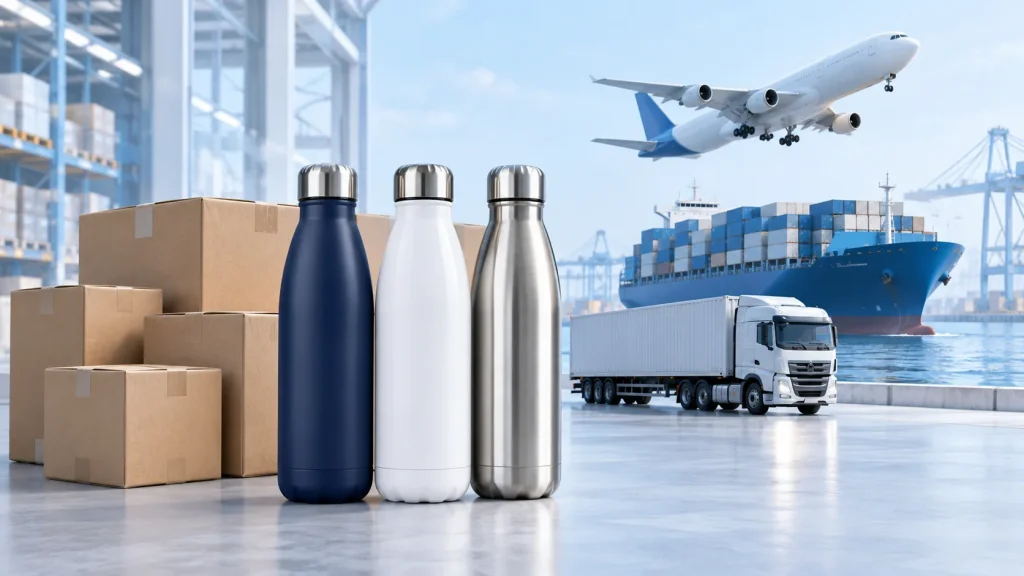
When shipping custom water bottles from China, compare the cost to the same delivery point—not just the freight headline. A useful quotation identifies the packed shipment, transport service, delivery terms, included charges, exclusions, and validity period.
Imagine two suppliers offering the same stainless steel tumbler, logo, and quantity. One freight quotation is lower. But it ends at an arrival terminal, while the other includes delivery to your warehouse. They are not competing prices for the same service.
The difference matters especially for a small first order. Fixed handling charges, import clearance, and local delivery can outweigh the apparent saving on the main transport leg.
For brands, importers, and corporate-gift buyers, the following workflow helps turn a freight estimate into a comparable purchasing decision. It is a procurement checklist, not a promise of universal rates or transit times.
1. Give Every Quoter the Same Shipment Brief

Before requesting alternatives, agree on what is actually being shipped. A bottle photograph and order quantity are not enough: a handled tumbler, a slim bottle, and a multi-lid gift set can require very different packing.
| Information | What to confirm |
|---|---|
| Product and quantity | Model, capacity, units by SKU, and included accessories |
| Packing | Individual box, units per master carton, and total carton count |
| Dimensions and weight | External dimensions and gross weight of each carton type |
| Collection point | Exact location in China and cargo-ready date |
| Destination | Country, postal code, and delivery address or named terminal |
| Receiving conditions | Commercial address, delivery appointment, unloading, or pallet requirements |
| Timing | Required arrival date and whether partial delivery is acceptable |
Mark early packing data as estimated. Replace it with final measurements before booking, especially if the packaging or accessories change.
For the box and protection specification behind these inputs, use our custom drinkware packaging guide.
2. Understand the Chargeable Weight
Actual weight measures the packed goods on a scale. Volumetric weight reflects the space they occupy. For relevant express services, the larger figure can determine the chargeable weight.
DHL’s published guidance gives a standard volumetric divisor of 5,000 when dimensions are in centimeters and weight is in kilograms:
Volumetric weight in kg = length × width × height in cm ÷ 5,000
As a simple illustration, a 50 × 40 × 30 cm carton has a volumetric weight of 12 kg. If its actual gross weight is 10 kg, the unrounded dimensional figure is higher.
This is not a universal billing formula for every courier, forwarder, or transport mode. Ask the provider to confirm its divisor, measurement rounding, minimum charge, multi-piece calculation, and surcharges. Never assume that a total scale weight alone is the billed weight.
If a quote requires palletization, ask whether pallet dimensions and weight replace the loose-carton inputs. A quote calculated from six loose cartons may change once those cartons are placed on a pallet.
3. Compare Transport Modes for Your Order, Not a Generic Quantity Rule
There is no reliable worldwide rule that says every order below a certain quantity must use express or every larger order must use sea freight.
| Option | When it deserves consideration | What to check before choosing |
|---|---|---|
| Express courier | Samples, small launches, or urgent replenishment | Chargeable weight, tax billing, service coverage, and delivery exceptions |
| Air cargo with a forwarder | Time-sensitive shipments needing a tailored service | Airport handling, clearance, minimum charges, and last-mile delivery |
| Sea freight LCL | Non-urgent orders sharing container space | Consolidation, minimum billing, origin/destination charges, and delivery scope |
| Rail or multimodal service | Eligible European routes with suitable timing | Route availability, pallet rules, customs points, and final delivery |
LCL means less-than-container load. Sharing a container does not remove shipment-level costs. Ask for the applicable minimums rather than multiplying a very small volume by an advertised ocean rate.
For each option, establish when the transit estimate starts and where it ends. Collection-to-warehouse and departure-to-terminal are different promises. Separate production readiness from transport planning; our custom water bottle lead-time guide explains that distinction.
4. Separate Door Delivery from Import Clearance
“Door-to-door” describes a delivery scope. By itself, it does not establish who pays import duty, import VAT, or customs brokerage.
Incoterms® rules allocate contractual delivery responsibilities, costs, and risk. Record the chosen rule, precise named place, and edition in the sales agreement. They are trade rules, not replacements for customs law or a complete sales contract.
The following are brief purchasing distinctions, not full rule definitions:
| Basis | Key distinction for the buyer |
|---|---|
| FCA | The seller completes export clearance and delivers to the buyer-nominated carrier at the agreed place; applicable to different transport modes. |
| FOB | The seller delivers on board the vessel at the named shipment port; it is a sea/inland-waterway rule, not an air-courier term |
| DAP | The seller arranges carriage to the named destination; the buyer handles import clearance and applicable import charges. |
| DDP | The seller handles import clearance and applicable import duties/taxes as part of its obligations; confirm it can lawfully do so. |
FCA can be more appropriate than FOB for containerized or multimodal arrangements. DAP and DDP are normally delivered ready for unloading, not automatically unloaded inside your warehouse.
If a provider calls a service “DDP” but excludes import taxes, resolve that inconsistency in writing. Also identify the importer and the documents you will receive. A label on a freight offer is not proof that the import arrangement is workable.
5. Ask for Inclusions, Exclusions, and Conditional Charges
Request a breakdown covering the following, as applicable:
- China collection, export handling, and documentation
- Main transport and consolidation
- Fuel, demand-season, remote-area, or special-handling surcharges
- Destination terminal handling and release
- Customs brokerage and any duty/tax advancement fees
- Import duties and taxes, clearly separated from service fees
- Final delivery, appointment, tail lift, or unloading services
- Cargo insurance and its coverage conditions
Then ask which charges arise only under specific circumstances, such as customs examination, storage after free time, address correction, or redelivery. Record the payer and how those costs will be evidenced.
“Customs clearance included” may refer to routine brokerage work, not taxes or every possible customs-related expense. Have the provider explain exactly what the phrase covers.
Keep this freight review separate from product-cost differences. Our custom water bottle pricing guide covers the materials, lids, finishes, and customization assumptions behind the goods price.
6. Normalize Two Quotes Before Comparing Them
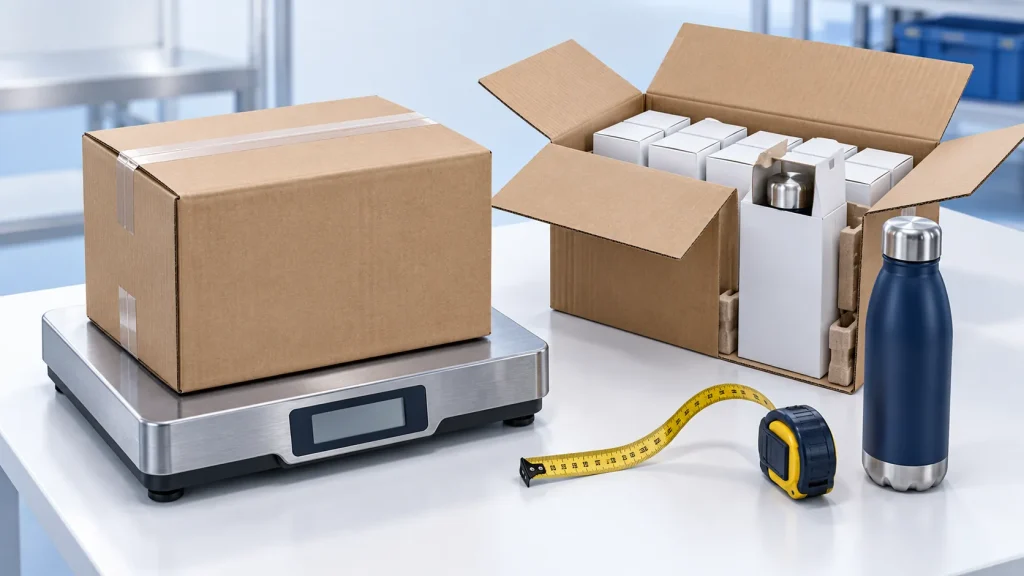
Start with the same product, packing, collection point, destination, and cargo-ready date. Request dated offers in the same currency with matching validity and service assumptions.
The illustration below uses invented amounts solely to demonstrate comparison. It is not a current market rate, customer case, or Funzlife quotation.
Assume 300 tumblers, identical packing, and the same warehouse endpoint:
| Cost item | Quote A | Quote B |
|---|---|---|
| Headline transport amount | USD 500 | USD 690 |
| Origin collection/handling | USD 100 additional | Included |
| Routine destination brokerage | USD 80 additional | Included |
| Final warehouse delivery | USD 120 additional | Included |
| Known transport/service subtotal | USD 800 | USD 690 |
| Import duties and taxes | Excluded; confirm separately. | Excluded; confirm separately. |
| Cargo insurance | Not included | Not included |
Quote A’s lower headline becomes the higher known subtotal. However, neither column is a complete landed cost: taxes, insurance, and any unresolved conditional charges still need review.
If an item is unknown, mark it “not confirmed.” Do not silently replace it with zero. If one offer expires earlier or uses a different delivery endpoint, obtain a revised comparable offer before choosing.
For budgeting, add the goods cost and all applicable shipment costs without double-counting amounts already included in the product price or delivered quotation. Divide by the same ordered quantity. Keep tax treatment consistent and ask your broker or accountant about market-specific obligations.
7. Prepare the Customs Handoff Before Dispatch

Confirm the importer, customs broker, or courier contact and who supplies each document. A commercial invoice, packing list, and shipment description should agree on the goods and quantity; provide product details so the broker can verify classification.
Do not apply a tariff code to every bottle, tumbler, or food jar simply because another supplier uses it. Product construction and destination rules matter.
For EU customs operations, economic operators need an EORI number. Establish whose registration is used and ask the appointed broker to confirm the import setup. An EU requirement should not be treated as a universal rule for the UK, Switzerland, or other markets.
Product-compliance evidence is a separate question from the freight service. Paying for clearance does not establish that the finished product meets its target-market requirements, and supplying reports does not guarantee customs release.
Agree on what happens if information is missing: who responds, who approves additional costs, and who updates the arrival estimate.
8. Reduce Cost Without Creating a Bigger Purchasing Risk
First remove avoidable empty space and compare practical packaging options. Keep sufficient protection for the coating, lid, and accessories; the cheapest shipment is poor value if it arrives damaged.
Other options worth asking about include:
- Using a standard box instead of an oversized presentation box
- Consolidating compatible orders when timing and documentation allow
- Shipping only the genuinely urgent quantity by a faster service
- Using the buyer’s nominated forwarder for a like-for-like comparison
- Checking the actual final destination before requesting a different route
A split shipment creates extra booking and handling work. Calculate its combined cost rather than assuming a fixed air/sea percentage will suit every project.
Increasing quantity may spread fixed costs, but buying unwanted inventory merely to lower freight per unit can be a worse decision. Evaluate the order against actual sales plans and storage needs.
A Freight RFQ Checklist You Can Send
Use the following alongside your product inquiry:
- Product model, quantity by SKU, packaging and accessories
- Estimated carton count, external dimensions and gross weight
- Collection address and expected cargo-ready date
- Destination country, postal code and exact receiving point
- Required warehouse arrival date and permitted alternatives
- Pallet, appointment and unloading requirements
- Requested delivery basis, named place and Incoterms® edition
- Who handles import clearance and pays duties/taxes
- Required inclusions, exclusions, insurance and conditional-charge details
- Quote currency, issue date, expiry date and remeasurement terms
For the wider product brief, see our custom stainless steel drinkware RFQ checklist.
Frequently Asked Questions
Is sea freight always cheaper for a small custom bottle order?
No. Compare the complete route, applicable minimums, handling, clearance and final delivery. A low ocean-freight line does not establish the lowest cost to your warehouse.
Does door-to-door shipping include customs duties and VAT?
Not automatically. Confirm the contractual delivery rule and written charge scope. Under DAP, import clearance and applicable import charges are the buyer’s responsibility; DDP assigns those obligations to the seller.
Can I compare freight quotes before final packing is ready?
Yes, as estimates using the same assumptions. Reconfirm dimensions, weights, pallet requirements, rate validity and availability before booking. Packaging changes may affect the final charge.
Can Funzlife work with my nominated forwarder?
Discuss the arrangement during quotation. Funzlife can help coordinate relevant packing information and the agreed handoff with manufacturing resources and your nominated logistics provider. Responsibilities and any local charges must be confirmed for the project.
Compare the Delivered Scope Before You Commit
The best shipping decision combines a clear endpoint, reliable packing inputs, a workable customs arrangement and a written list of charges. It does not depend on choosing the smallest number on the first quotation.
Funzlife supports product selection, customization, sampling, packaging planning, quality-control coordination and manufacturing-resource coordination. We can help organize the shipment inputs needed for a project-specific logistics review; transport, customs and insurance arrangements remain subject to confirmation with the relevant providers.
Share your product model, quantity, packaging preference, destination postal code and required arrival date through our custom drinkware project support page. With those details, we can clarify what needs to be compared before you approve the order.