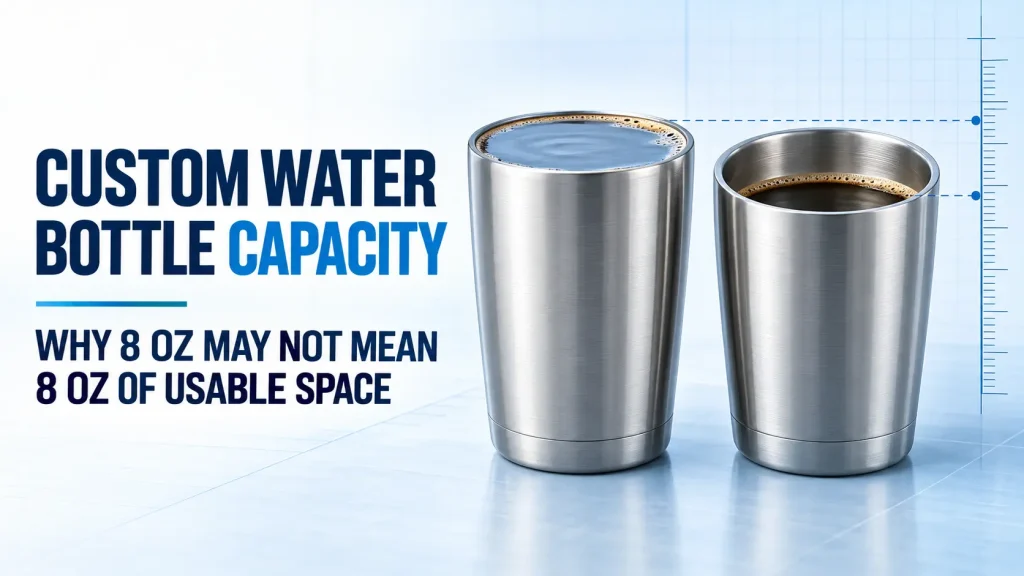
A buyer chooses an 8 oz coffee tumbler for a recipe that uses 24 g of powder and 200 ml of water. On paper, the size looks suitable: 8 US fluid ounces is about 237 ml.
Then the sample arrives. The prepared drink sits close to the rim. Stirring causes spills, and inserting the lid pushes the liquid level even higher.
Was the capacity wrong? Not necessarily. The buyer and supplier may simply have been using different definitions of “8 oz.” One may mean the maximum volume to the brim; the other may mean the amount a customer can comfortably use with the lid installed.
That difference can affect product claims, recipe compatibility, packaging artwork, customer reviews, and even which model a brand should launch. Before approving a custom bottle or tumbler, buyers should define exactly what the capacity number means—and how it will be checked.
The “8 oz” Trap: Three Numbers Can All Be Correct
Capacity is often treated as one simple product field. In practice, a supplier may be working with several different numbers.
| Capacity term | What it usually describes | Why buyers should care |
|---|---|---|
| Brimful or overflow capacity | The maximum liquid volume when the open vessel is filled to the upper rim | It is not a realistic drinking level and normally does not allow for lid intrusion or movement. |
| Nominal or marketed capacity | The rounded size used to identify and sell the product | It may be based on a conventional market size rather than an exact measured volume. |
| Usable or working capacity | The practical fill volume below an agreed line, with enough space for the intended use | This is often the most relevant number for recipes, ice, stirring, transport, and drinking. |
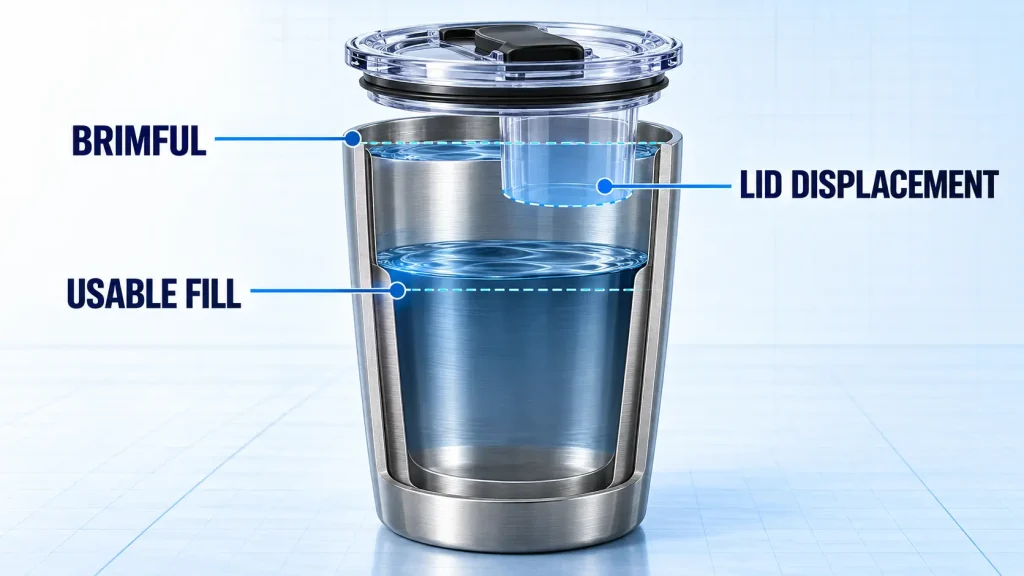
“Usable capacity” is not a universal definition that every factory applies in the same way. If it matters to the project, the buyer must define the fill point, lid condition, and use scenario in the specification.
The real sourcing risk is therefore not that one capacity term is always wrong. It is that a quotation, sample approval, and packaging claim may each use a different term without anyone noticing.
First Question: Which Fluid Ounce Are You Using?
International drinkware projects commonly show both ounces and milliliters, but “oz” alone is incomplete. It can be confused with an ounce of mass, and US and Imperial fluid ounces are not the same volume.
According to the US National Institute of Standards and Technology, one US fluid ounce is approximately 29.57 ml. This makes:
- 8 US fl oz approximately 236.6 ml
- 40 US fl oz approximately 1,182.9 ml
By comparison, one Imperial fluid ounce is approximately 28.41 ml, so 8 Imperial fl oz is about 227.3 ml.
Global drinkware ranges often retain familiar US size names even in other markets. Make milliliters the controlling specification and use fluid ounces as a secondary description.
A clear line might read:
Marketed size: 8 US fl oz / 237 ml nominal. Minimum usable fill volume: 210 ml to the approved reference line with the production lid installed.
Those figures are illustrative. The correct usable volume must come from the actual product and use.
The Lid Can Reduce the Space Your Customer Can Use
A cup body can pass a brimful capacity check and still be too small for the intended drink.
Many lids project below the rim. A screw plug, straw mechanism, infuser, sealing wall, or internal drinking channel may enter the vessel and displace liquid. If the drink is already near the top, installing the lid can raise the level or force liquid into the thread area.
Headspace is also needed for ordinary use. Consider whether the customer will:
- Add ice cubes
- Stir powder into water
- Create foam with coffee or a supplement
- Insert a straw or tea infuser.
The correct headspace is application-specific. A straight-sided cup used for still water does not need the same working volume as a small coffee tumbler used for a measured recipe. This is why a product sample should be tested with the real lid and a realistic beverage scenario, not only filled with water to the rim.
For a closer look at how lid structure and test conditions affect real-world performance, see our guide to leak-proof vs spill-resistant drinkware lids.
A Capacity Name Is Not a Complete Product Specification
Two “500 ml bottles” can have different internal geometries. Because vacuum-insulated drinkware has a double-wall structure, external dimensions do not reveal internal volume. Ask how an existing model was measured; for new tooling, agree on the target and method before approval.
Do not copy a tolerance from a glass jar or another bottle design. OIML R 138 is useful for the definitions of brim capacity and headspace, but it is not automatically the acceptance standard for an OEM tumbler.
How to Measure Capacity Without Creating Another Argument
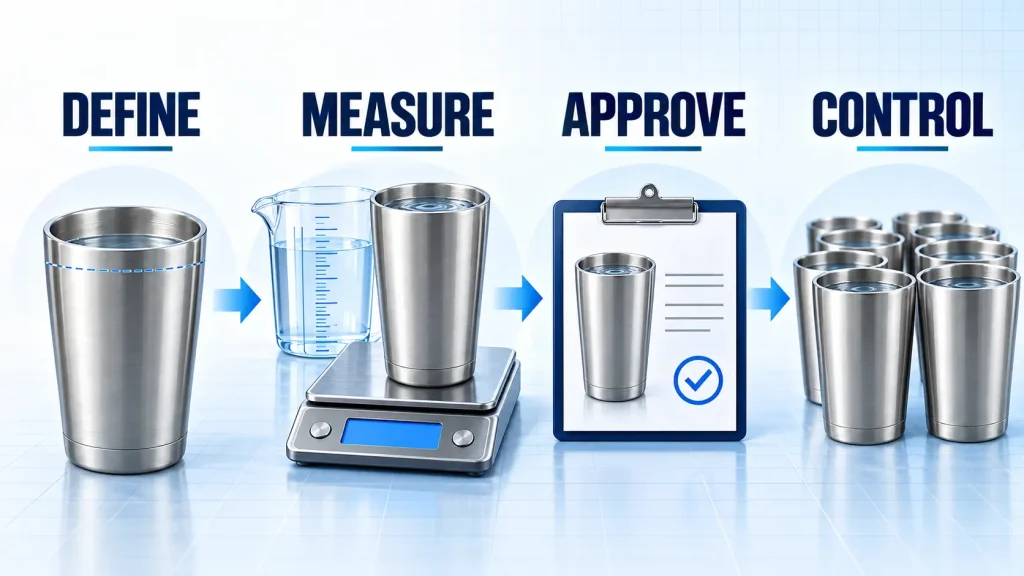
The simplest method uses water, but the procedure must still define:
- the exact product and lid version;
- whether the body is finished and at an agreed room temperature;
- the fill reference—upper rim for brimful capacity or a marked line for usable capacity;
- the equipment, number of samples, and reporting format.
Avoid “fill it almost full.” Two inspectors can interpret that differently.
Capacity can be checked with calibrated volumetric equipment or by this gravimetric method:
- Weigh the empty, dry vessel.
- Fill it with water to the agreed reference point.
- Weigh it again.
- Divide the water mass by the water density at the recorded temperature.
At normal room temperature, 1 g of water is often treated as approximately 1 ml for a quick check. Controlled testing should use the recorded temperature, applicable density, and calibrated equipment.
Keep individual readings because an average can hide an undersized unit. Record the method, fill point, date, and product version with sample approval. If capacity is critical, also give bulk inspection an agreed sampling plan and pass/fail limit.
For a wider view of this control process, see our guide to quality control for custom stainless steel drinkware.
Test the Customer’s Recipe, Not Just the Conversion Table
Return to the 8 oz coffee tumbler example. The buyer wants to combine 24 g of powder with 200 ml of water.
It would be unsafe to conclude that any vessel above 224 ml is large enough. Powder mass does not convert directly into the same number of milliliters; mixing, foam, and the lid also affect the required space.
A better approval test is practical:
- Prepare the recipe with the maximum intended water amount.
- Stir or shake as the consumer would.
- Install the production lid.
- Check overflow, thread contamination, comfort, and headspace.
If the recipe sits too high, the solution may be a larger body—not a promise to “control the capacity more carefully.” Testing the use case early is cheaper than changing printed packaging or handling customer complaints after launch.
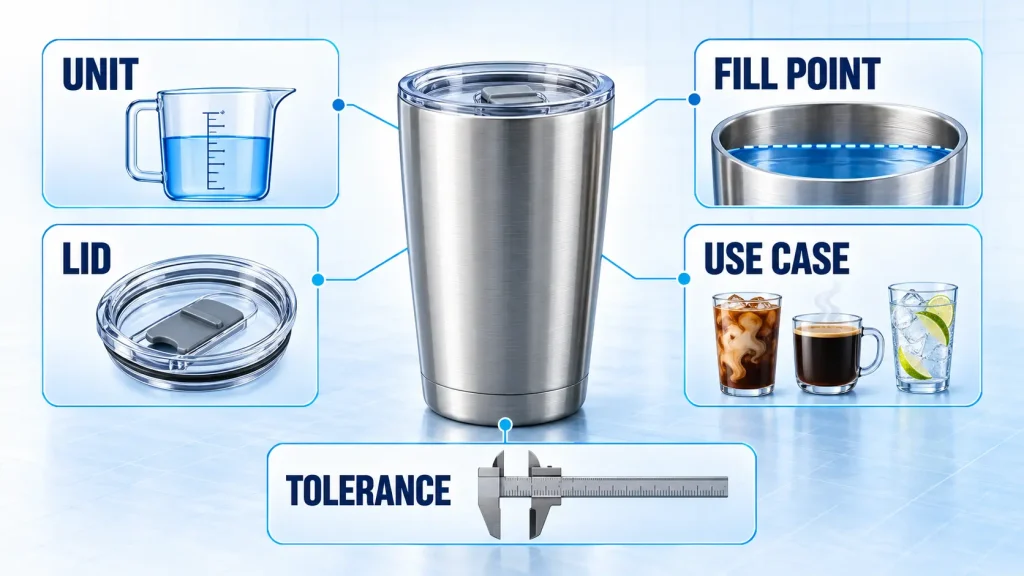
Put These Fields in the RFQ and Approved Specification
| Specification field | What to write |
|---|---|
| Product reference | Model number, drawing revision, and approved lid version |
| Marketed capacity | For example, 8 US fl oz / 237 ml nominal |
| Controlling unit | Usually milliliters for an international OEM specification |
| Capacity definition | Brimful, nominal, or usable; do not leave it implied. |
| Fill reference | Upper rim, engraved line, distance below rim or another objective point |
| Lid condition | Open body, lid installed, or specified internal component installed |
| Intended use | Water, coffee, supplement recipe, ice, straw, infuser, or another scenario |
| Acceptance criterion | Target, allowable tolerance, and whether the limit applies to every tested unit |
| Measurement method | Equipment, water condition, procedure, and number of samples |
| Change control | Reapproval required after changes to body tooling, inner geometry, or lid components. |
This information can be included in the first inquiry or added during sample development. Our custom stainless steel drinkware RFQ checklist covers the other details needed for an accurate quotation.
Capacity Also Changes Cost, Fit, and Packaging
Buyers should compare capacity with the complete product envelope:
- overall height with the lid ;
- base diameter for car cup-holder compatibility;
- mouth diameter and filling access;
- net weight;
- units per carton and carton dimensions.
A small increase in volume may require a taller shell, different tooling, a new lid match, or less efficient carton packing. Approve capacity together with dimensions, lid function, and packaging. Buyers comparing models can review Funzlife’s custom drinkware options and request the measurement basis for shortlisted products.
Capacity is also only one factor behind the final quotation. Our custom water bottle pricing guide explains how buyers can compare structure, materials, lids, finishes, and packaging more accurately.
Ask These Questions Before Paying the Deposit
- Is the listed capacity nominal, brimful, or usable?
- Does “oz” mean US fluid ounces, and what is the milliliter value?
- Where is the exact fill reference point?
- Was the measurement taken with or without the production lid?
- Can we test the intended recipe or ice load on a sample?
- What capacity value and tolerance will appear in the approved specification?
- How will capacity be checked during mass production?
A supplier who answers these questions clearly is not making the project more complicated. They are removing ambiguity before it becomes an expensive problem.
FAQ
Is an 8 oz tumbler exactly 240 ml?
Not under the US conversion. Eight US fluid ounces is approximately 236.6 ml, commonly rounded to 237 ml. Some brands use 240 ml as a convenient nominal size, so confirm the controlling value.
Is brimful capacity the same as usable capacity?
No. Brimful capacity is the maximum volume to the rim. Usable capacity leaves space for the lid, movement, and the intended drinking scenario. The difference is product-specific.
Does the lid count when measuring a bottle’s capacity?
It depends on the agreed definition. Brimful capacity is usually checked on the open vessel, while a practical use test should consider any part of the lid, straw or infuser that enters the liquid space.
Can capacity be checked by weighing water?
Yes. Convert the water mass to volume using density at the recorded temperature, calibrated equipment and a written fill reference.
Define the Number Before You Approve the Cup
An “8 oz,” “500 ml” or “40 oz” name is useful for browsing, but not for approving an OEM order. The buyer and supplier need one controlling unit, capacity definition, fill point and repeatable method.
Funzlife supports product selection, sample coordination, written specifications and quality-control planning. If a product must fit a recipe, fill line, cup holder or packaging limit, share the use case so suitable models and measurements can be confirmed before production.