Your supplier says, “Production takes 25 days.”
You add 25 days to today’s date and begin planning the product launch. Five weeks later, however, the bottles may still be waiting for packaging, final inspection, or a shipping booking.
Was the supplier dishonest? Not necessarily. You may simply have been counting two different timelines.
In a custom drinkware project, “25 days” often means factory production after every required detail has been approved. It may not include sampling, color approval, packaging, testing, quality inspection, freight, customs, or final delivery.
This guide explains where custom water bottle lead time really goes, which delays buyers can prevent, and the questions to ask before paying a deposit.
For many standard projects coordinated by Funzlife, bulk production may be quoted at around 25–30 days after all agreed start conditions are complete. New tooling, special lids, several custom colors, retail packaging, or testing can extend the schedule.
The “25-Day” Trap: Which Clock Is Your Supplier Using?
When buyers ask, “What is your lead time?” they often mean the complete inquiry-to-delivery timeline. The supplier may be answering only with the factory production period. Neither number is useful until its start and finish points are clear.
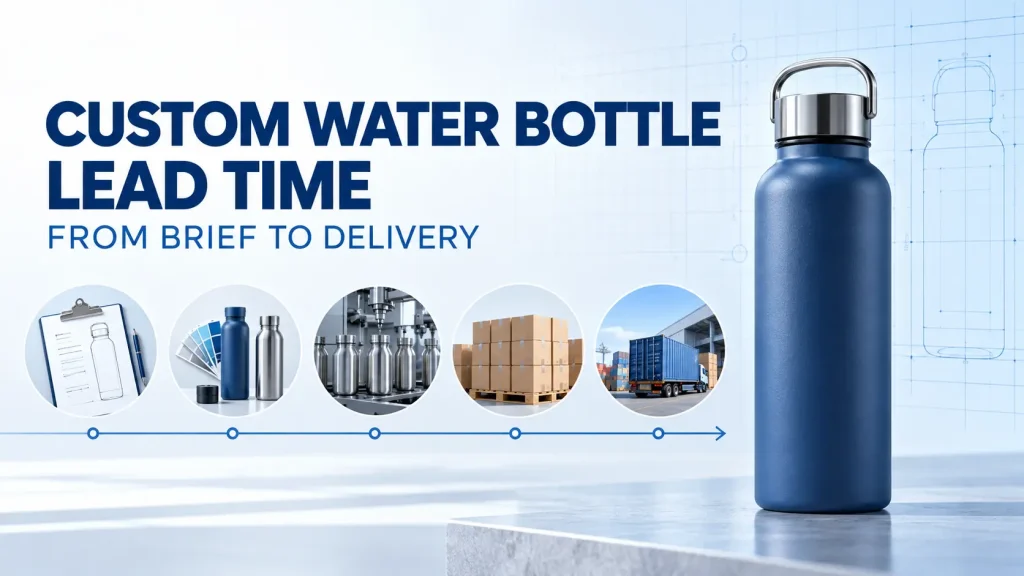
Separate the main stages before comparing quotations:
| Schedule stage | Starts when | Ends when |
|---|---|---|
| Sample lead time | Sample specification, artwork, and payment are confirmed. | The sample is ready for dispatch. |
| Approval time | Sample or proof is received. | The buyer gives written approval. |
| Bulk production lead time | All agreed production-start conditions are complete | Finished goods are packed or ready for inspection. |
| Shipment preparation | Goods pass inspection. | Cargo is handed to the forwarder or loaded. |
| Transit time | The carrier accepts or departs with the cargo. | Cargo reaches the port, airport, or final destination. |
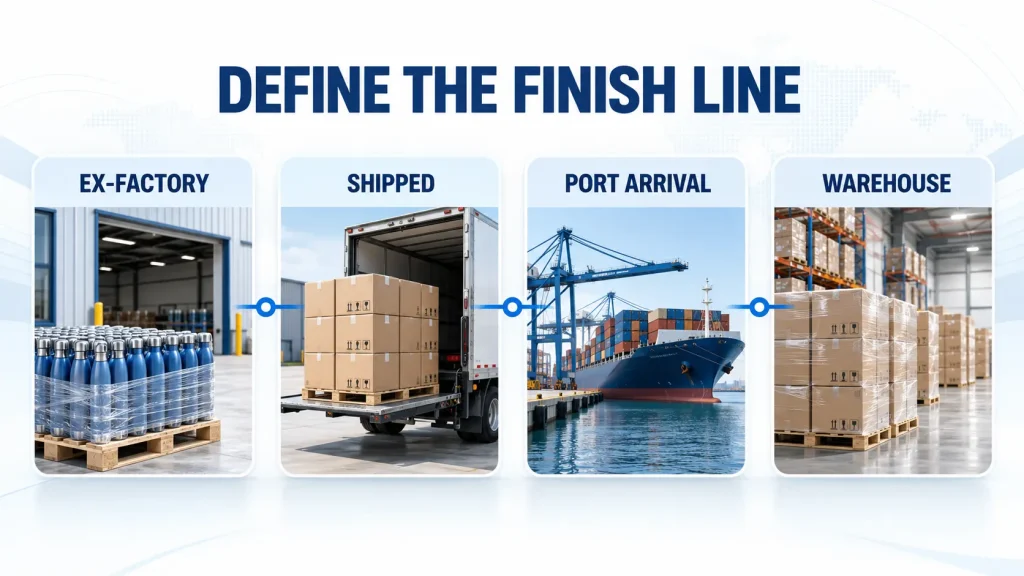
“30 days ex-factory” and “30 days to our warehouse” are not comparable. State whether the target date means packed, ex-factory, shipped, port arrival, or warehouse delivery.
Incoterms® rules allocate cost, risk, and obligations. They do not replace a project schedule, so the named place and delivery milestone should also be written clearly.
Your Production Clock May Not Start When You Pay
A production estimate is meaningful only when the start trigger is defined.
Depending on the project, production may start only after the purchase order and deposit, final specification, sample, color, logo, lid, packaging files, and testing plan have all been approved.
This is where many schedules quietly slip. The buyer has paid and believes day one has started. The supplier is still waiting for the final artwork or box confirmation and has not released the order to production.
If a quotation says only “lead time: 30 days,” ask whether this means 30 days from:
- Deposit receipt
- Artwork approval
- Sample approval
- Final specification approval
- Completion of all the above conditions
A complete custom drinkware RFQ checklist helps close these gaps before sampling.
One Missing Approval Can Stop the Entire Order
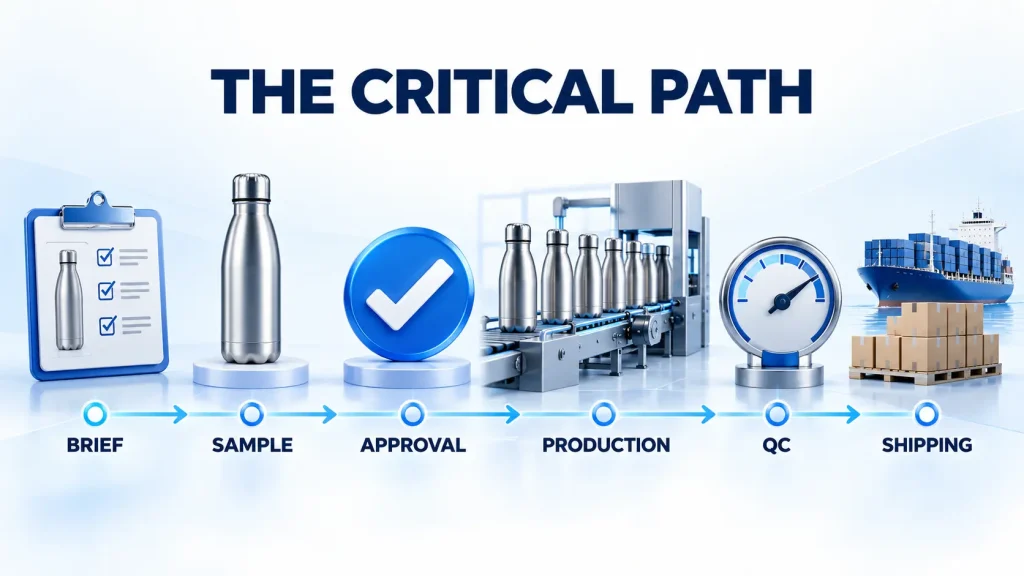
The critical path is the chain of dependent tasks that determines the earliest realistic completion date:
Product brief → quotation and specification → sample or proof → buyer approval → production → final inspection → shipment
Packaging may create a second critical path:
Final product dimensions → box dieline → artwork → approval → packaging production → packing
If the boxes are late, finished bottles cannot ship. If one custom lid color is unavailable, every completed bottle may still remain in the warehouse. The slowest critical component—not the fastest production line—often controls the final date.
Good planning runs compatible tasks in parallel. Artwork, barcodes, packaging copy, inspection requirements, and freight options can be prepared while samples are in progress. However, mass coating should not begin before the color is approved, and full box printing should wait until the dimensions, dieline, and artwork are frozen.
Five Things That Quietly Add Days to Your Timeline
1. Treating a new product like a logo order
Using an established bottle body and compatible lid is normally the fastest route. A new shape, handle, or lid mechanism may require drawings, prototypes, molds, trial parts, corrections, and repeated testing. Adding “a few extra days” to a standard quotation is rarely enough; it needs a separate development schedule.
2. Dividing one order into too many SKUs
Three thousand bottles in one color are easier to schedule than the same quantity divided across six colors, several lids, and two packaging designs. The total quantity looks identical on the purchase order, but every SKU adds setup, approvals, component allocation, packing instructions, and inspection records.
Our custom water bottle MOQ guide explains how colors, lids, logos, and packaging create different practical minimums.
3. Assuming a Pantone number completes color approval
A custom Pantone color may require trial application, curing, review, and adjustment. Gloss, texture, and substrate all affect appearance. If the buyer comments only after seeing the physical sample, the approval cycle may restart. See our guide to Pantone color matching for custom water bottles.
Logo timing depends on the printing method, artwork quality, number of colors, and placement. Ready vector artwork and one clear approval route usually save more time than choosing a nominally faster decoration process.
4. Underestimating lids and packaging
A lid may contain molded parts, silicone seals, a straw, a hinge, a spring, a pin, a button, or a handle. A custom component color or new mechanism adds production and validation time. If leak resistance is critical, define the intended use and test conditions before production. Our lid design and leak-testing guide provides a practical checklist.
Retail boxes, sleeves, inserts, instruction cards, and labels also need stable product dimensions and approved artwork. A late bottle or accessory change may force packaging revision or a remake. Read our custom drinkware packaging guide for the main packaging decisions.
5. Leaving testing and capacity checks until the end
Testing may require production-equivalent materials, colors, lids, or decorations. Confirm the laboratory schedule and report scope early; an existing report may not cover a changed product.
Production capacity also changes during retail peaks and holidays. A lead time quoted three weeks ago does not reserve today’s production slot. Reconfirm it before placing the order, especially when a launch date cannot move.
Work Backward from the Launch Date—not Forward from the Deposit
Starting from the deposit date encourages false confidence: every later stage is treated as if it will happen perfectly. A safer plan starts with the date the goods must be available, then works backward through:
- Warehouse receiving date
- Customs and inland-delivery allowance
- Transport and carrier cut-off
- Export preparation and cargo handover
- Final inspection and corrective-action reserve
- Packing and bulk production
- Sample, artwork, and packaging approval
Transport time should come from a current route-specific quotation. Carrier schedules, customs, and last-mile delivery can change, so a previous shipment is not a guaranteed timetable.
A short milestone sheet makes responsibility visible:
| Milestone | Owner | Approval evidence |
|---|---|---|
| Product specification frozen | Buyer + supplier | Signed specification |
| Production reference approved | Buyer | Written sample or proof approval |
| Packaging released | Buyer + supplier | Approved dieline and artwork |
| Final inspection passed. | QC / appointed inspector | Inspection report |
| Cargo handed over | Supplier / forwarder | Forwarder receipt |
| The warehouse received | Buyer / logistics provider | Receiving record |
How to Save Time Without Creating a Quality Problem
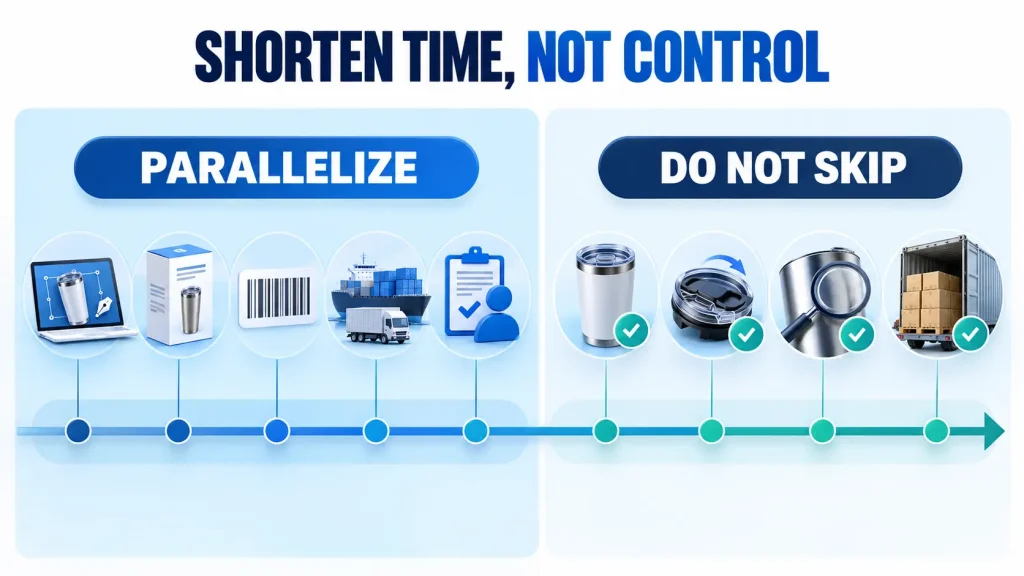
- Use a proven platform. Choose an existing body and compatible lid for a time-sensitive first order.
- Reduce first-order SKUs. Fewer colors, lid combinations, and boxes mean fewer approvals and changeovers.
- Freeze one specification. Record the bottle, lid, color, logo, accessories, packaging, tests, and acceptance criteria.
- Appoint one final approver. Consolidate comments before sending them to the supplier.
- Choose packaging early. The structural format should be decided during quotation, even if final graphics follow later.
- Plan inspection and freight in advance. Share the estimated completion window before production finishes.
The objective is to remove waiting and rework—not to skip samples, testing, or final inspection. Fast decisions shorten a project; missing controls merely move the problem to production or delivery.
Ask These Eight Questions Before Paying the Deposit
- What event starts the quoted lead time?
- What milestone ends it: packed, ex-factory, shipped, or delivered?
- Is the production slot reserved?
- Which sample or proof must be approved first?
- Which tasks can run in parallel?
- What is the latest date for artwork and packaging copy?
- When will testing and final inspection occur?
- How will specification changes affect timing?
A reliable supplier should explain the assumptions and dependencies behind the date, not simply repeat “25–30 days.”
Frequently Asked Questions
How long does it take to produce custom water bottles?
For many standard existing-model projects, bulk production may take around 25–30 days after all agreed start conditions are complete. Sampling, approvals, inspection, transport, and new tooling extend the full timeline.
Does paying the deposit start the production lead time?
Not always. The quotation or purchase order should state whether sample, artwork, color, packaging, and other technical approvals must also be complete.
Can we skip the sample to save time?
This may be reasonable only for a proven repeat order with no relevant changes and an agreed reference. A new color, logo, lid or box normally requires suitable approval.
Does custom packaging add lead time?
Yes. Packaging requires a stable product configuration, dieline, artwork approval, production and delivery to the packing location. Some tasks can run in parallel, but late changes can delay shipment.
Are repeat orders always faster?
They can be when the specification and controlled components remain unchanged. A different lid supplier, coating, color, logo, box or compliance requirement may require new approval.
The Real Question Is Not “How Many Days?”
Custom water bottle lead time is not one factory number. It is a chain of approvals, component dependencies, production steps and logistics milestones.
Instead of asking only, “How many days?”, ask:
From which confirmed event, to which exact delivery milestone—and what must happen in between?
Define the start trigger and finish point, plan backward from the warehouse date, and record who approves each critical stage. That creates a schedule buyers can actually use.
Funzlife supports brands, importers, retailers, wholesalers and corporate-gift buyers with product selection, customization, sampling, packaging, quality control and manufacturing-resource coordination.
Contact Funzlife with your bottle style, quantity, color plan, logo, packaging, target market and required warehouse date. We can help prepare a realistic project timeline for review.