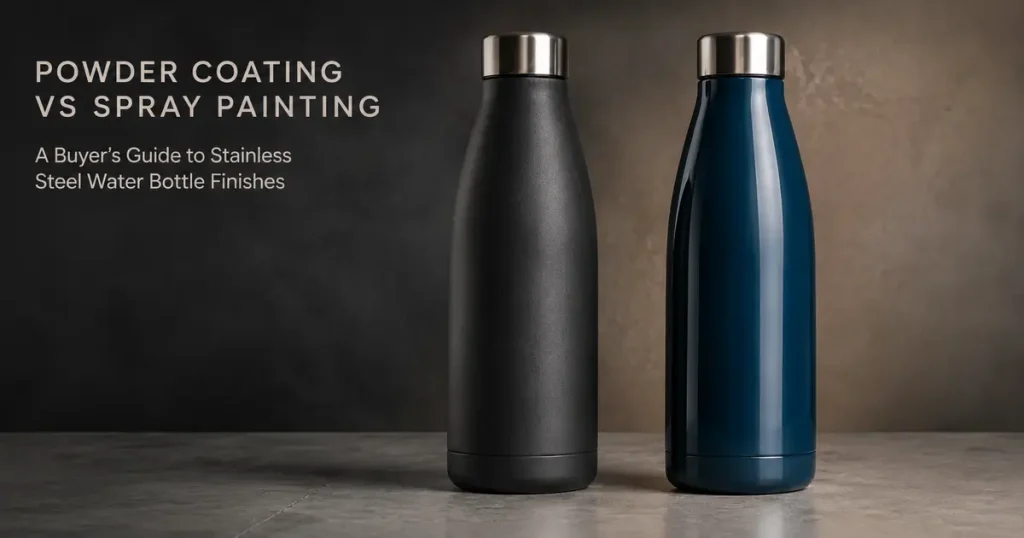
Powder coating vs spray painting for water bottles is not simply a choice between a matte surface and a glossy one.
The selected finish can affect scratch resistance, grip, color effects, logo adhesion, packaging requirements, production consistency, and the customer’s perception of the finished product.
Two custom stainless steel bottles may look equally attractive in a digital rendering. However, after production, shipping and daily use, their surfaces can perform very differently.
Powder coating is often selected for durable, textured, and frequently handled drinkware. Spray painting provides greater flexibility for smooth, glossy, metallic, pearlescent, gradient, and other decorative effects.
Neither process is automatically better for every project. The correct choice depends on the target market, product use, desired appearance, logo method, order quantity, quality requirements, and expected retail price.
The Short Answer
Choose powder coating when the project prioritizes:
- Scratch and impact resistance
- A textured or grip-friendly surface
- Outdoor, sports or daily-use applications
- Laser-engraved branding
- Lower risk of visible wear during transport and use
- Consistent matte or semi-matte finishes
Choose spray painting when the project prioritizes the following:
- Smooth or high-gloss surfaces
- Metallic, pearlescent or mirror-like effects
- Gradient and color-transition designs
- Soft-touch or other decorative finishes
- Fashion, gift and lifestyle positioning
- Greater flexibility in visual effects
However, the coating name alone does not guarantee performance. Surface preparation, coating formulation, application control, curing conditions, logo decoration, and packaging can be just as important as the selected process.
Powder Coating vs Spray Painting: Quick Comparison
| Factor | Powder Coating | Spray Painting |
|---|---|---|
| Basic process | Dry powder is applied and cured with heat | Liquid coating is sprayed and then dried or cured |
| Typical appearance | Matte, semi-matte, textured or smooth | Smooth, glossy, metallic, pearlescent, gradient or soft-touch |
| Durability | Often strong for daily handling when properly applied | Depends heavily on primer, coating system and curing |
| Grip | Textured options can provide good grip | Usually smoother, although special textures are possible |
| Decorative flexibility | Good for solid colors and selected effects | Strong for gradients and complex visual finishes |
| Laser engraving | Usually highly compatible | Possible, but the result must be sampled |
| Printed logos | Compatible, subject to ink and surface testing | Compatible, subject to ink and surface testing |
| Environmental consideration | Generally lower in VOC emissions than conventional solvent-based coatings | Depends on whether the liquid system is solvent-based, water-based, or low-VOC |
| Shipping risk | Often more tolerant of normal handling | Decorative surfaces may require additional protection |
| Common applications | Sports bottles, outdoor bottles, school bottles and daily-use tumblers | Gift collections, fashionable drinkware, and premium lifestyle products |
This table describes common tendencies rather than guaranteed performance. The actual result depends on the complete coating system and production conditions.
What Is Powder Coating?
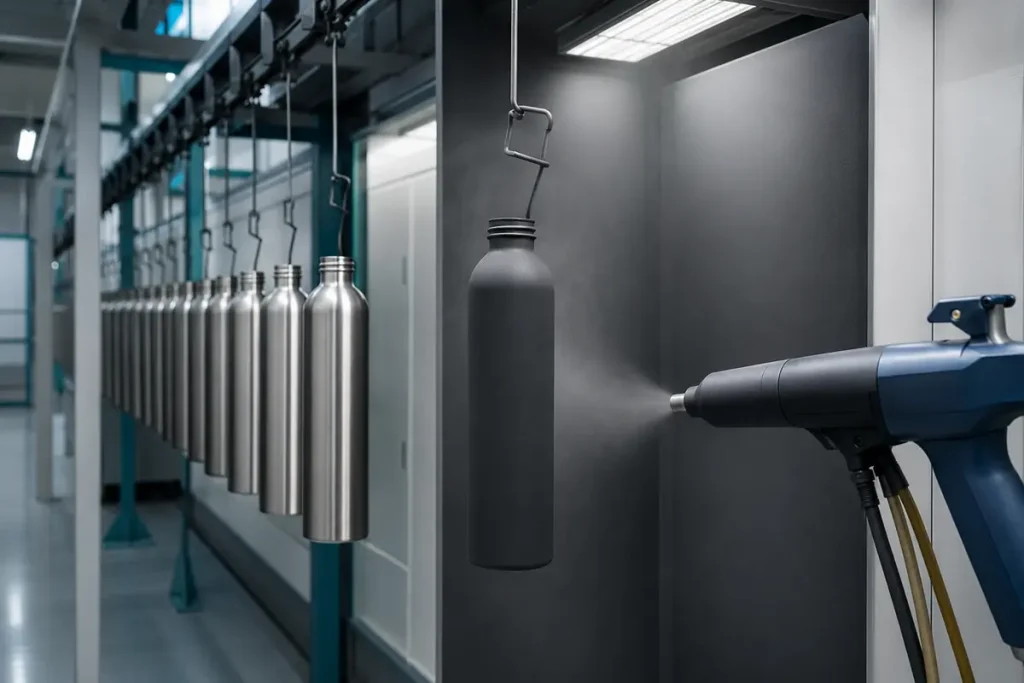
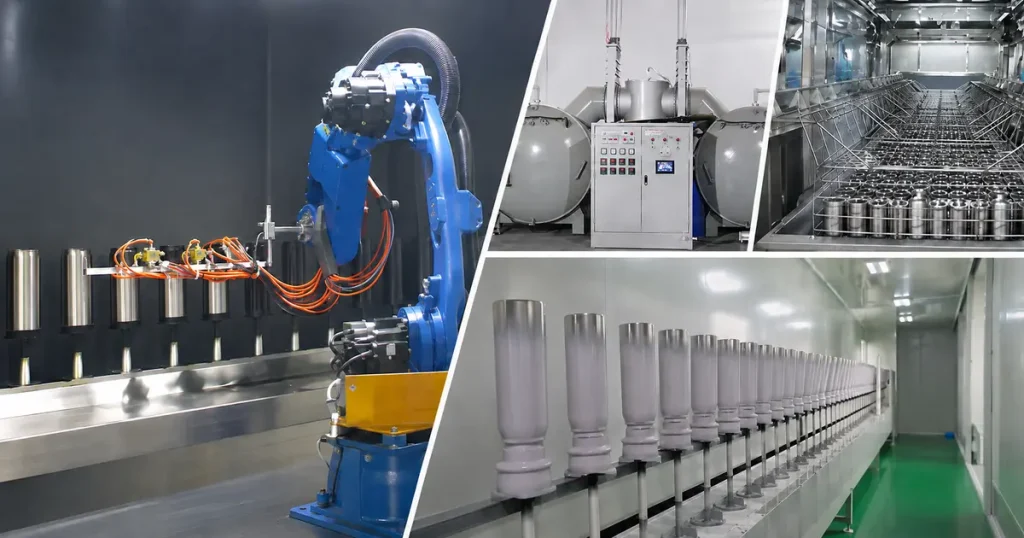
Powder coating is a dry finishing process. Fine particles of pigment and resin are normally applied electrostatically to the prepared stainless steel surface. The coated bottle then passes through a curing process, allowing the powder to melt, flow, and form a continuous coating layer.
A typical production sequence may include:
- Cleaning and preparing the stainless steel surface
- Removing oil, polishing residue and other contamination
- Applying the powder evenly
- Controlling coverage around curves, shoulders and the bottle base
- Curing the coating under defined conditions
- Cooling and inspecting the finished surface
Powder coating is widely used for stainless steel water bottles and tumblers because it can produce a durable and grip-friendly surface.
It is particularly suitable for products that will be handled frequently, carried in bags, or used for sports, school, commuting, and outdoor activities.
Common Powder-Coating Effects
Powder coating does not mean that every product must have the same rough matte texture. Depending on the powder formulation and application process, possible effects may include:
- Fine matte
- Semi-matte
- Smooth powder coating
- Textured or grip-style finishes
- Solid custom colors
- Selected speckled or decorative effects
The final texture, gloss level, and color should be confirmed with a physical sample. A Pantone reference alone may not fully describe how a color will appear on a particular coating, bottle shape, and surface texture.
What Is Spray Painting?
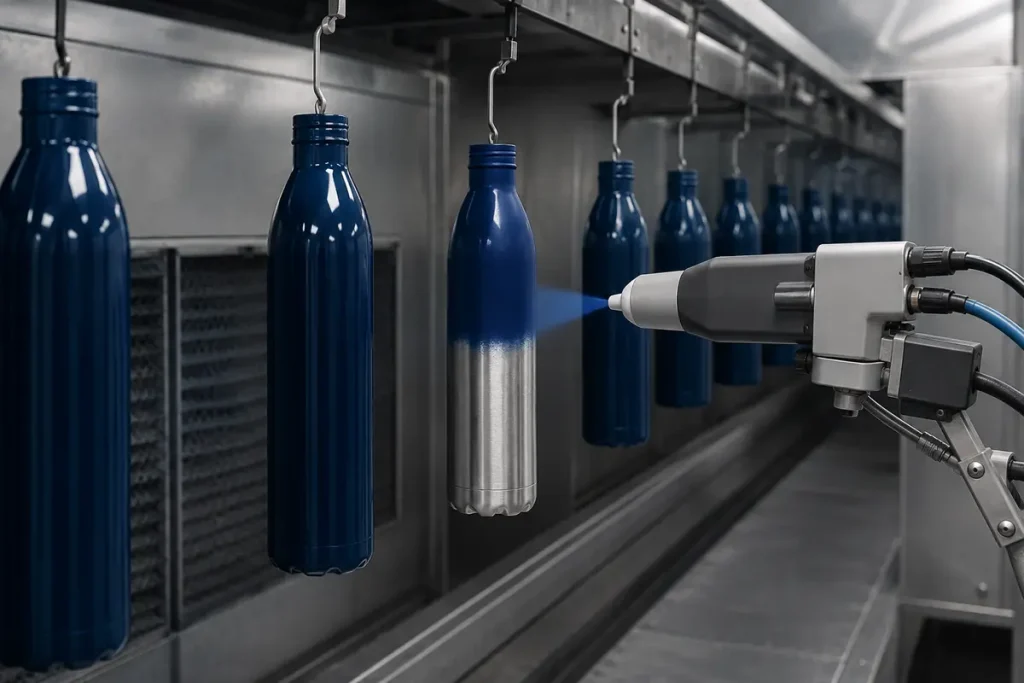
Spray painting applies a liquid coating to the prepared stainless steel surface. Depending on the required appearance and performance, the complete system may include a primer, color layer, effect layer, and protective topcoat.
The coating is then dried or cured under the conditions required by the selected material.
Spray painting provides considerable visual flexibility. It may be selected for:
- High-gloss colors
- Metallic effects
- Pearlescent finishes
- Gradient colors
- Translucent effects
- Smooth pastel surfaces
- Rubberized or soft-touch effects
- Fashion-oriented decorative finishes
This makes spray painting attractive for giftware, premium retail collections, and lifestyle products where appearance is a central part of the product’s value.
However, a visually impressive finish still needs suitable adhesion, curing, and packaging. Some decorative coatings may show scratches, rubbing marks, or edge damage more easily than a well-controlled powder coating.
Which Finish Is More Durable?
Powder coating is often the safer choice when durability is the main priority, but it is not enough to specify only “powder coated.”
The performance of either finish may be affected by:
- Surface cleanliness
- Surface pretreatment
- Coating formulation
- Primer selection
- Coating thickness
- Application consistency
- Curing temperature and time
- Bottle geometry
- Contact around the base and top rim
- Logo-decoration process
- Washing conditions
- Packaging protection
- Actual end use
A poorly prepared powder-coated bottle can still suffer from peeling or uneven coverage. A professionally developed liquid coating with the correct primer, curing, and topcoat can perform considerably better than a low-quality spray finish.
For that reason, buyers should define the expected use rather than relying only on the coating name.
For example, a promotional bottle used occasionally at an event does not need the same surface-performance standard as an outdoor bottle carried every day in a gym bag.
Appearance and Brand Positioning
Surface finish helps communicate the intended market position of the product.
A textured powder-coated bottle may feel practical, durable, and suitable for active use. A smooth metallic or gradient finish may feel more decorative and appropriate for fashion, gifting, or a premium retail collection.
The right decision should consider:
- Target customer
- Retail channel
- Expected selling price
- Product-use environment
- Brand colors
- Collection design
- Shelf presentation
- Online product photography
- Risk of customer complaints and returns
The most decorative option is not always the best commercial choice. A finish should still survive production, packaging, international transportation, and normal consumer use.
How Does the Finish Affect Logo Decoration?
The bottle coating and logo method should be selected together.
Laser Engraving
Laser engraving is frequently used on powder-coated stainless steel bottles. The laser removes or modifies the coating to reveal the stainless steel underneath, creating a clean and permanent-looking result.
It can also be used on some spray-painted surfaces, but the final appearance depends on the coating material, color, and laser settings.
A sample is necessary because different coatings may produce different engraving colors, edge definition, and contrast.
Screen Printing
Screen printing works well for simple one- or two-color logos. Its adhesion depends on the ink system, bottle surface, curing, and production control.
A heavily textured surface may affect fine details or small text, while a smoother surface may provide a cleaner printing area.
UV Digital Printing
UV printing can reproduce full-color artwork, gradients, and detailed graphics. The coating underneath the print influences adhesion and appearance.
The buyer should confirm the bottle surface, artwork, printing area, and required durability before approving the process.
For a more detailed comparison, see our guide to UV printing, screen printing, and laser engraving.
How Do Powder Coating and Spray Painting Affect MOQ?
There is no universal rule stating that one finish always has a lower MOQ.
MOQ may be influenced by:
- Minimum coating-material purchase
- Custom color-matching requirements
- Production-line setup
- Color-change and cleaning time
- Number of colors in the order
- Bottle model and production quantity
- Whether the color is already in production
- Special primer or topcoat requirements
- Sampling and approval process
- Expected production loss
A standard available color may be considerably more flexible than a new custom Pantone color, regardless of whether it is powder coated or spray painted.
An order containing one color is also different from an order divided among six colors. Each color may require separate preparation, spraying, curing, inspection, and production loss.
Buyers should therefore ask for the MOQ per color and per finish, not only the total product MOQ.
Our custom water bottle MOQ guide explains why bottle bodies, colors, lids, logos, and packaging may have different minimum quantities.
Which Finish Costs More?
The cost cannot be determined from the coating name alone.
Important cost factors include:
- Coating material
- Number of coating layers
- Custom color development
- Surface pretreatment
- Required texture or visual effect
- Production quantity
- Color-change frequency
- Curing requirements
- Defect and rework risk
- Inspection standard
- Individual packaging protection
A standard powder-coated color may be economical for a large daily-use program. A special textured powder, however, may cost more than a simple liquid finish.
Similarly, a basic spray-painted color may be straightforward, while a gradient, metallic, or multi-layer soft-touch finish can add material, labor, sampling, and inspection costs.
Buyers should compare the complete specification instead of assuming that all powder coating or all spray painting has one standard price.
Environmental and Compliance Considerations
Powder coatings generally have lower volatile organic compound emissions than conventional solvent-based liquid coatings. Overspray may also be recoverable in suitable production systems.
However, buyers should avoid overly broad claims such as “every powder coating process is completely emission-free.”
The U.S. Environmental Protection Agency identifies powder coatings among low- or no-VOC coating technologies, while also noting that actual compliance should be supported by relevant material documentation and operating records.
Liquid spray painting also covers several different technologies. A solvent-based coating, a water-based coating, and a low-VOC liquid coating should not automatically be treated as the same system.
For a custom project, relevant questions may include:
- What coating material is being used?
- Is a material data sheet available?
- Does the finish create an odor after curing?
- Does the coating extend to the drinking rim or any food-contact area?
- What market and regulatory requirements apply?
- Are environmental or social-compliance audits required for the factory?
Food-contact compliance should be evaluated for the finished bottle and all relevant components—not inferred from the exterior color alone. See our guide to FDA and LFGB requirements for custom water bottles for further information.
What Should Buyers Check During Sampling?
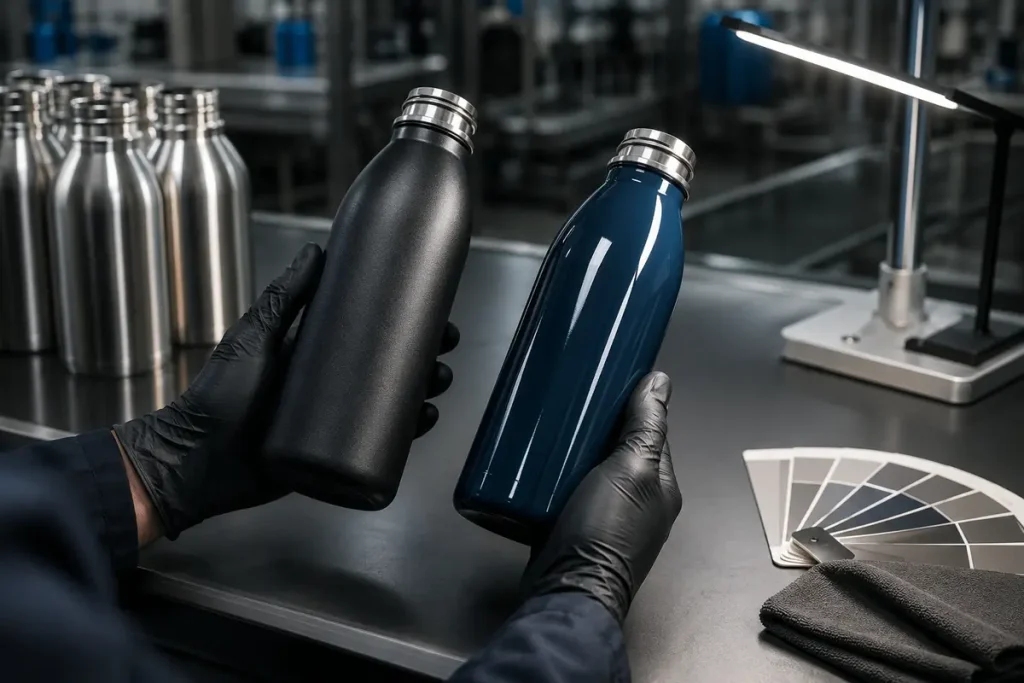
A coating sample should confirm more than color.
Before approving mass production, review:
- Color under suitable lighting
- Gloss level
- Texture and hand feel
- Coverage around the shoulder, neck and base
- Pinholes, dust, unevenness or orange-peel effects
- Scratches and visible rubbing marks
- Logo appearance and adhesion
- Compatibility with the bottle lid and silicone parts
- Odor after curing
- Packaging protection
- Difference between the sample and intended mass-production process
The approved sample should be retained as a visual reference. For strict color programs, a physical approved color sample or limit sample is more useful than relying solely on a screen image.
Sampling should also use a production basis that can later be reproduced in bulk. A carefully hand-finished sample may look excellent but provide little value if the same result cannot be repeated consistently across thousands of bottles.
Coating Quality-Control Checklist
Depending on the project and required standard, coating control may include the following:
Visual Inspection
Check for:
- Uneven color
- Dust or contamination
- Exposed metal
- Pinholes
- Runs or sagging
- Orange-peel texture
- Scratches
- Edge chipping
- Inconsistent gloss
- Color differences between production batches
Adhesion Testing
A cross-cut or tape test may be used to evaluate whether the coating adhesion is adequate for the agreed application.
ASTM D3359 describes tape-test methods for evaluating coating adhesion. However, the test does not by itself prove long-term dishwasher resistance, impact durability, or years of consumer use. The test method, specimen, conditioning, and acceptance criteria should be agreed upon before production.
Abrasion Evaluation
Abrasion testing can help compare how coating systems respond to repeated surface wear. ASTM D4060 covers abrasion resistance testing using a Taber Abraser on suitable rigid specimens.
Not every bottle project requires formal laboratory testing, and a test designed for flat panels may need an appropriate test specimen. The agreed method should match the actual product claim and commercial risk.
Packaging Simulation
A coating can pass an adhesion test and still arrive scratched if the packaging allows the bottle, lid, or accessories to rub during transportation.
Review:
- Protective bags or tissue
- Separation between the bottle and lid
- Box and insert fit
- Accessory placement
- Movement inside the individual box
- Carton dividers
- Vibration, impact and drop risks where required
Packaging should be treated as part of the surface-protection system. Our custom drinkware packaging guide explains how to balance presentation, protection, MOQ, and shipping cost.
Which Finish Should You Choose for Different Products?
| Product or Market | Practical Starting Point | Reason |
| Outdoor sports bottle | Powder coating | Grip, durability and tolerance of frequent handling |
| School water bottle | Powder coating | Practical surface for repeated daily use |
| Amazon or e-commerce tumbler | Powder coating or validated durable liquid coating | Helps reduce scratch-related complaints and returns |
| Premium corporate gift | Powder coating with laser engraving | Clean, durable and professional appearance |
| Fashion-focused tumbler | Spray painting | Greater flexibility for decorative colors and effects |
| Gradient bottle collection | Spray painting | Better control of transitions and multi-tone effects |
| Metallic or pearlescent gift set | Spray painting | Supports more visual-effect options |
| High-volume promotional bottle | It depends on logo, color and price target | The complete specification and quantity should determine the process |
These recommendations are starting points, not fixed rules. The finish should always be confirmed on the actual bottle, with the intended logo and packaging.
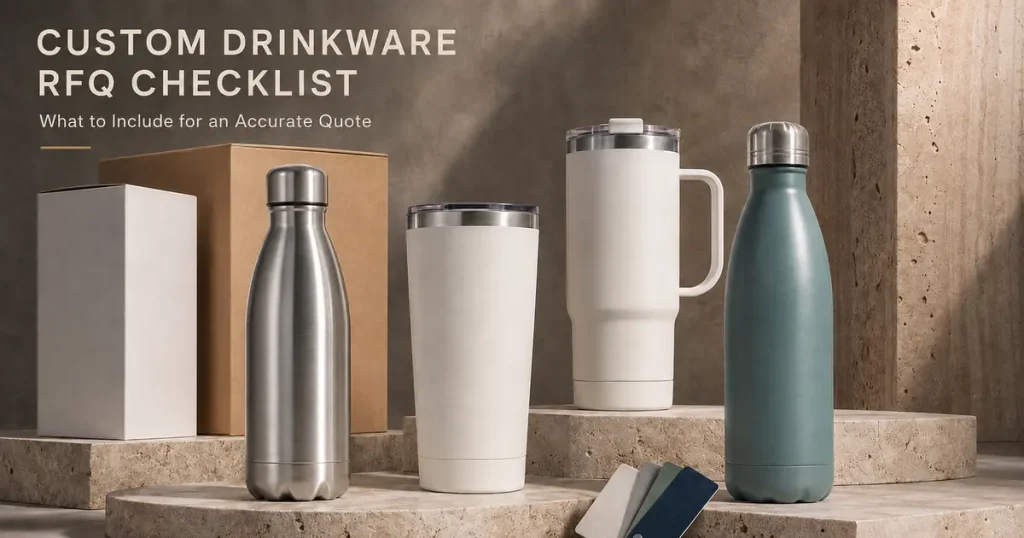
Information to Include in Your RFQ
To receive a more accurate coating quotation, provide the following:
- Bottle model and capacity
- Order quantity
- Quantity per color
- Pantone reference or physical color sample
- Desired gloss and texture
- Powder coating or spray-paint preference, if known
- Required special effect
- Logo artwork, size, color and position
- Intended sales market
- Product-use scenario
- Durability or washing requirements
- Individual packaging
- Required tests or inspection standard
- Target delivery time
If you do not know which finish is suitable, explain the intended appearance and product use. A supplier should be able to compare the available options before sampling.
Frequently Asked Questions
Is powder coating always more durable than spray painting?
Not always. Powder coating commonly provides strong durability for frequently handled drinkware, but final performance depends on surface preparation, coating formulation, curing, and production control. A well-developed liquid coating can outperform a poorly applied powder coating.
Which finish is better for gradient colors?
Spray painting is generally more suitable for gradients, metallic effects, and smooth color transitions.
Can laser engraving be used on both finishes?
Yes, it may be used on both, but the final contrast and appearance depend on the coating and laser settings. A physical sample should be approved.
Does powder coating make a bottle dishwasher safe?
Not automatically. Dishwasher resistance depends on the complete bottle, coating, logo, lid, seals, and defined washing conditions. If dishwasher suitability is required, it should be specified and validated before production.
Which finish has the lower MOQ?
It depends on the selected color, coating material, current production schedule, order quantity, and number of colors. Buyers should confirm MOQ per color and per finish.
Should coating and logo samples be approved separately?
They should be evaluated together whenever possible. A coating may look good before decoration but react differently to laser engraving, printing, curing, or abrasion after the logo is applied.
Final Thoughts
The best surface finish is not necessarily the one that looks most impressive in a photograph.
It is the finish that supports the product’s intended use, brand position, logo design, target cost, and quality expectations—and can be reproduced consistently during mass production.
Powder coating is often a practical choice for durable, frequently handled stainless steel drinkware. Spray painting offers greater freedom for smooth, decorative, and visually distinctive finishes.
For both processes, clear specifications, representative samples, measurable quality requirements, and suitable packaging are essential.
Funzlife supports brands, importers, and promotional product companies with custom stainless steel bottles, tumblers, travel mugs, and food jars. We help review colors, surface finishes, logo methods, lids, packaging, and production requirements before sampling and mass production.
Explore our custom drinkware options or contact us with your bottle reference, quantity, color, logo, and target market.