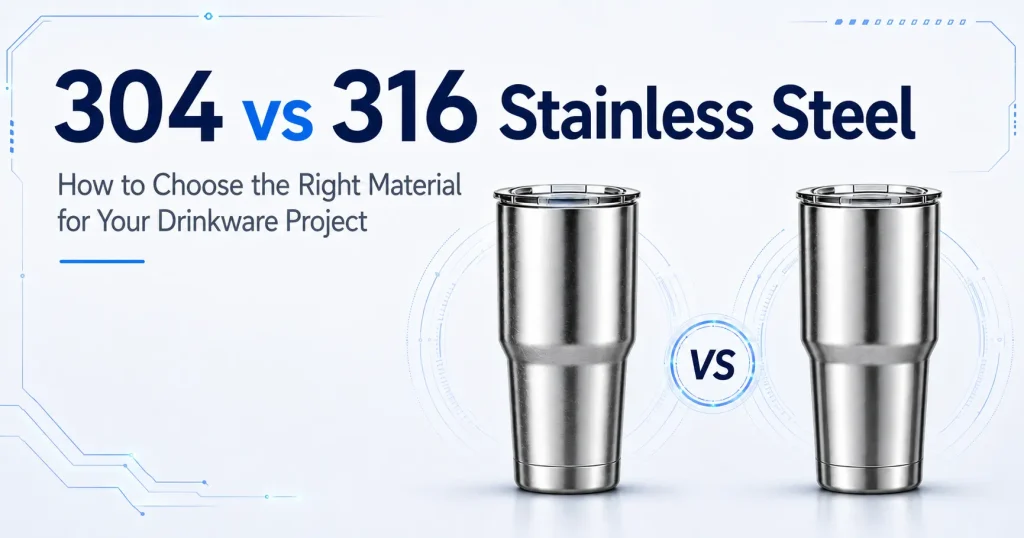
When buyers compare 304 vs 316 stainless steel water bottles, the discussion often ends with a simple conclusion: 316 is better, and 304 is cheaper.
That answer is incomplete.
316 stainless steel does provide greater resistance to certain corrosive conditions, particularly environments involving chlorides. However, 304 stainless steel remains the standard material for a large share of reliable reusable drinkware because it offers a strong balance of corrosion resistance, formability, durability, availability, and cost.
The correct choice depends on more than the grade number. Buyers also need to consider:
- Which component uses the material
- What beverages the product is designed to hold
- How long liquids may remain inside
- The expected cleaning method
- The target retail position
- The sales market and compliance requirements
- The evidence used to verify the material
A bottle with a 316 inner liner can still fail if its welding, surface treatment, lid, gasket, or quality control is poor. At the same time, a well-made 304 bottle may perform reliably for years in normal daily use.
For an OEM project, the useful question is therefore not simply
Is 316 stainless steel better than 304?
It is:
Which grade is appropriate for each component, intended use, and target market—and how will that specification be verified during production?
The Short Answer
Choose 304 stainless steel for the inner liner when the project is intended for general daily hydration, coffee, tea, office use, school use, corporate gifts, promotional programs, or mainstream retail. For most conventional drinkware applications, it provides an effective balance of performance and cost.
Consider a 316 stainless steel inner liner when the project requires greater resistance to chloride-rich, salty, or more demanding conditions; targets a premium material position; or carries a product claim that makes upgraded corrosion resistance commercially valuable.
Do not choose 316 only because the number is higher. It does not automatically make the complete bottle safer, more leakproof, more durable, or better insulated.
Also, do not approve a bottle based only on the phrase “food-grade stainless steel.” The inner liner, outer shell, drinking rim, metal accessories, lid, gasket, straw, coating, and decoration should be reviewed as a complete product system.
304 vs 316 Stainless Steel: Quick Comparison
| Factor | 304 Stainless Steel | 316 Stainless Steel |
|---|---|---|
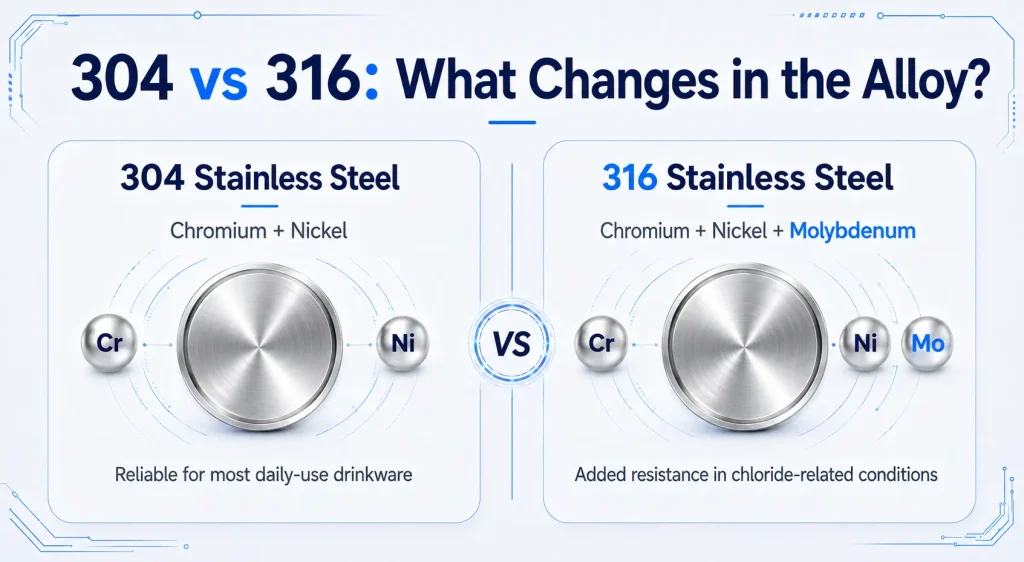
| Common references | AISI 304, SUS304, EN 1.4301; often described as 18/8 | AISI 316, SUS316, and EN 1.4401 contain molybdenum. |
| Main alloy distinction | Chromium-nickel stainless steel | Chromium-nickel stainless steel with added molybdenum |
| Corrosion resistance | Strong for most normal drinkware uses | Higher resistance to pitting and crevice corrosion in chloride-related conditions |
| Typical drinkware role | Mainstream inner liner and, depending on the design, outer shell | Premium or demanding-use inner liner; sometimes used for both walls |
| Formability and weldability | Well suited to bottle forming and vacuum construction | Also suitable, subject to correct process control |
| Material cost | Standard commercial baseline | Higher and more sensitive to nickel and molybdenum prices |
| Best commercial fit | Promotional, corporate gift, school, office, and mainstream retail programs | Premium retail, selected outdoor or coastal applications, and projects requiring upgraded material positioning |
| Does it guarantee compliance? | No | No |
| Does it guarantee insulation? | No | No |
This comparison describes normal tendencies. Final performance still depends on the precise alloy, sheet quality, forming, welding, cleaning, surface condition, product design, and use environment.
What Is 304 Stainless Steel?
304 is an austenitic chromium-nickel stainless steel and one of the most widely used grades in food equipment, kitchenware, and reusable drinkware.
It is commonly described as 18/8 stainless steel, referring approximately to its chromium and nickel content. Exact composition is governed by the applicable material standard, so “18/8” should be treated as a commercial shorthand rather than a complete material certificate.
For stainless steel water bottles, 304 is popular because it combines:
- Strong corrosion resistance under normal use
- Good formability for deep drawing and shaping
- Good weldability for double-wall vacuum structures
- A stable, cleanable surface
- Broad material availability
- A practical cost for volume production
These characteristics make 304 a logical starting point for many insulated bottles, tumblers, travel mugs, and food jars.
However, 304 is corrosion-resistant—not corrosion-proof. Chloride concentration, acidity, temperature, contact time, surface contamination, and cleaning conditions can all affect stainless steel performance.
What Is 316 Stainless Steel?
316 is also an austenitic chromium-nickel stainless steel, but it contains molybdenum. This addition improves resistance to localized corrosion, particularly pitting and crevice corrosion associated with chloride-containing environments.
The British Stainless Steel Association explains that molybdenum in 316 helps reduce the ability of chloride ions to break down the stainless steel’s passive protective layer.
For drinkware, this improved resistance may be useful when the product is expected to face:
- Salty or electrolyte-containing liquids
- Repeated exposure to coastal environments
- More aggressive cleaning conditions
- Longer contact with demanding beverage formulations
- A premium retail specification centered on material performance
316 is frequently positioned as an upgrade, but buyers should avoid describing it as universally necessary. A standard office bottle used mainly for water does not automatically gain a meaningful consumer benefit simply because its inner liner changes from 304 to 316.
The upgrade should support an actual use requirement, risk-control objective, or market position.
Is 316 Stainless Steel Safer Than 304?
Not automatically.
304 and 316 can both be suitable for food-contact drinkware when the correct grade is used, the product is manufactured properly, and the finished configuration meets the relevant requirements for its target market and intended use.
“304” and “316” are alloy designations. They do not prove, by themselves, that:
- The supplied material matches the declared grade
- The bottle surface was processed and cleaned correctly
- Welding residue or free-iron contamination is absent
- The lid and gasket use suitable food-contact materials
- Custom pigments and printed decoration are appropriate
- The finished bottle has passed the required testing
- Mass production matches the approved sample
A 316 inner liner cannot compensate for a leaking lid, an unsuitable silicone seal, an unverified colored plastic component, or poor production hygiene.
This is why food-contact compliance should be evaluated at the finished-product and component level, not inferred from one steel grade. Our guide to FDA and LFGB requirements for custom water bottles explains this distinction in more detail.
Does 316 Keep Drinks Hot or Cold Longer Than 304?
The steel grade should not be the main reason for choosing a bottle’s insulation claim.
In a vacuum-insulated bottle, thermal performance is influenced much more by:
- Vacuum integrity between the two walls
- Bottle shape and wall construction
- Mouth diameter
- Lid structure and sealing
- Heat bridges around the neck and base
- Manufacturing consistency
- The conditions used for the insulation test
304 and 316 have somewhat different physical properties, but the difference between them is not what normally determines whether a finished bottle keeps a drink hot for 6, 12, or 24 hours.
If insulation performance matters, buyers should specify the test conditions and acceptance criteria rather than assuming that a 316 bottle must retain temperature longer.
18/8, 18/10, SUS304 and SUS316: What Do These Labels Mean?
Material descriptions in catalogs are not always used consistently.
Is 18/8 the Same as 304?
“18/8” is commonly used to describe 304-type stainless steel because of its approximate chromium and nickel content. In commercial drinkware, the terms are often used together.
However, an 18/8 marking is not a substitute for a precise grade specification or material-verification record. If the project requires SUS304, write SUS304 or the agreed equivalent standard into the specification.
Does 18/10 Always Mean 316?
No.
The term “18/10” only describes an approximate chromium-nickel ratio. It does not confirm the molybdenum content that distinguishes 316 from 304.
Some 304 compositions may also be marketed as 18/10. Therefore, buyers should not treat “18/10” as proof of 316 stainless steel.
If 316 is required, the specification should state SUS316, AISI 316, or the agreed equivalent grade, supported by appropriate verification.
Are SUS and AISI the Same System?
They are different designation systems. SUS is commonly associated with Japanese Industrial Standards, while AISI designations are widely used in American and international trade language.
The grade numbers are often treated as equivalents in commercial discussions, but the purchase specification should still identify the applicable standard or agreed equivalent. This helps prevent vague descriptions such as “high-grade stainless steel.”
Can a Bottle Use 304 Inside and 201 Outside?
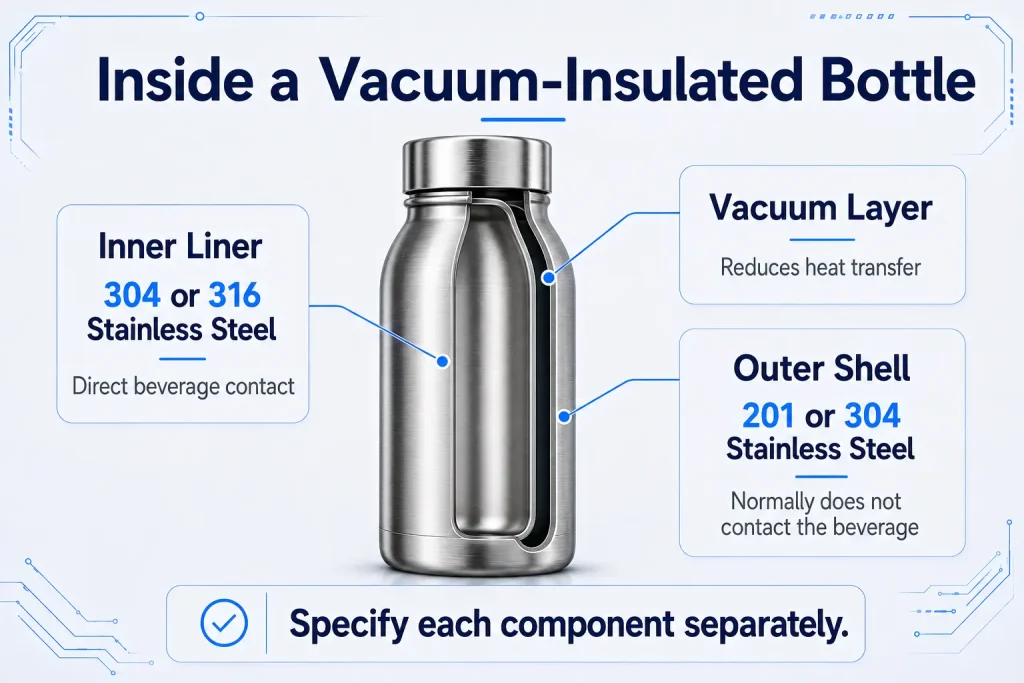
Yes. A mixed construction such as 304 inner liner and 201 outer shell is used in some cost-sensitive vacuum drinkware projects.
The logic is straightforward:
- The inner liner is the primary beverage-contact surface, so higher corrosion resistance is prioritized there.
- The outer shell normally does not contact the beverage and can be protected by powder coating or another finish.
- Using a different outer-shell grade can reduce material cost.
This construction should not be judged by the outer grade alone. Buyers should consider the intended market and use conditions.
An outer shell made from 201 may be a practical option when:
- The product is positioned for a price-sensitive promotional or volume program
- The outside is fully and reliably coated
- Dishwasher suitability is not claimed
- The product is not intended for persistent coastal, salty, or highly humid exposure
- The approved appearance and corrosion expectations are clearly defined
A 304 outer shell may be preferable when:
- The product targets premium retail
- Uncoated stainless steel is visible
- Stronger exterior corrosion resistance is required
- The bottle will be used in coastal or demanding environments
- The brand wants an all-304 construction claim
- Long-term appearance is more important than the lowest unit cost
For the beverage-contact inner liner, 304 or 316 is normally the more appropriate B2B starting point. If another grade is proposed, the buyer should review the exact material standard, intended use, and compliance evidence rather than accepting a generic claim.
Which Grade Should Different Buyers Choose?
Corporate Gifts and Promotional Programs
For corporate gifts, exhibition merchandise, employee programs, and promotional campaigns, a 304 inner liner is usually the practical baseline.
In these projects, perceived quality often depends as much on the bottle design, coating, logo execution, packaging, and leak resistance as on an upgrade from 304 to 316.
Budget may be better allocated to:
- A reliable lid structure
- Durable powder coating
- Clean laser engraving or printing
- Better individual packaging
- Representative pre-production samples
- Clear mass-production inspection standards
Mainstream Retail and E-commerce
304 is suitable for many mainstream retail bottles and tumblers, provided the material and finished product are properly controlled.
For e-commerce, complaint risks may be driven more directly by leaking, odor, coating damage, dented packaging, difficult cleaning, or inconsistent color than by the absence of 316.
The material decision should therefore be part of a broader product-risk review.
Kids’ Drinkware
304 can be an appropriate material for kids’ stainless steel water bottles. Choosing 316 only because the user is a child oversimplifies the safety question.
For kids’ products, buyers should also pay close attention to:
- Lid and straw materials
- Small detachable parts
- Cleaning access
- Silicone valves and gaskets
- Drop resistance
- Leak resistance
- Drinking-rim design
- Applicable market requirements
A complete, well-tested 304 product may be more reliable than a poorly designed bottle promoted only with a “316” claim.
Premium and Specialist Product Lines
316 can add real technical and marketing value to premium collections, especially when the product is intended for more demanding beverage or environmental conditions.
It may be considered for:
- Premium outdoor collections
- Coastal hospitality and resort programs
- Products intended for electrolyte or salty beverage use
- High-end food jars or drinkware with longer holding times
- Brands that want a verified 316 inner-liner specification
The claim should still be accurate and supported. “316 stainless steel inner liner” is more precise than describing the entire product as “316” when the outer wall or accessories use other materials.
How Much More Does 316 Cost?
There is no reliable universal percentage.
Some online comparisons give one fixed price difference between 304 and 316. That can be misleading because the actual impact on a finished bottle depends on:
- Current nickel and molybdenum prices
- Stainless steel supplier and material origin
- Sheet thickness
- Whether only the inner liner or both walls use 316
- Bottle size and weight
- Order quantity
- Production loss
- Forming and welding requirements
- Material-verification requirements
- Product construction and accessories
The raw-material price difference is not the same as the finished-product price difference.
For example, upgrading only a thin inner liner to 316 will affect the unit cost differently from specifying an all-316 bottle body. The lid, coating, logo, packaging, and assembly costs remain part of the same product.
Buyers should therefore request two quotations based on identical specifications:
- 304 inner liner with the agreed outer-shell material
- 316 inner liner with the same design, lid, finish, logo, and packaging
This produces a commercially meaningful comparison.
How Can Buyers Verify 304 or 316 Stainless Steel?
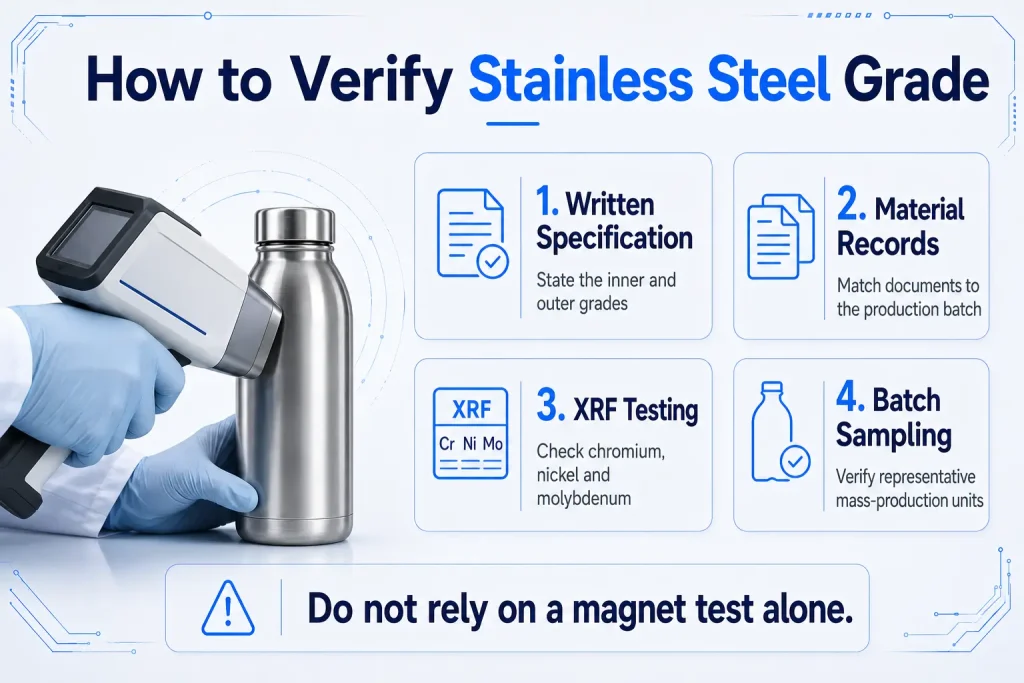
Material verification should be planned before mass production, not raised only after a dispute.
1. Write the Grade Into the Product Specification
The purchase order, specification sheet, or signed PI should state:
- Inner-liner material
- Outer-shell material
- Drinking-rim material where relevant
- Stainless steel used in exposed lid accessories, springs, or inserts
- Applicable grade designation or agreed equivalent
Avoid descriptions such as “stainless steel,” “premium stainless,” or “food-grade steel” without a grade.
2. Review Supplier Material Records
Depending on the project, records may include:
- Raw-material purchase documents
- Mill or supplier certificates
- Coil or batch identification
- Incoming-material inspection records
- Internal traceability records
Documents help establish traceability, but they should correspond to the material actually used for the order.
3. Use Positive Material Identification Where Appropriate
Handheld X-ray fluorescence, or XRF, can identify alloying elements such as chromium, nickel, and molybdenum. It is useful for distinguishing 316 from 304 because molybdenum is a key differentiator, and it can also help identify many 200-series substitutions.
However, XRF has limitations. Standard handheld XRF does not measure carbon reliably, so it should not be used alone to distinguish a normal grade from its low-carbon “L” version.
The test location, calibration, surface condition, and sampling plan should also be controlled.
4. Do Not Rely on a Magnet Test
304 and 316 are generally considered non-magnetic in their annealed condition, but forming, welding, and cold working can introduce some magnetic response.
A finished bottle may therefore show slight magnetism even when genuine 304 is used. Conversely, weak magnetism does not prove that a material is 304.
A magnet can be a rough screening tool in limited situations, but it is not a reliable grade-verification method for an OEM order.
5. Define the Sampling Stage
Verification may be performed on:
- Incoming stainless steel sheet or coil
- Formed inner liners
- Outer shells before coating
- Finished bottles from mass production
Testing only one pre-production sample does not prove that the same material was used for the complete order. For higher-risk projects, buyers should define representative batch sampling during production or pre-shipment inspection.
Material Grade Is Only One Part of Corrosion Performance
Even correctly identified 304 or 316 can show staining or corrosion if the manufacturing and use conditions are poor.
Important influences include:
- Surface roughness and polishing quality
- Residual iron or tooling contamination
- Welding quality
- Cleaning and rinsing after production
- Passivation condition
- Crevices that trap liquid or detergent
- Chloride concentration
- Beverage acidity
- Temperature
- Contact time
- Cleaning chemicals
- Failure to wash and dry the bottle after use
This is why a buyer should not compare two quotations by grade alone. Material, product design, manufacturing process, and quality control work together.
Our guide to stainless steel bottle quality control explains how approved samples, leak testing, insulation testing, coating inspection, and mass-production controls should be connected.
What Should Be Confirmed During Sampling?
A material sample should do more than look attractive.
Before approving production, confirm:
- Declared inner and outer stainless steel grades
- Product weight and wall construction
- Interior polishing and cleanliness
- Weld and drinking-rim condition
- Odor after washing
- Lid fit and gasket compression
- Leakage in the intended carrying position
- Insulation performance under agreed conditions
- Resistance to the intended beverage or cleaning method, where relevant
- Coating, logo, and packaging compatibility
If the project makes a special claim—such as dishwasher safe, suitable for electrolyte drinks, or 316 stainless steel interior—the sample and testing plan should reflect that claim.
The approved sample should also be representative of the intended production method. A hand-finished prototype is not enough if the same result cannot be reproduced consistently in mass production.
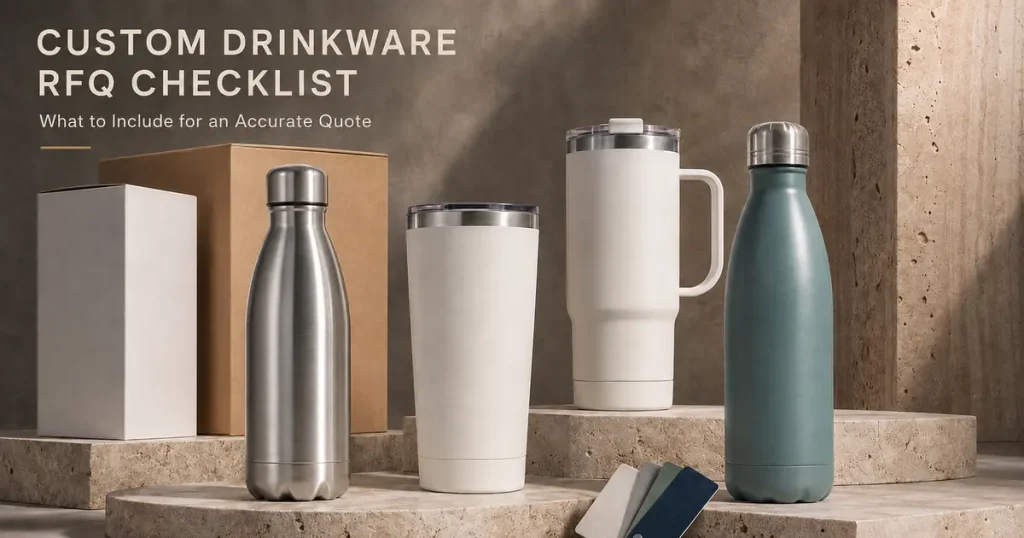
What OEM Buyers Should Include in the RFQ
To receive an accurate material recommendation and quotation, provide:
- Product type and capacity
- Single-wall or vacuum-insulated construction
- Required inner-liner grade
- Required outer-shell grade, if known
- Intended beverages
- Expected liquid-contact time
- Hot- and cold-use requirements
- Cleaning method and any dishwasher claim
- Target market
- Retail, promotional, or corporate-gift positioning
- Order quantity and quantity per color
- Logo method and placement
- Surface finish
- Packaging requirements
- Required material documents or testing
- Inspection and acceptance requirements
- Target delivery time
If the material grade is not yet decided, describe the use scenario and price position. A supplier should be able to compare 304 and 316 based on the complete project rather than automatically recommending the most expensive option.
For a complete product brief, see our guide to requesting an accurate custom stainless steel drinkware quote.
Frequently Asked Questions
Is 316 stainless steel always better than 304 for water bottles?
316 provides greater resistance in certain chloride-rich and demanding conditions, but it is not automatically the better commercial choice for every bottle. For ordinary daily water, office, school, promotional, and mainstream retail applications, 304 often provides an effective balance of performance and cost.
Is 304 stainless steel food grade?
304 is widely used in food-contact applications, but the grade number alone does not establish finished-product compliance. Material authenticity, manufacturing quality, surface condition, other components, intended use, and target-market requirements must also be considered.
Does 18/10 mean the bottle is made from 316 stainless steel?
No. 18/10 is an approximate chromium-nickel description and does not confirm the molybdenum content associated with 316. Specify and verify the actual grade when 316 is required.
Can genuine 304 stainless steel be magnetic?
Yes. Although annealed 304 is generally non-magnetic, cold forming and welding can create a slight magnetic response. A magnet test alone cannot reliably confirm or reject 304.
Is a 304 inner liner with a 201 outer shell acceptable?
It can be a practical construction for cost-sensitive projects because the outer shell normally does not contact the beverage. Suitability depends on the coating, environment, cleaning method, corrosion expectations, and market position. The material of each component should be stated clearly.
Will 316 stainless steel never rust?
No stainless steel grade is completely corrosion-proof in every environment. 316 has stronger resistance than 304 in many chloride-related conditions, but salt deposits, harsh chemicals, high temperatures, crevices, contamination, and poor cleaning can still cause staining or localized corrosion.
Does upgrading to 316 improve leak resistance?
Not by itself. Leakage is mainly affected by lid design, thread fit, gasket material, gasket compression, assembly, and dimensional consistency.
Should the complete bottle be advertised as 316 if only the inner liner uses 316?
It is more accurate to state “316 stainless steel inner liner” and identify the other materials separately. This reduces misleading claims and helps buyers compare quotations correctly.
Final Thoughts
The best stainless steel grade is not automatically the one with the highest number or the highest price.
304 remains the practical standard for many reliable stainless steel bottles, tumblers, travel mugs, and food jars. It offers a strong balance of corrosion resistance, manufacturing performance, availability, and cost.
316 is a valuable upgrade when the product faces more demanding conditions or when verified material performance supports a premium market position.
For both options, professional sourcing requires more than a grade name. Buyers should define the material for each component, intended beverages, cleaning conditions, target market, verification method, and finished-product requirements before approving production.
Funzlife supports brands, importers, retailers, and promotional product companies with custom stainless steel bottles, tumblers, travel mugs, and food jars. We help review product structures, stainless steel options, lids, colors, logos, packaging, and quality requirements before sampling and mass production.
Explore our custom drinkware options or contact us with your product reference, quantity, target market, and intended use.