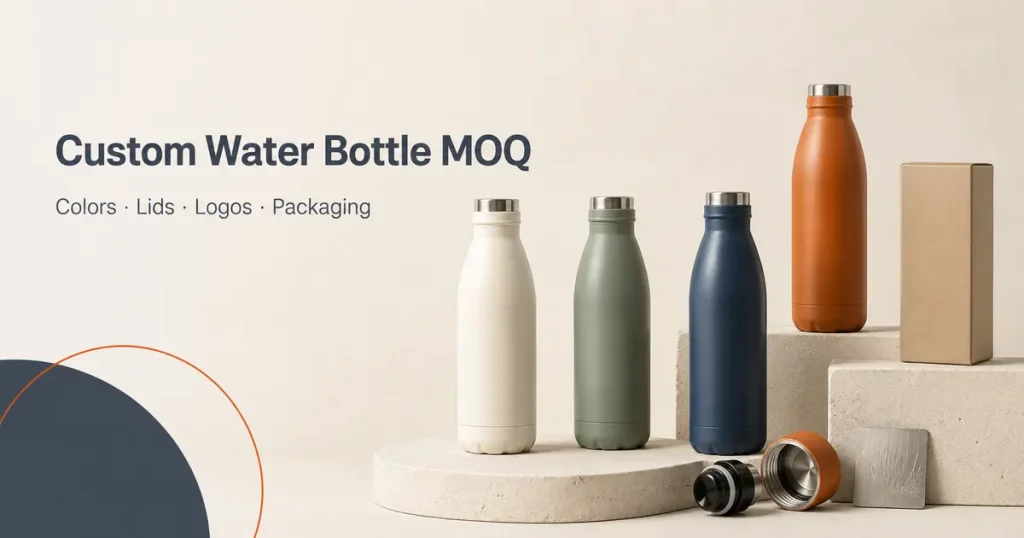
When a buyer asks, “What is your minimum order quantity?” the expected answer is usually one number.
In custom drinkware manufacturing, however, the honest answer is often more complicated.
A stainless steel bottle may have one minimum quantity for the bottle body, another for each coating color, another for the plastic lid components, and yet another for the printed packaging. A logo may be possible on a few hundred pieces, while a custom-colored lid or retail box may require a much larger production batch.
This is why two suppliers can quote different MOQs for what appears to be the same bottle—and why a project described as “1,000 custom bottles” may not be a true 1,000-piece project once all the details are confirmed.
Understanding the logic behind a custom water bottle MOQ helps brands plan more realistic launches, compare quotations more accurately, and avoid expensive changes after sampling has already started.
A Custom Bottle Does Not Have Just One MOQ
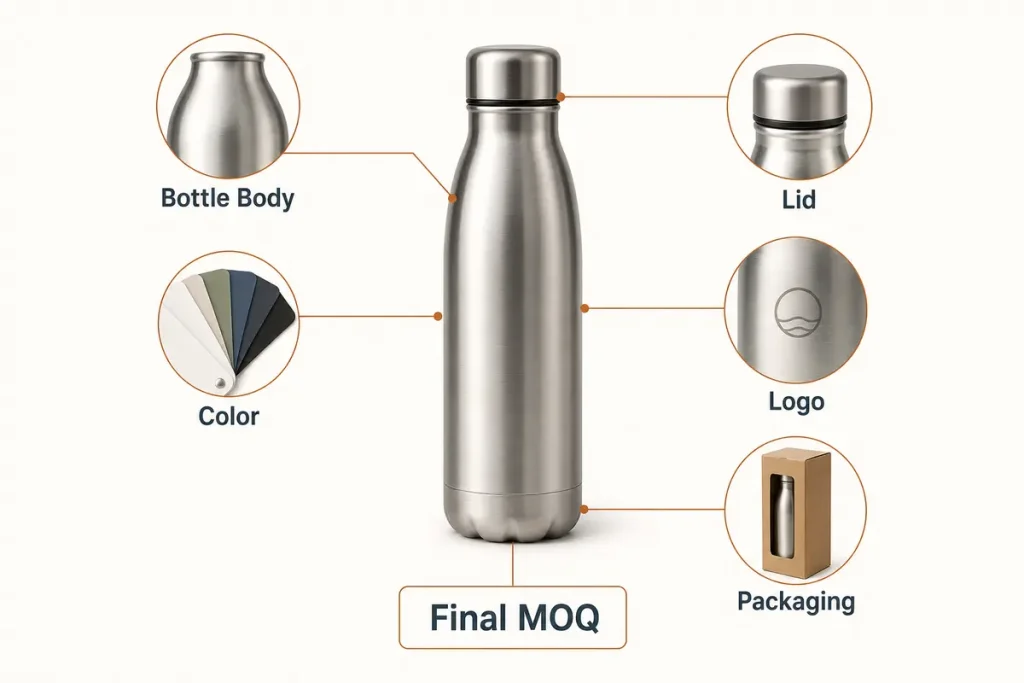
The finished bottle is one product, but it is assembled from several production processes and supply chains.
Depending on the design, these may include the following:
- Stainless steel bottle bodies
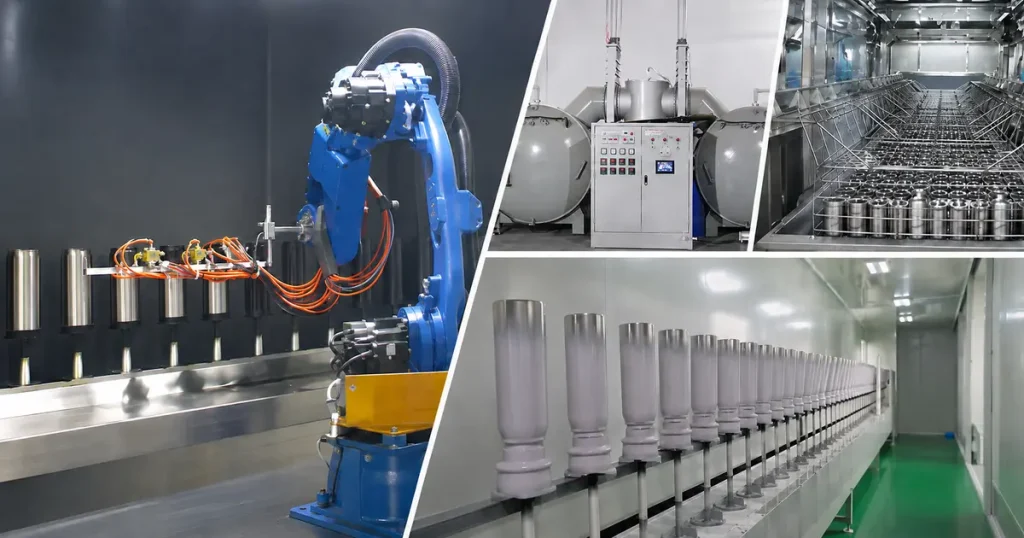
- Powder coating or spray painting
- Injection-molded lid parts
- Silicone seals, straws and handles
- Logo decoration
- Printed labels, sleeves or color boxes
- Inner trays, gift packaging and shipping cartons
Each process has its own setup cost, material purchasing requirement, production efficiency, and supplier minimum. The practical MOQ for the finished product is usually determined by the component with the highest minimum quantity.
In other words:
Final project MOQ = the highest workable MOQ among all required components and processes.
This is the first point buyers should clarify when comparing low-MOQ offers. Does the quoted MOQ apply only to adding a logo to an existing bottle, or does it also include a custom Pantone color, a special lid, and fully printed packaging?
Those are very different projects.
1. Existing Bottle Model or New Tooling?
The biggest distinction is whether the project uses an existing bottle structure or requires a completely new design.
Existing model customization
An existing stainless steel bottle or tumbler model already has established tooling, dimensions, production parameters, and compatible components. The buyer can normally customize selected elements such as the following:
- Body color
- Surface finish
- Logo
- Lid option
- Accessories
- Packaging
Brands can review our custom drinkware options to compare practical ways to customize product structure, colors, finishes, lids, logos, and retail packaging.
Because the bottle structure does not need to be redeveloped, this is usually the most practical route for a first order, a seasonal promotion, or a new retail collection being tested in the market.
Fully customized OEM development
A new bottle shape, neck size, handle structure, or lid mechanism may require industrial design, engineering review, prototypes, new molds, and several rounds of testing.
The cost is not limited to the mold itself. These development steps are added to the standard stainless steel water bottle manufacturing process, and a new design may also require:
- Drawability and wall-thickness evaluation
- Lid-and-neck tolerance development
- Mold trials and revisions
- Leak, drop and opening-cycle tests
- Assembly fixtures
- New packaging dimensions
- Pilot production before mass production
For this type of OEM project, the commercial question is not only “How many bottles?” It is also whether the expected sales volume can justify the development cost and stabilize the new process.
2. Why Custom Colors Usually Have an MOQ Per Color
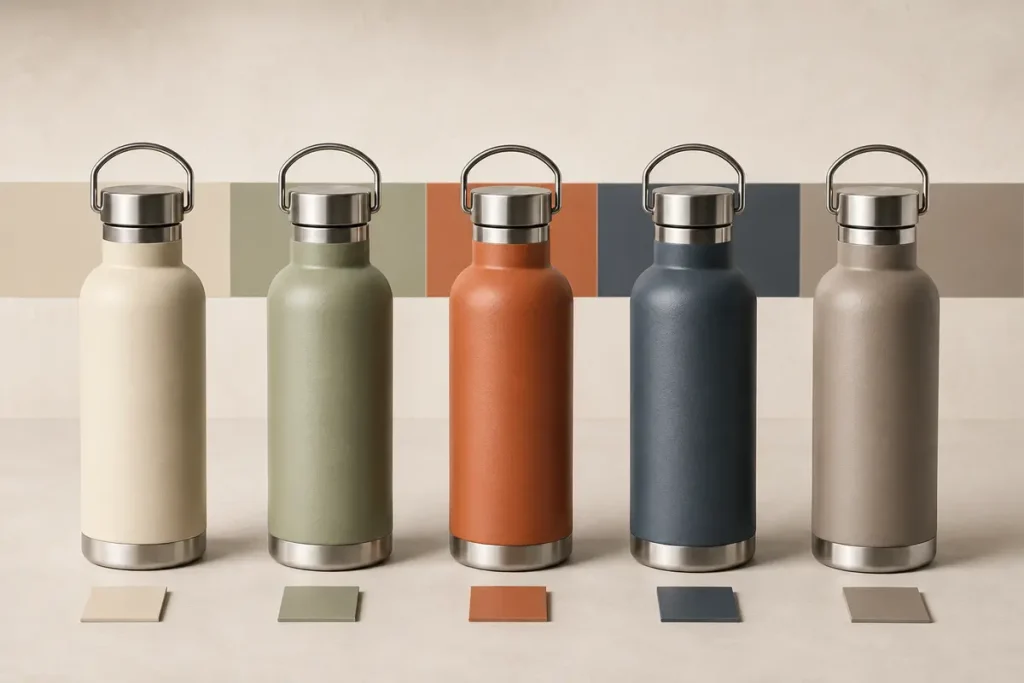
Buyers often focus on the total order quantity, while the production team focuses on the quantity for each color.
For example, an order of 1,200 bottles divided into six colors is not always treated as one 1,200-piece coating run. From the coating line’s perspective, it may be six separate 200-piece runs.
Each custom color can involve:
- Confirming a Pantone reference or physical color sample
- Preparing or purchasing the coating material
- Producing a color sample for approval
- Cleaning and adjusting the spraying line
- Testing film thickness, adhesion and appearance
- Allowing for setup pieces and production loss
- Conducting first-article inspection before the run continues
The line must repeat much of this work every time the color changes. This is why MOQ per color matters even when the total order quantity is acceptable.
Standard colors or colors already scheduled for production can sometimes support greater flexibility. A precise custom Pantone shade, metallic effect, gradient coating, or special texture generally requires more preparation and tighter process control.
Buyers should therefore confirm both figures:
- Total order MOQ
- MOQ for each body color
Without this distinction, a quotation may look workable until the color breakdown is submitted.
3. Why the Lid Can Determine the Entire Project MOQ
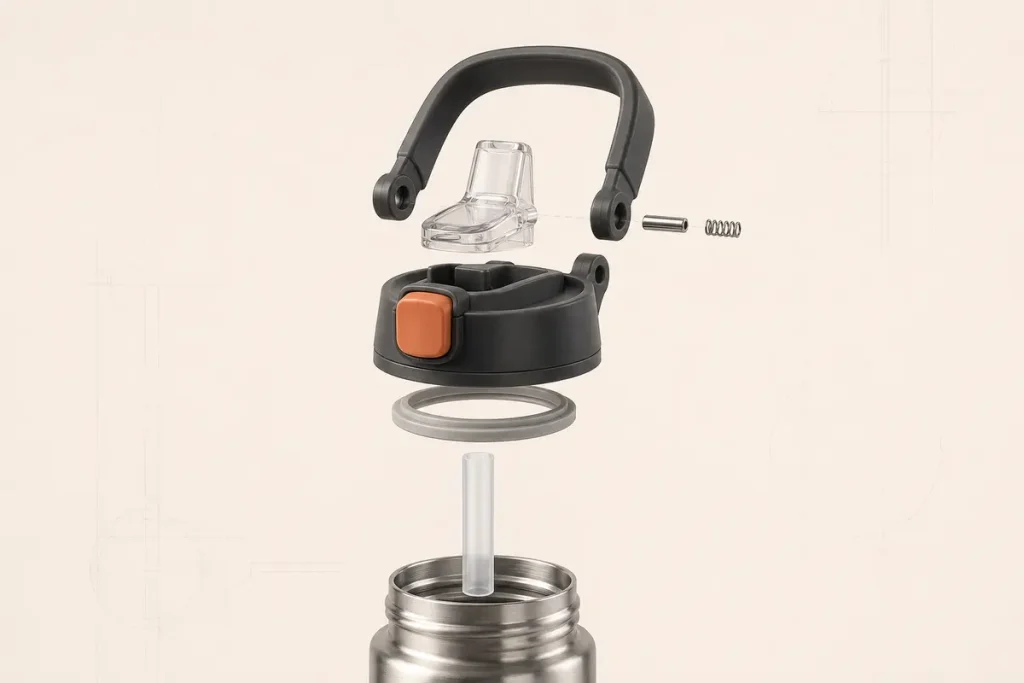
The lid is often the most underestimated part of a custom bottle.
A bottle body is mainly a stainless steel component, but a functional lid may contain several different parts:
- PP or Tritan lid body
- Button, slider or locking component
- Handle or carry loop
- Silicone gasket
- Straw or spout
- Decorative insert
- Metal pin or spring
These parts may come from different molds and sometimes different specialist suppliers. Changing the lid color is therefore not the same as changing the bottle coating.
For injection-molded plastic parts, a custom color may require a color masterbatch, machine setup, material drying, purging of the previous resin, and a stable production run. A small quantity can create disproportionate material waste and color inconsistency.
The problem becomes more complex when one lid contains multiple colors. A buyer may request a beige lid body, an orange button, a matching silicone gasket, and a branded handle. Technically, that “one lid” may involve four separate color and component requirements.
There are three very different levels of lid customization:
Level 1: Use an existing lid in an available color
This normally offers the lowest risk and the most flexible MOQ.
For example, a 3-in-1 stainless steel water bottle with interchangeable lids can offer different drinking experiences without developing an entirely new bottle neck or lid system.
Level 2: Use an existing lid in a custom color
No structural mold is needed, but the plastic or silicone components may still have their own color MOQ.
Level 3: Develop a new lid structure
This may require product engineering, new molds, tolerance adjustment, and functional testing. Leak resistance, drinking flow, opening force, gasket compression, and durability all need to be validated before mass production.
For many OEM projects, the bottle body is not the limiting factor. The custom lid is there.
4. Logo MOQ Depends on the Decoration Method
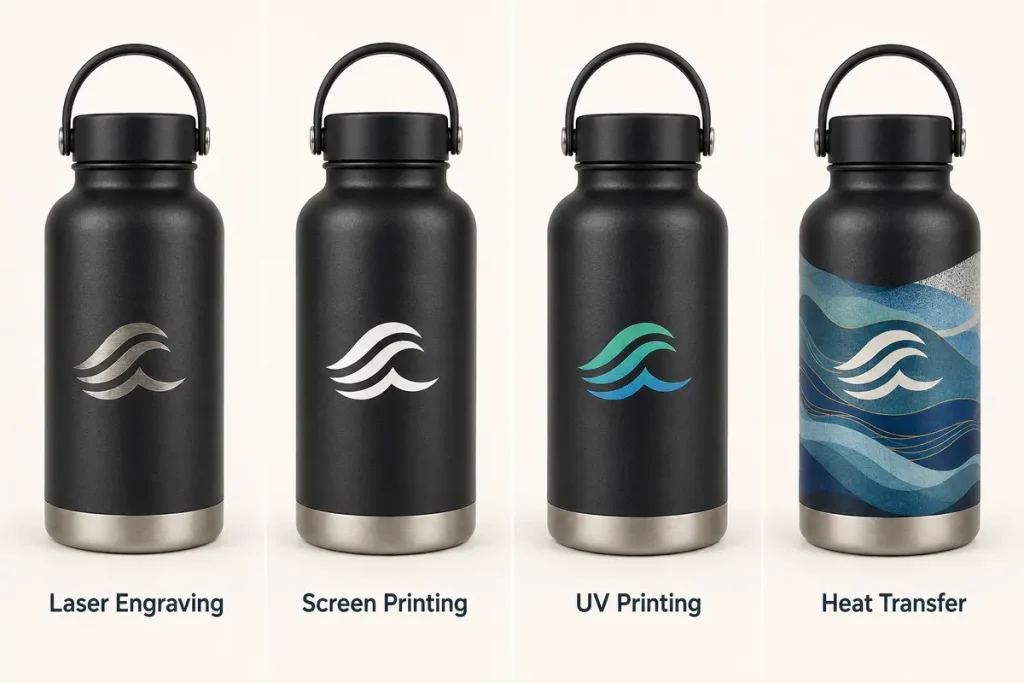
“Add our logo” sounds like one simple requirement, but the artwork and decoration process can change both MOQ and cost.
Laser engraving
Laser engraving requires no ink or printing plate. It is suitable for simple artwork, names, and single-color permanent branding. Because setup is relatively straightforward, it is often one of the more flexible options for smaller orders.
However, the final appearance depends on the coating, stainless steel surface, and laser settings. A pre-production sample is still important.
Screen printing
Screen printing is widely used for clean, solid-color logos. Each artwork and ink color requires setup, and multi-color designs need accurate registration. Small orders carry a higher setup cost per unit, especially when several logos or positions are required.
UV printing
UV printing can reproduce gradients and detailed full-color artwork without traditional screens. It offers design flexibility, but the curved bottle surface, white-ink base, adhesion, and abrasion performance still need to be evaluated.
Heat-transfer printing
Heat transfer is suitable for large graphics and wraparound designs. The transfer film itself normally has a production minimum, so the film supplier’s requirement may influence the project MOQ even if the bottle quantity is lower.
The buyer should provide the actual vector artwork, print size, number of colors, and print position before relying on a logo quotation. “One logo” can mean a small laser mark, a two-color screen print, or a full-wrap photographic design—and they do not have the same production logic.
5. Why Custom Packaging Has Its Own Minimum
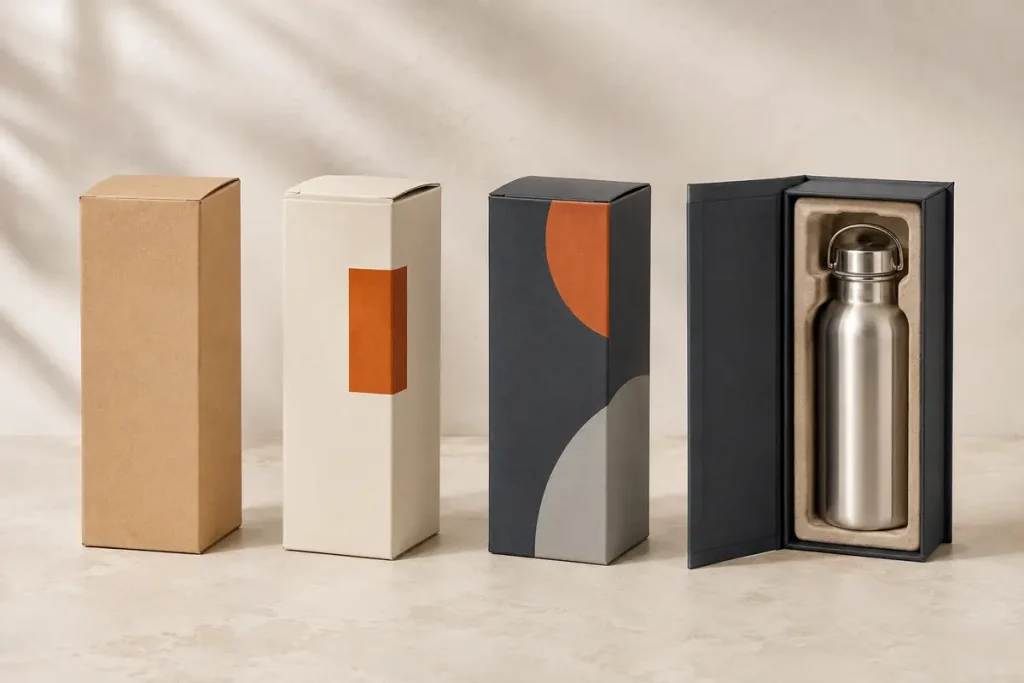
Packaging is another common reason a low-MOQ bottle project becomes more complicated.
A plain white or kraft box with a printed label is relatively flexible because the box structure can be standardized and the brand information is added separately.
A fully printed color box usually involves the following:
- Packaging artwork preparation
- Printing setup or printing plates
- Paper or board purchasing
- Die cutting
- Surface finishes such as lamination, foil or spot UV
- Custom inserts
- Assembly and packing
The packaging supplier plans production by sheet size, printing layout, and machine efficiency—not by the number of bottles in the order. As a result, the minimum for a printed box may be higher than the minimum for the bottle itself.
Premium gift boxes can add another layer of requirements. Rigid boxes, molded pulp trays, EVA inserts, magnetic closures, and special paper finishes all have separate setup and material considerations.
For a market test, a standard box with a branded sticker or printed sleeve may create a more practical balance between presentation and inventory risk.
A Simple Example: Which MOQ Controls the Order?
Consider a brand planning a new bottle launch with the following requirements:
| Project element | Requested specification | Production consideration |
|---|---|---|
| Bottle body | Existing 650 ml model | Existing tooling makes the structure relatively flexible |
| Body colors | Four custom colors | Quantity must be reviewed per color, not only in total |
| Lid | Existing structure in a new custom color | Plastic and silicone component MOQs may apply |
| Logo | One-color screen print | Screen setup and print loss must be considered |
| Packaging | Fully printed retail color box | The packaging printer has a separate economical batch size |
Even if the bottle body can be produced at the requested total quantity, the custom lid color or printed box may require a larger batch. The order cannot be completed as specified unless every necessary component is available in the same quantity.
Possible solutions may include:
- Using one standard lid color across all four bottle colors
- Keeping the custom body colors but using neutral packaging with a branded label
- Producing extra lids or boxes for a planned repeat order, subject to storage and purchasing arrangements
- Reducing the number of colorways in the first launch
- Starting with an existing color combination and moving to full customization after market validation
The best solution depends on which feature creates the most value for the brand. Not every element needs to be customized in the first order.
Why Two Suppliers May Quote Different MOQs
A lower MOQ does not automatically mean that one supplier has a more advanced production line. The offers may be based on completely different assumptions.
One supplier may be quoting the following:
- Existing inventory
- Stock body colors
- An available lid color
- Logo-only customization
- Neutral packaging
Another may be quoting:
- A new production run
- Pantone-matched coating
- Custom injection colors
- Retail-ready printed packaging
- Additional compliance or testing requirements
Both quotations could be correct, but they are not directly comparable.
Buyers should request a written customization breakdown showing what is standard, what is made to order, and which elements have separate minimum quantities. This is more useful than comparing one headline MOQ.
How to Reduce Custom Water Bottle MOQ Without Creating Quality Problems
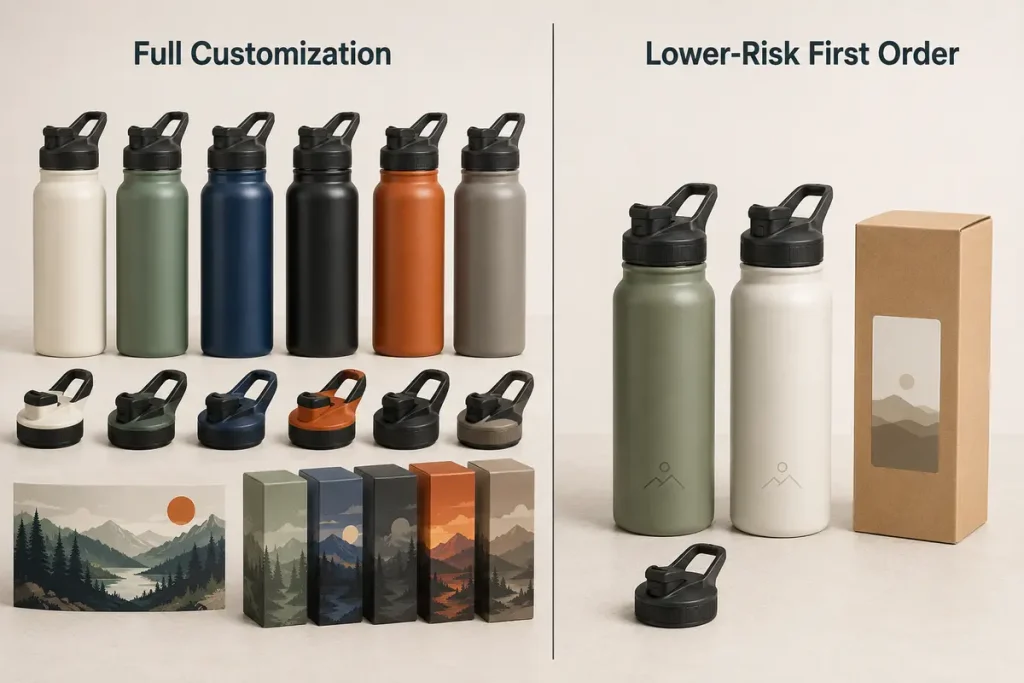
Reducing MOQ should come from simplifying the production plan—not from skipping necessary quality controls.
Here are several practical approaches.
1. Start with an existing bottle structure
Use differentiation through color, branding, and packaging before investing in a new body or lid mold.
2. Limit the number of first-order colors
Two well-selected colors with healthy quantities are often more efficient than six colors with very small allocations. Additional colors can be introduced in repeat orders.
3. Use one lid color across the collection
A shared black, white, or neutral lid can connect several bottle colors while avoiding multiple custom injection runs.
4. Choose the logo method according to the order size
Laser engraving or a simple one-color print may be more suitable for an initial order than a complex wraparound design.
5. Simplify the first packaging version
A standard box, branded sticker, belly band, or sleeve can still create a professional presentation without immediately committing to a large quantity of fully printed boxes.
6. Plan repeat orders before producing excess components
In some projects, buyers choose to manufacture extra lids or packaging and use the balance in the next order. This only works when storage responsibility, payment, component compatibility, and the repeat-order timeline are agreed upon in advance.
7. Ask where the MOQ comes from
Instead of only asking a supplier to “reduce the MOQ,” ask which component or process is setting the limit. Once the real constraint is identified, the product brief can often be adjusted intelligently.
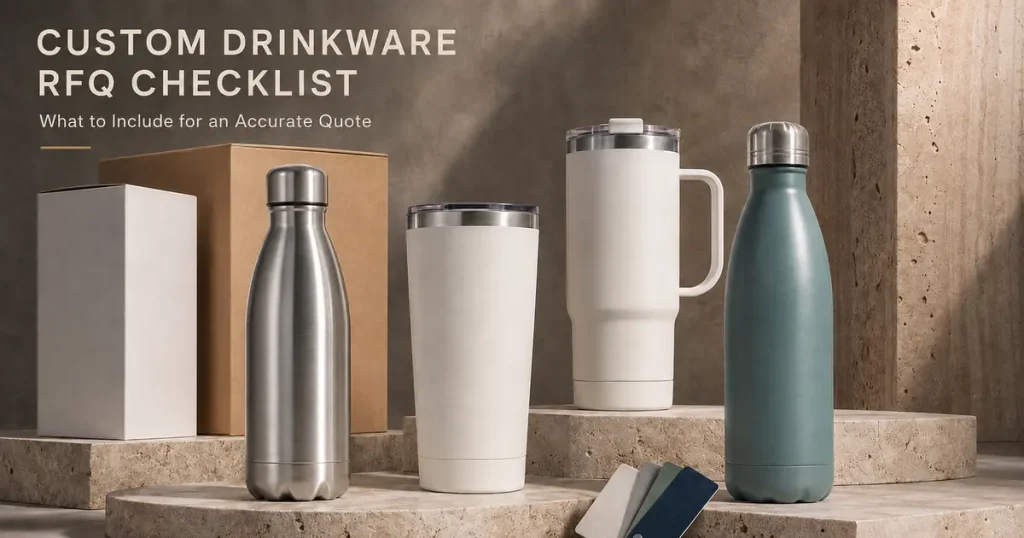
Information to Provide for an Accurate MOQ and Quotation
For a more complete RFQ framework, use our custom stainless steel drinkware quote checklist before contacting a supplier.
Before requesting a price, buyers should prepare the following information:
- Preferred bottle model and capacity
- Total order quantity
- Quantity required for each color
- Standard color or custom Pantone reference
- Lid structure and lid color
- Logo artwork, size, colors and position
- Preferred decoration method, if known
- Individual packaging requirement
- Target market and compliance requirements
- Target launch date
The more complete the brief, the more reliable the quoted MOQ, unit price, and lead time will be.
Final Thoughts
The custom water bottle MOQ is not simply a number attached to a finished bottle. It is the result of several connected manufacturing decisions.
The bottle model determines whether tooling already exists. The number of colors affects coating efficiency. The lid introduces injection-molded and silicone components. The logo method adds its own setup requirements. The packaging supplier works to a separate economical batch size.
Understanding these layers allows brands to make better trade-offs. Instead of removing the features that matter, buyers can concentrate customization where it creates the strongest customer value and keep the remaining elements production-friendly.
At Funzlife, we help promotional and retail brands review bottle models, color plans, lid options, decoration methods, and packaging before sampling begins. A clear project brief makes it easier to identify the real MOQ, control development risk, and build a product that can move smoothly from concept to repeat production.
Planning a custom stainless steel bottle or tumbler project? Contact our team with your target quantity, color breakdown, lid requirement, logo artwork, and packaging idea for a practical MOQ review.